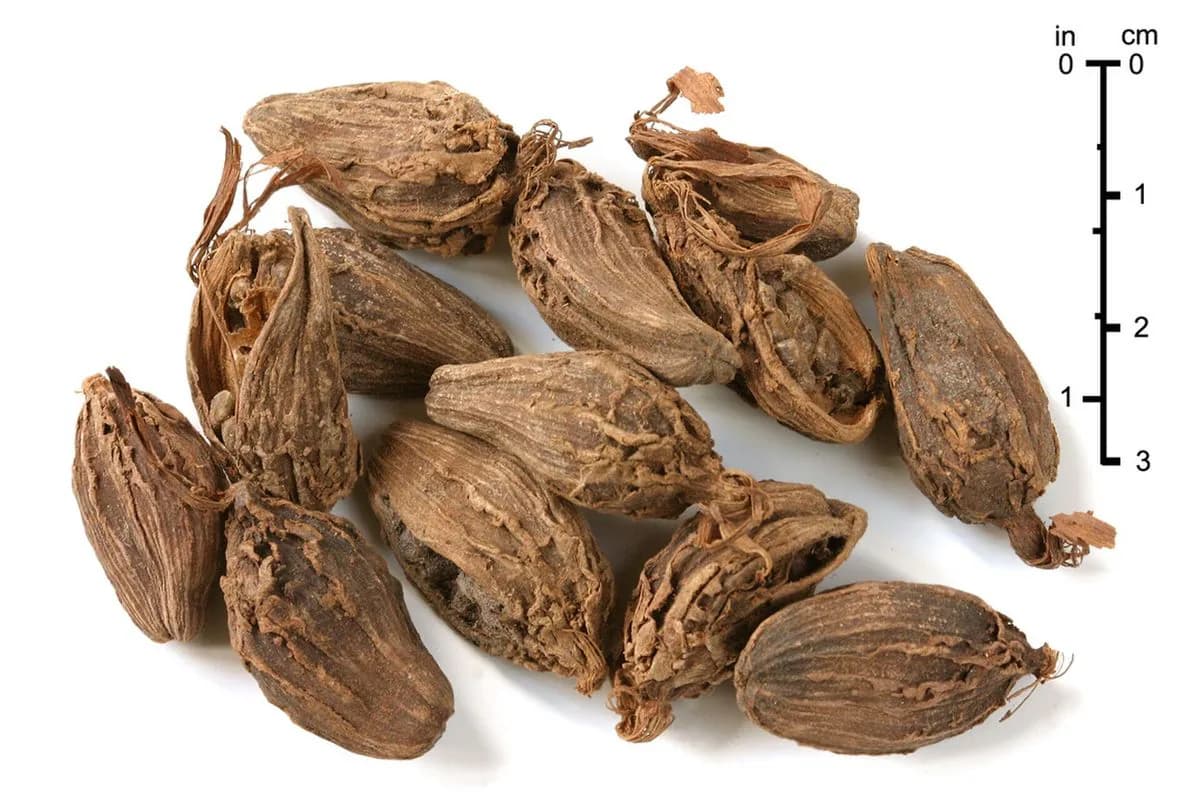
“What's your price per kg?” is the first question in almost every enquiry we get, and it's the hardest one to answer in a single number. A price is meaningless without a grade, a moisture spec, an Incoterm, and a quantity attached to it. This guide gives you all four, so you can compare quotes on equal terms instead of guessing. For the spice itself, rather than its price, start with our complete guide to black cardamom.
What actually drives the price
Black cardamom (Amomum subulatum, also sold as large cardamom, kali elaichi, or badi elaichi) is not a commodity with a single ticker price. Five variables move the number on your proforma invoice, roughly in order of impact:
1. Pod size and grade
This is the single biggest lever. Larger pods command a premium because Gulf and South Asian buyers use them whole and visible in biryani, pulao, and tagine, appearance is the product. We grade into three bands, and you can see the full specification on our products and grades page:
- Bold (22–28mm): the Gulf standard. Commands roughly a 20–30% premium over Fine.
- Medium (18–22mm): the common export grade, and the best value for cooking-forward use.
- Fine (under 18mm): the cheapest, bought largely by spice mills that grind the pods anyway, where size is irrelevant.
2. Moisture content: where buyers lose money
This is the most under-scrutinised line in the entire trade. Black cardamom is sold by weight, and water weighs something. Pods dried to 13% moisture instead of a proper 9% carry roughly 4% of dead water that you are paying spice prices for, and that water will grow mould in a sea container. A quote of USD 14/kg at 13% moisture is not cheaper than USD 14.50/kg at 9% moisture; it is meaningfully more expensive, and it carries a rejection risk on top.
3. Drying method
Most black cardamom in the region is dried in traditional bhattis, direct wood-fire kilns where smoke contacts the pods. It's cheap, and it's why the spice has a reputation for smokiness. It also deposits polycyclic aromatic hydrocarbons (PAHs), which are regulated carcinogens in the EU and UK. Closed-flue electric drying costs more per kilo and is the reason our pods clear European PAH limits. If a quote is unusually cheap, the drying method is often why.
4. Origin and traceability
A large share of Nepal's crop has historically moved across the border and been re-exported through Siliguri, picking up a trading margin and losing its origin identity along the way. Single-origin lots with a named district cost more and are worth more, particularly if you are making provenance claims on your own packaging. Ours all come from one cluster in Sankhuwasabha, which you can read about on our origin page.
5. Crop cycle and volume
Cardamom is a perennial that yields only 300–500kg of dried pods per hectare, and a bad monsoon or an outbreak of chirke and furkey viral disease can move regional prices by 20% in a season. Order volume matters too: the price break between a 25kg trial sack and a 2,000kg air-freight consignment is substantial, mostly because freight and documentation costs amortise.
Black cardamom price per kg, 2026
The table below is our working reference for the 2026 season. Farmgate is what the grower receives in Sankhuwasabha; FOB Kathmandu is the pods graded, tested, sacked, and cleared for departure at Tribhuvan International; CIF Dubai includes air freight and insurance to Dubai.
| Grade | Pod size | Farmgate (NPR/kg) | FOB Kathmandu (USD/kg) | CIF Dubai (USD/kg) |
|---|---|---|---|---|
| Bold | 22–28mm | 1,150–1,250 | 17.00–19.00 | 20.50–23.00 |
| Medium | 18–22mm | 1,000–1,120 | 15.00–17.00 | 18.50–21.00 |
| Fine | Under 18mm | 900–1,000 | 13.00–15.00 | 16.50–19.00 |
If you want to sanity-check these against the wider market, two public sources are worth bookmarking: ITC Trade Map, which shows declared trade values by HS code and partner country, and FAOSTAT for production volumes by country. Both will tell you whether a quote sits inside the real distribution or well outside it.
Reading a quote: FOB vs CIF vs DDP
A surprising number of first-time spice buyers compare an FOB price against a CIF price and conclude one supplier is 20% cheaper. They aren't. They're just quoting a different amount of the journey. The three terms you will actually encounter, defined under the ICC Incoterms rules:
| Term | You pay for | Risk passes to you |
|---|---|---|
| FOB Kathmandu | Freight, insurance, import duty, customs clearance, and delivery at your end. | Once goods are loaded for departure in Nepal. |
| CIF Dubai | Import duty, clearance, and final-mile delivery only. | On arrival at the named port or airport. |
| DDP Dubai | Nothing further. The price is the price. | On delivery to your door. |
For a first order, CIF is usually the sweet spot: you avoid arranging freight from a landlocked country you don't operate in, but you keep control of customs clearance, where a local broker will almost always beat a foreign exporter's rate. We quote on all three. The options are laid out on our export markets page.
Worked example: 500kg of Bold landed in Dubai
Here is the arithmetic most exporters won't show you. Assume 500kg of Bold grade, twenty 25kg jute sacks, air freight Kathmandu (KTM) to Dubai (DXB), CIF terms.
| Cost line | USD | Per kg |
|---|---|---|
| Product, 500kg Bold @ USD 18.00 FOB | 9,000.00 | 18.00 |
| Air freight KTM → DXB (~USD 2.60/kg) | 1,300.00 | 2.60 |
| Export documentation, phytosanitary, COO | 180.00 | 0.36 |
| Marine/air insurance (~0.35%) | 36.00 | 0.07 |
| CIF Dubai subtotal | 10,516.00 | 21.03 |
| Import duty @ 5% of CIF | 525.80 | 1.05 |
| Customs clearance + handling | 220.00 | 0.44 |
| Inland delivery, Dubai | 90.00 | 0.18 |
| Landed cost, before VAT | 11,351.80 | 22.70 |
So a USD 18.00/kg FOB price is really a USD 22.70/kg business, about 26% higher than the number in the email. UAE VAT at 5% is recoverable if you're registered, so it sits outside the cost base, but you still need the cash for it at clearance. The full documentation and clearance sequence is covered step by step in our companion guide, how to import black cardamom into the UAE.
Why the cheapest quote usually costs the most
There is always a cheaper price. Almost always, you can find the reason for it in one of four places:
- Moisture padding. Covered above. You are buying water at spice prices, and inviting mould.
- Aflatoxin. Improperly dried and stored pods develop Aspergillus moulds that produce aflatoxin B1. The EU enforces strict limits, and a positive test at the border means the consignment is destroyed at your cost. The EU publishes every rejection in the RASFF portal. Search it for “cardamom” and you will see how routine this is.
- PAHs from wood-fire drying. Cheap to produce, regulated in the EU and UK, and invisible without a lab test.
- Pesticide residues. Limits vary by destination; the EU Pesticides Database publishes the MRLs, and Codex Alimentarius sets the international reference standard many Gulf regulators adopt.
A rejected container doesn't just cost you the goods. It costs the freight, the destruction fee, the demurrage, the customer you were supplying, and, if it happens twice, your importer record. Against that, a USD 1.50/kg premium for a lot with a clean, current lab report is not a cost. It is the cheapest insurance available in this trade. Our compliance documentation lists what travels with every shipment.
Seasonality: when to buy
Black cardamom is harvested in Nepal from roughly September through November, then dried and graded over the following weeks. The market follows a fairly reliable rhythm:
- November–January: the buyer's window. Fresh crop, maximum supply, softest prices. If you are placing one large annual order, place it here.
- February–May: stable. Prices drift up slowly as stock is drawn down.
- June–August: the tightest and priciest. Old-crop stock, thinning supply, and the highest risk of buying pods that have been sitting in poor storage through the monsoon. Buy in this window with lab reports dated to the shipment, not to the harvest.
Frequently asked questions
What is the price of black cardamom per kg?
In 2026, Himalayan black cardamom trades at roughly USD 13–19 per kg FOB Kathmandu depending on grade, with Bold (22–28mm) pods at the top of that range and Fine (under 18mm) at the bottom. Landed CIF Dubai typically adds USD 2.50–4.00 per kg on air freight, putting Bold grade around USD 21–23 per kg delivered. Farmgate prices in Sankhuwasabha sit near NPR 900–1,250 per kg.
Why is black cardamom so expensive?
Black cardamom is hand-harvested from perennial plants grown under forest shade at 1,100–1,500m, yields only 300–500kg of dried pods per hectare, and loses roughly 75% of its weight during drying. It takes about 4kg of fresh capsules to produce 1kg of export-grade dried pods. Add lab testing, phytosanitary certification, and air freight from a landlocked country, and the cost structure is fundamentally different from commodity spices.
Is black cardamom cheaper in Nepal than in India?
Nepali black cardamom is usually priced below Indian (Sikkim) equivalents at farmgate, but a large share of Nepal's crop historically transits India and is re-exported, which adds a trading margin and destroys origin traceability. Buying direct from a Nepali exporter removes that intermediary layer. That is the price gap worth capturing.