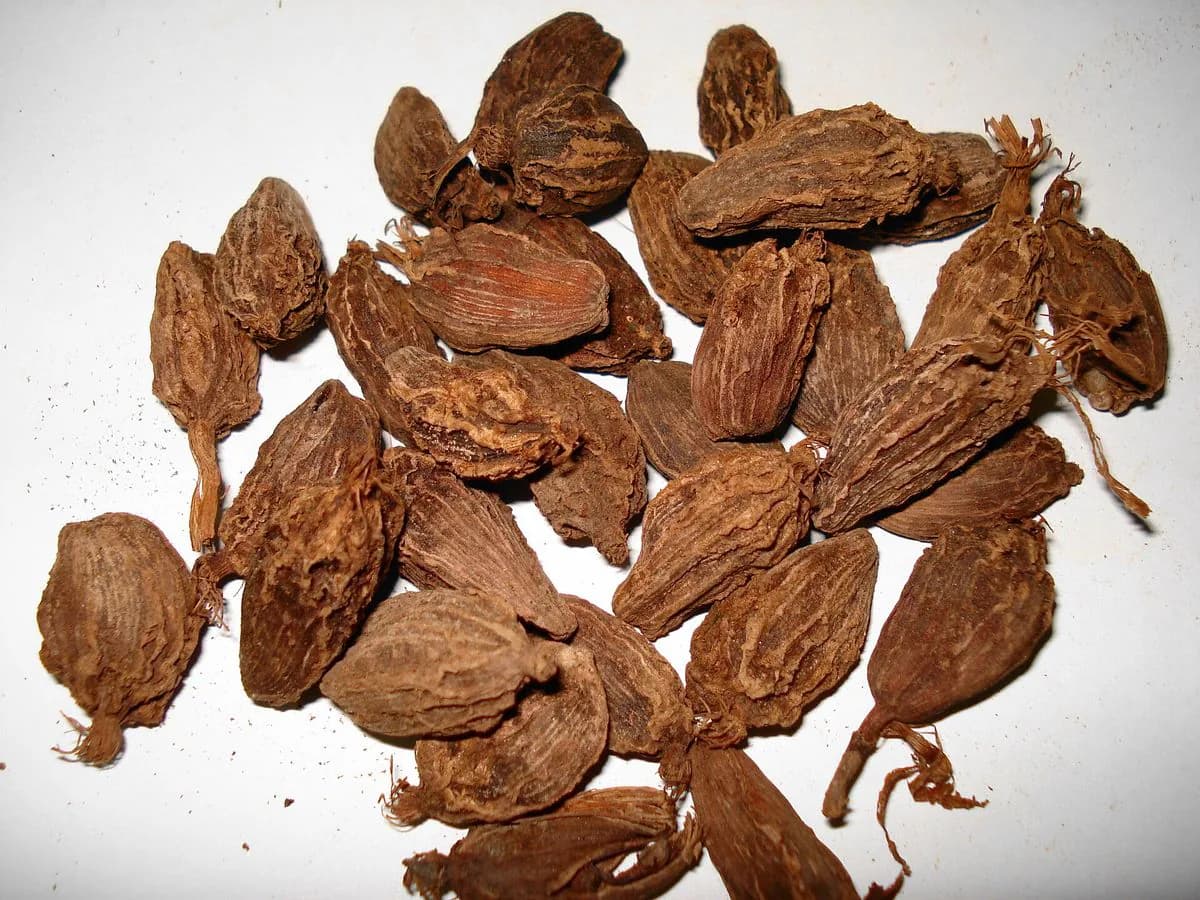
Ask any biryani master in Karachi, Lahore, Dubai, or Dhaka to name the spice their pot cannot live without, and green cardamom rarely tops the list. The honest answer is black cardamom for biryani (badi elaichi), the large, smoky pod that gives the dish its deep, savoury base note. And here is what most buyers never learn: the finest of these pods are grown and smoke-dried in the hills of eastern Nepal, even when the sack they arrive in says otherwise.
What badi elaichi actually does in a biryani pot
Every celebrated biryani (Sindhi, Hyderabadi, Kolkata, or the Gulf-style spiced rice dishes descended from them) is built in layers. Saffron and rose sit at the top. Green cardamom, cinnamon, and cloves fill the middle. But the foundation, the note you taste at the back of the palate and remember the next day, comes from black cardamom.
Crack a pod and the aroma explains why: camphor, resin, and woodsmoke, far bolder than its green cousin. During a slow dum, those oils migrate into the rice and meat, giving the dish a savoury depth that no other of the classic biryani spices can replace. Skip it, and even a technically perfect biryani tastes strangely flat. If you are new to the spice, our complete guide to black cardamom covers the botany, grades and curing behind that aroma.
A symbol of prosperity on the Pakistani table
In Pakistan especially, badi elaichi biryani carries meaning beyond flavour. Finding a whole pod in your portion signals a host who spared no expense, whole spices are the visible proof that the dish was made properly, not assembled from a packet. For restaurants, those visible pods in the serving dish are a quality statement customers recognise instantly.
Why Bhatti-dried Nepali pods beat sun-dried alternatives
Two pods can look identical in a sack and behave completely differently in the pot. The difference is curing. Fresh cardamom capsules hold too much moisture to store, so every producer must dry them, and how they dry them decides the flavour ceiling of your biryani.
In Nepal's eastern districts (Ilam, Taplejung, Sankhuwasabha, Panchthar), farmers cure the harvest in traditional Bhatti kilns: wood-fired chambers where warm smoke passes slowly over the pods for many hours. Sun-drying, the shortcut used for cheaper lots elsewhere, does the job faster and worse.
| Attribute | Bhatti-dried (Nepal) | Sun-dried |
|---|---|---|
| Aroma | Bold smoky-camphor note that survives a long dum | Faint, flat; fades early in cooking |
| Essential oils | Slow, even cure preserves volatile oils | UV and uneven heat degrade oils |
| Moisture control | Dried below 9%, verified per lot | Weather-dependent, inconsistent |
| Shelf life | 12–24 months with aroma intact | Loses potency within months |
| In the biryani | Deep, layered smoke through every grain | Adds bulk, little flavour |
That smoky signature is not a flavouring added later. It is the kiln itself, absorbed over hours of slow drying. It is why chefs who once try genuine smoked black cardamom from a Bhatti-cured lot rarely go back to commodity pods.
How to use black cardamom for biryani: pods, timing, technique
Black cardamom is powerful, and the most common mistake is treating it like green cardamom. Here is the working rule our restaurant clients use.
How many pods
- Home cooking: 2–3 whole pods per kilogram of rice (roughly one pod per 2 cups). Lightly crack each pod so the seeds stay inside but the oils can escape.
- Restaurant degs: scale linearly, a 10kg rice deg takes 20–30 Bold pods. Consistent pod size matters here, which is why kitchens specify graded lots rather than mixed sacks.
- Ground in masala: if you blend your own biryani masala, one part black cardamom seed to roughly ten parts total whole spice keeps the smoke present without dominating.
When to add them
Add black cardamom early, with the other whole spices for biryani, in the hot oil or ghee at the start, before the onions. The pod needs time and heat to release its oils; added late, it contributes almost nothing. Leave the pods in through the dum and serve them in the rice. Diners set them aside, or, in Pakistan, smile when they find one.
Where badi elaichi sits among biryani masala ingredients
A classic biryani masala balances four roles: heat (black pepper, dry chilli), sweetness (cinnamon, fennel), fragrance (green cardamom, mace, bay), and depth. Depth is black cardamom's job, with cloves and cumin in support. Spice brands know this: in nearly every commercial biryani, nihari, and korma blend sold from Karachi to Bradford, badi elaichi is the backbone ingredient the recipe is built around.
That is also why quality matters disproportionately. A weak pod weakens the whole blend; a Bhatti-cured pod lets a brand use less spice for more flavour, a real cost advantage at production scale.
For restaurants and spice brands: sourcing in bulk
If you run biryani kitchens or manufacture spice blends, the economics are simple: the pods you buy through re-export channels were very likely grown in Nepal, marked up at every border and re-packing stop. Sourcing at origin removes those layers. Direct buyers get:
- Grade choice against samples. Bold and Medium for whole-pod cooking, Fine for grinding, specified by you, not blended by a re-packer. Full specifications are on our products and grades page.
- Origin pricing. Typically USD 13–19/kg FOB Kathmandu by grade, see the full breakdown in our black cardamom price per kg guide.
- Documentation that clears customs. Nepali certificate of origin, phytosanitary certificate, per-lot lab reports, and halal paperwork support for Gulf and UK buyers.
- Supply security.A direct line to the world's largest producing country, instead of dependence on a trading hub that can reroute or reprice your supply.
Frequently asked questions
What is the minimum order quantity for restaurant or wholesale buyers?
Our MOQ starts at a single 25kg jute sack, enough for a busy biryani kitchen to run a genuine trial before committing to pallet or container volumes. Qualified buyers can request 200–500g samples first to test the pods in their own pot.
Which grade of black cardamom is best for biryani?
Bold grade is the restaurant favourite: large, heavy pods that release aroma steadily through a long dum and look impressive served whole in the rice. Medium grade performs nearly as well at a lower price. Fine grade suits spice brands grinding pods into biryani masala, where pod size stops mattering.
How do you ship to Pakistan, the UAE, Saudi Arabia, Bangladesh, and the UK?
Trial orders move by air freight from Kathmandu; container volumes ship by sea via Kolkata or air-sea routings through Dubai. Every shipment carries a Nepali certificate of origin, phytosanitary certificate, and a per-lot lab report for smooth customs clearance.
Is your black cardamom halal certified?
Black cardamom is a whole dried plant product and inherently halal, no animal-derived processing aids touch it at any stage. Where importers, halal-certified restaurants, or retail brands require formal documentation, we support halal certification paperwork alongside the standard export pack.
How much does Nepali black cardamom cost per kg?
Himalayan black cardamom typically trades at roughly USD 13–19/kg FOB Kathmandu depending on grade and season, often close to half the landed cost of the same crop re-exported under Indian brands. Our price guide breaks down the full farmgate-to-CIF chain.
The takeaway: better pods, better biryani
The secret behind a perfect biryani is not a hidden recipe. It is the quality of the foundation spice. Choosing genuine Bhatti-smoked black cardamom for biryani, graded and traceable to the hills of eastern Nepal, upgrades every pot it touches, whether that pot serves a family of six or six hundred customers a night.