If you buy large cardamom in bulk — for biryani masala, spice blends, or restaurant kitchens — you have probably weighed Nepal vs India black cardamomat some point. Perhaps a trader told you Indian badi elaichi is the "original". Perhaps you have only ever seen Indian brands on offer. Here is what most buyers never hear: Nepal produces the majority of the world's large cardamom, and a significant share of the "Indian" crop sold in Pakistan, the Gulf, Bangladesh, and the UK was grown in Nepal's eastern hills, moved across the border, re-packed, and re-exported — at close to double the price.
One crop, two labels: how Nepali cardamom becomes "Indian"
Large cardamom grows in a narrow belt of the eastern Himalayas, and Nepal dominates global production — you can verify the country-level figures in FAOSTAT. India, mainly through Sikkim, and Bhutan account for most of the rest.
Yet look at trade statistics on ITC Trade Map and something odd appears: India exports far more black cardamom than it grows. The gap is filled by Nepali crop. The typical route looks like this:
- Farmers in eastern Nepal harvest and cure the capsules.
- Traders buy at Nepali collection markets and truck the crop to Indian hubs such as Siliguri.
- There it is graded, re-packed, and branded as Indian badi elaichi.
- Importers in Karachi, Dubai, Jeddah, Dhaka, and London buy it with an Indian label — and an Indian markup.
So when a buyer asks whether Indian black cardamom is "better", the honest answer is often uncomfortable: you may already be buying Nepali cardamom, just at re-export prices.
Nepal vs India black cardamom: growing regions compared
Any genuine large cardamom comparison starts with geography. Both origins sit in the same Himalayan ecosystem — which is exactly why the crop is so similar, and why the label matters far less than the supply chain behind it.
Eastern Nepal: Ilam, Taplejung, Sankhuwasabha, Panchthar
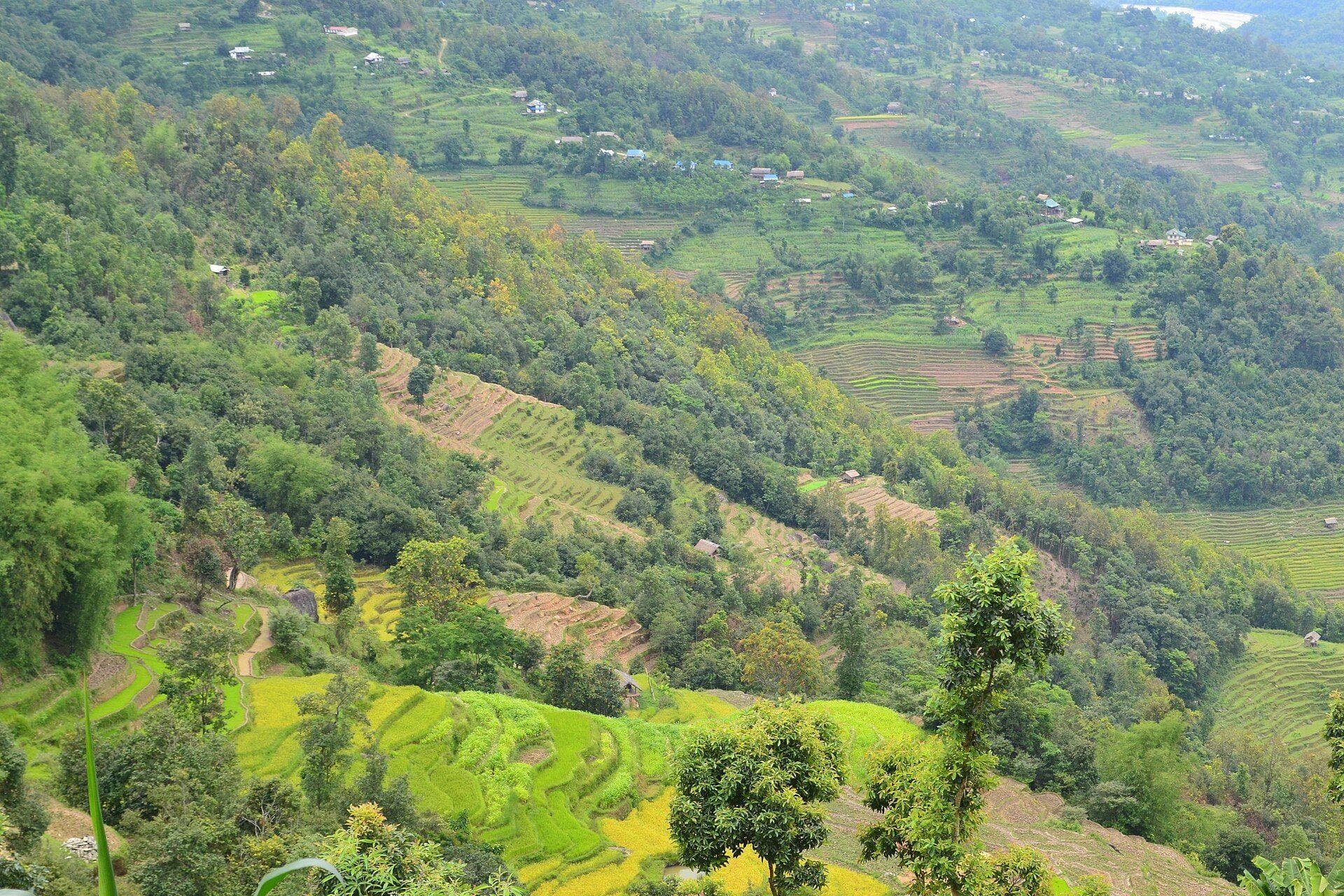
Nepal's cardamom belt runs across its eastern hill districts, grown under forest shade at roughly 1,100–1,500m. Cool, misty slopes, rich soil, and generations of smallholder expertise produce large, heavy, oil-rich capsules. Taplejung and Sankhuwasabha are known for bold pods; Ilam and Panchthar for consistent quality and organised farmer groups. Our own lots come from a single growing cluster in Sankhuwasabha, in the Arun Valley.
India: Sikkim and Darjeeling
Across the border, Sikkim and the Darjeeling hills grow the same species in near-identical conditions. Sikkim cardamom is genuinely good — no honest exporter will tell you otherwise. But India's own production is limited, which is precisely why so much Nepali crop flows in to meet export demand.
| Attribute | Nepal | India (Sikkim / Darjeeling) |
|---|---|---|
| Share of world production | Largest producer — the majority of global supply | Second, well behind Nepal |
| Key districts | Ilam, Taplejung, Sankhuwasabha, Panchthar | Sikkim, Darjeeling hills |
| Species & altitude | Amomum subulatum, ~1,100–1,500m | Same species, same band |
| Typical curing | Traditional Bhatti kilns; modern flue drying on premium lots | Similar kiln drying |
| Export label reality | Often re-exported under Indian brands | Exports include substantial Nepali-grown crop |
| Buying at origin | Direct farm-to-port traceability, lower landed cost | Extra middleman layers for the same Himalayan crop |
Flavour and curing: the Bhatti difference
If there is a real flavour difference in the Nepal-vs-India debate, it comes from how the pods are dried — not from which side of the border they grew on.
Fresh capsules hold too much moisture to store or ship. In eastern Nepal, farmers cure them in traditional Bhatti kilns — wood-fired drying chambers where warm smoke passes over the pods for many hours. That slow cure does three things:
- Signature smoky depth. The campfire note that makes black cardamom essential in biryani, nihari, pulao, and Gulf-style rice dishes comes from this smoke contact.
- Preserved essential oils. Gradual drying protects the volatile oils that carry aroma into a slow-cooked pot.
- Shelf-stable pods. Properly cured capsules store and ship without losing potency.
Judging Nepali black cardamom quality
Whatever the origin, evaluate any lot on the same objective criteria: pod size and weight (bigger, heavier capsules mean more seed and oil), deep brownish-black colour with intact ridges, a strong smoky-camphor aroma the moment the bag opens, safe moisture content, and cleanliness — no stalks, dust, or immature capsules.
Nepali black cardamom quality at the top of the market matches or exceeds anything on the re-export shelf — unsurprising, since at the premium end it is frequently the same crop. Export lots are graded Bold, Medium, and Fine by pod size, dried below 9% moisture, and backed by per-lot lab reports; the full specification sheet is on our products and grades page. The difference when you buy at origin is that you choose the grade against samples yourself, instead of accepting whatever a re-packer blended.
Price and traceability: why buying at origin wins
For wholesale buyers, this is the bottom line. Every border crossing and re-packing step adds margin without adding value. By the time Nepali cardamom reaches an importer as an "Indian" brand, it can cost close to double the origin equivalent. Sourcing directly from Nepal gives you:
- Better landed cost. Himalayan black cardamom trades at roughly USD 13–19/kg FOB Kathmandu by grade — the full farmgate to CIF breakdown is in our guide to black cardamom price per kg.
- True traceability. Nepali certificate of origin, named districts, even named farmer clusters — increasingly demanded by food-safety audits and halal certification bodies.
- Grade control. You specify Bold, Medium, or Fine against physical samples, with lab-verified moisture on every lot.
- Supply security.A direct relationship in the world's largest producing country, instead of dependence on a trading hub. Our lanes into the Gulf, South Asia, and the UK are documented on the export markets page.
Frequently asked questions
What is the minimum order quantity for Nepali black cardamom?
Our MOQ starts at a single 25kg sack, letting new buyers trial a lot before committing to pallet or container volumes. Samples of 200–500g are available to qualified buyers to inspect pod size, aroma, and moisture before ordering.
Which grades of black cardamom does Nepal export?
Export lots are graded Bold, Medium, and Fine by pod size. Bold and Medium suit restaurants and retail packers, where whole pods are visible in biryani and pulao. Fine grade is the value choice for spice mills and blenders, since size no longer matters once the pod is ground.
How is Nepali black cardamom shipped to Pakistan, the Gulf, Bangladesh, and the UK?
Trial orders move by air freight from Kathmandu; container volumes ship by sea via Kolkata or air-sea routings through Dubai. Every shipment carries a Nepali certificate of origin, phytosanitary certificate, and per-lot lab report for smooth customs clearance.
Is Nepali black cardamom halal certified?
Black cardamom is a whole dried plant product and inherently halal — no animal-derived processing aids are involved. Where importers or retailers require formal documentation, we support halal certification paperwork alongside the standard export document pack.
Is Indian badi elaichi better than Nepali black cardamom?
They are the same species from the same Himalayan belt, and much 'Indian' badi elaichi was actually grown in Nepal and re-exported. Judge any lot on pod size, aroma, moisture, and lab results — not the label. Buying at origin delivers the same quality at a lower landed cost.
The verdict: same Himalayas, different invoice
In the Nepal vs India black cardamom question, the best black cardamom origin is not defined by a border — it is defined by altitude, curing, and how directly you can trace a lot back to the farm. The pods are the same Himalayan species either way; what changes is how many hands touch your invoice before it reaches you. Buying at origin in Nepal removes the re-export detour, and the markup that rides on it.