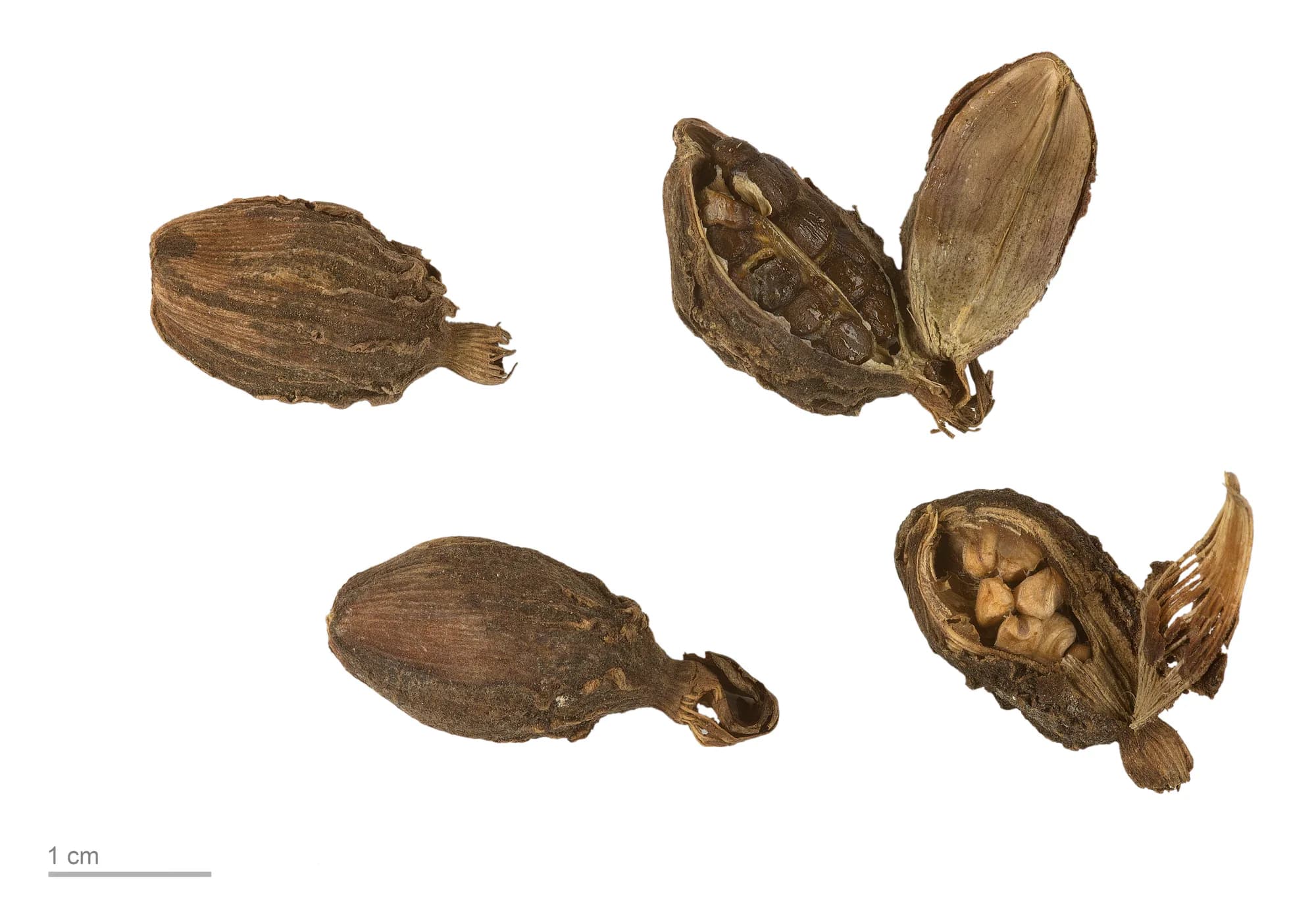
Inside a black cardamom pod
A black cardamom pod is a tough, ridged husk wrapped around a sticky cluster of small, dark seeds. The pod is the dried fruit of Amomum subulatum, and it runs from about 18 to 28mm long.
The husk is leathery and deeply wrinkled, and it splits into three chambers. Inside, the seeds are packed together and held by a sweetish, sticky pulp, so they come out as a clump rather than loose. A well-filled pod holds a few dozen of them.
Fill depends on size and maturity. Larger, fully ripe pods are packed tight; pods picked early or dried badly have fewer, thinner seeds and more empty space. Our complete guide to black cardamom covers how pods are graded by size.
The rattle test: shake a pod beside your ear. A well-filled pod feels heavy for its size and barely rattles. A hollow rattle means thin or old seeds with little left to give.
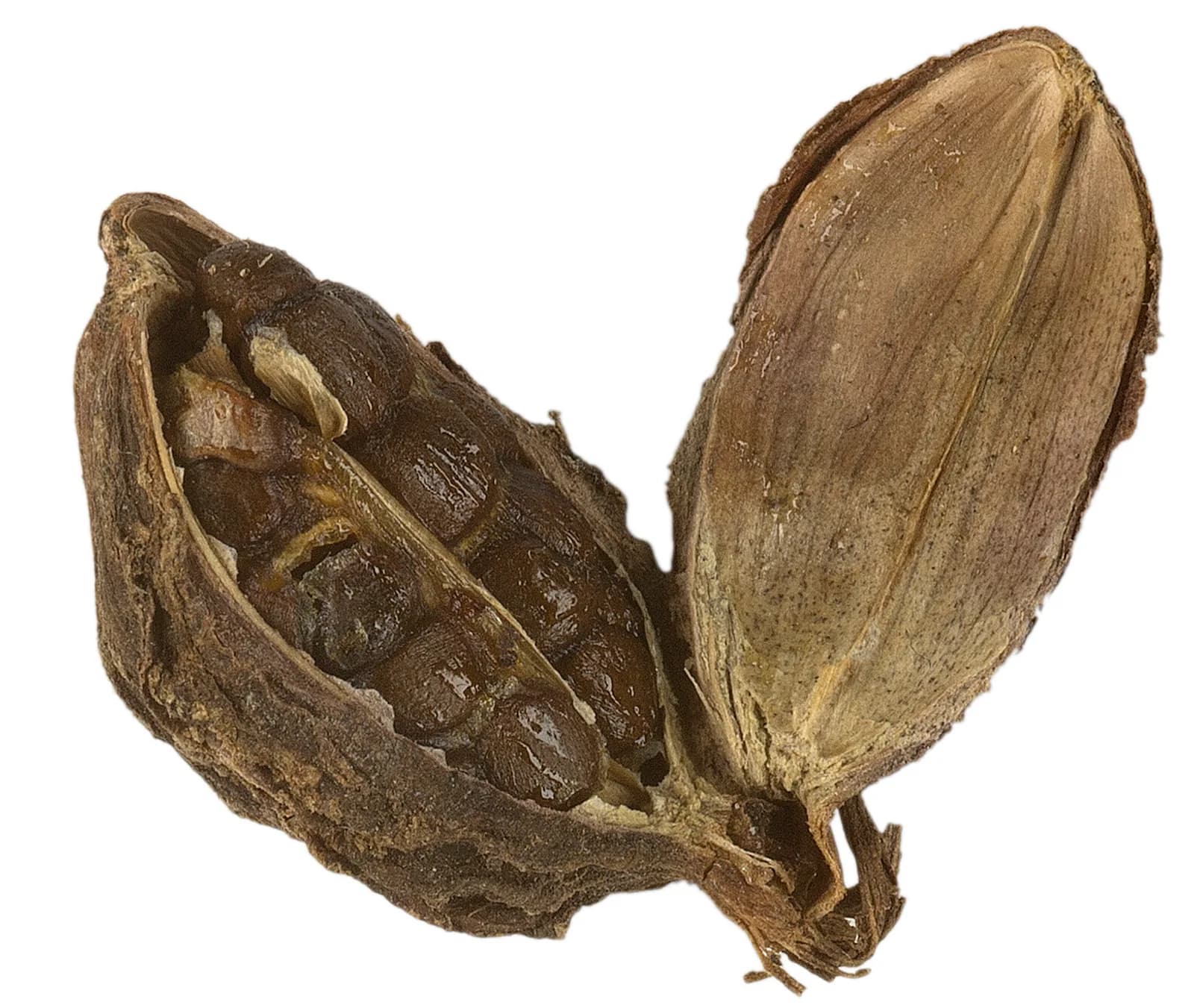
Husk vs seeds: where the flavour lives in black cardamom pods
The husk carries the smoke; the seeds carry the menthol and camphor. Almost every mistake people make with black cardamom comes from getting that balance wrong.
The husk is the surface the wood fire touches during drying, so it is where most of the smoke settles. It also carries woody, resinous, piney notes. On its own it is fairly mild, but over a long cook it gives depth and a smoky backbone.
The seeds are where the cooling, camphor-like compound 1,8-cineole is most concentrated. Crushed, they are intense: menthol first, then camphor. Laboratory analysis of Nepali black cardamom backs this up: the seed oil is markedly richer in 1,8-cineole than the husk oil, while the husk oil has more of the piney compounds. The smoke is our own observation from drying, not part of that study.
What this means in the pot: a whole pod gives a gentle, smoke-forward flavour. A cracked pod releases both, for a balanced result. Seeds alone give menthol up front and turn medicinal quickly.
That is why dishes taste “medicinal”: too many seeds exposed for too long. For how each note tastes on its own, see what cardamom tastes and smells like.
| Part | Main flavour | Strength | Edible? | Best use |
|---|---|---|---|---|
| Husk | Smoke, wood, resin, pine | Mild alone, builds over time | Not pleasant; remove before serving, unless ground fine | Long simmers, braises, rice |
| Seeds | Menthol, camphor, cool eucalyptus | Intense, especially crushed | Yes, but very strong | Tempering, spice blends, tea |
Whole, cracked or seeds only: which to use
Whole or cracked black cardamom comes down to the dish: whole pods for gentle smoke, cracked pods for most cooking, and seeds only when you want the cool note up front. For pod counts per dish, see how to use black cardamom.
| Method | How to do it | Flavour result | Best for | Cooking time |
|---|---|---|---|---|
| Whole pod | Drop in as it is | Gentle, smoke-forward | Stocks, long braises | 45 minutes or more |
| Lightly bruised | Press until it just gives | Smoke with a hint of cool | Rice, stews | 30 minutes or more |
| Cracked open | Press until the husk splits | Balanced smoke and menthol | Curries, biryani, dal | 20 to 40 minutes |
| Seeds only, whole | Scrape out the cluster | Cool, camphor-forward | Tempering, tea | 30 seconds in fat, then the dish |
| Seeds crushed or ground | Pound or grind fresh | Intense menthol; easily medicinal | Rubs, finishing | Last 10 to 15 minutes |
| Husk and seeds ground | Grind the whole pod | Both, evenly | Garam masala, blends | As the blend requires |
Whole or lightly bruised
For anything that simmers 45 minutes or more, a whole pod releases its smoke slowly without flooding the pot with menthol. Bruise it lightly for a rice dish of around half an hour.
Cracked
The everyday choice. Bloom the cracked pod in hot oil or ghee with the other whole spices for 30 to 60 seconds, then build the dish. This is how it goes into biryani, as set out in black cardamom in biryani.
Seeds only
Use a few seeds in a tempering or a pot of tea when you want the cool note without much smoke. A cracked pod steeped for three to five minutes is the usual way into black cardamom tea.
Ground
Crushed seeds go in late, in the last 10 to 15 minutes, or they turn harsh. Whole pods ground husk and all belong in spice blends.
Can you eat black cardamom?
The seeds, yes; the husk, not really. Cook the pod whole or cracked, then lift it out before serving, as you would a bay leaf.
The husk is fibrous, tough and woody. It will not hurt you, but biting into one is an unpleasant, intense mouthful of smoke. Ground finely with the seeds, as in garam masala, it is eaten without anyone noticing.
The seeds are edible, and strong. In some Nepali and South Asian households a few are chewed after a meal to freshen the breath. That is a traditional use, not medical advice.
Children and guests are the ones who bite into pods by accident. Tell them to push the pods aside, or tie the pods in a small square of muslin so you can lift them all out at once.
Green cardamom pods are softer and can be ground whole; for how the two differ, see our guide to what cardamom is. How to crack and use green pods is in our guide to cardamom pods.
How to get black cardamom seeds out
Here is how to open black cardamom: press the pod with the flat of a knife until it splits, then peel it open and scrape out the seeds.
- Press the pod under the flat of a heavy knife, or the base of a glass, until the husk splits.
- Peel the husk back along its ridges.
- Scrape out the sticky seed cluster with a fingertip or the tip of the knife.
- Separate or crush the seeds, depending on the recipe.
A mortar alone is the wrong tool for a whole pod. The husk is tough and springy, so the pestle bruises it rather than opening it, and the seeds end up half crushed inside. Open the pod first, then use the mortar on the seeds.
Do this just before cooking. Once the seeds are out, their oils start escaping, and seeds prepared hours in advance lose much of their cool, bright edge.
What about ground black cardamom?
Most ground black cardamom is husk and seeds milled together, in a balance that varies from one producer to another. That is why two jars can taste so different.
More husk in the grind means more smoke and woodiness; more seed means more menthol and camphor. Neither is wrong, but you cannot tell which you have from the label.
Grinding your own lets you choose. Grind whole pods for an even balance, add extra seeds for a cooler blend, or extra husk for a smokier one. Grind small amounts, because the powder loses its top notes within weeks. If you are out of pods entirely, our guide to black cardamom substitutes ranks what comes closest.
A grower's note: pods at harvest
In Sankhuwasabha, in eastern Nepal, our black cardamom pods grow in clusters at the base of the plant, close to the ground. Fresh from the plant they look nothing like the spice in your jar.
A fresh pod is reddish, plump and soft, about 80% water, with pale seeds inside and a fruity, green smell. There is no smoke in it.
In the bhatti, over a wood fire, that changes. The husk darkens, wrinkles and takes on the smoke, while the seeds inside turn dark and sticky. The husk is the part the fire touches, which is why the smoke sits there. Pods dried with indirect heat keep far less of it, as we explain in bhatti-dried versus machine-dried black cardamom.
Common mistakes
- Chewing a whole pod: a mouthful of husk and a burst of camphor. Push pods aside when eating.
- Leaving husks in the serving dish: someone will bite one. Lift them out, or cook them in muslin.
- Crushing too many seeds: the dish turns medicinal. Crack pods instead, and use fewer.
- Grinding seeds in advance: the cool, bright notes fade within hours. Grind just before cooking.
- Using a mortar on a whole pod: it bruises the husk instead of opening it. Split it with a knife first.
Frequently asked questions
Can you eat black cardamom seeds?
Yes. Black cardamom seeds are edible, but they are very strong, with an intense cooling, camphor-like taste. Most cooks let them flavour a dish rather than eat them on their own. In some Nepali and South Asian households a few seeds are chewed after a meal to freshen the breath, which is a traditional use, not medical advice.
Do you remove black cardamom pods before serving?
Yes, ideally. The husk is tough and fibrous, so treat the pod like a bay leaf: it flavours the pot and comes out before serving. In biryani and pulao, cooks often leave pods in and let people push them aside. If you are cooking for children or guests, tie the pods in muslin so they are easy to lift out.
Should you crack black cardamom before cooking?
Usually, yes. A light crack lets the seeds' cooling, camphor-like oils out alongside the smoke on the husk, which gives the most balanced flavour. Leave the pod whole when you want a gentle, smoke-forward background in a long simmer. Take the seeds out only when you want the menthol note up front, and use fewer of them.
Is the black cardamom husk edible?
It is not harmful, but it is not pleasant to eat. The husk is tough, fibrous and woody, and biting into it gives an intense hit of smoke. That is why it is cooked whole and removed, like a bay leaf. Ground finely with the seeds, as in garam masala, the husk is eaten without anyone noticing.
How many seeds are in a black cardamom pod?
A well-filled pod usually holds a few dozen small seeds, packed in a sticky cluster inside its three chambers. Larger, fully mature pods hold more, and pods picked early or dried badly hold fewer and thinner seeds. A pod that feels heavy and barely rattles is well filled; one that rattles loudly has little inside.
Is ground black cardamom made from the husk or the seeds?
Usually both, milled together, and the balance varies from one producer to another. That is why two jars can taste so different: more husk gives more smoke and woodiness, more seed gives more menthol and camphor. Grinding your own lets you choose the balance, and it tastes far fresher than ready-ground powder.
Why does my dish taste medicinal?
Usually because too many seeds were exposed for too long. The seeds carry black cardamom's cooling, camphor-like compound, and crushed seeds in a long simmer can take over a dish. Next time, use whole or lightly cracked pods, fewer of them, and lift them out once the dish tastes right. Never use black cardamom in something sweet.
Can you reuse black cardamom pods?
A pod steeped in tea can be dried and used once more in a stock or a pot of rice, though it will be much weaker, because the seeds give up most of their oils the first time. Discard pods that have been cooked in meat, dairy or sauce, rather than keeping them to reuse.