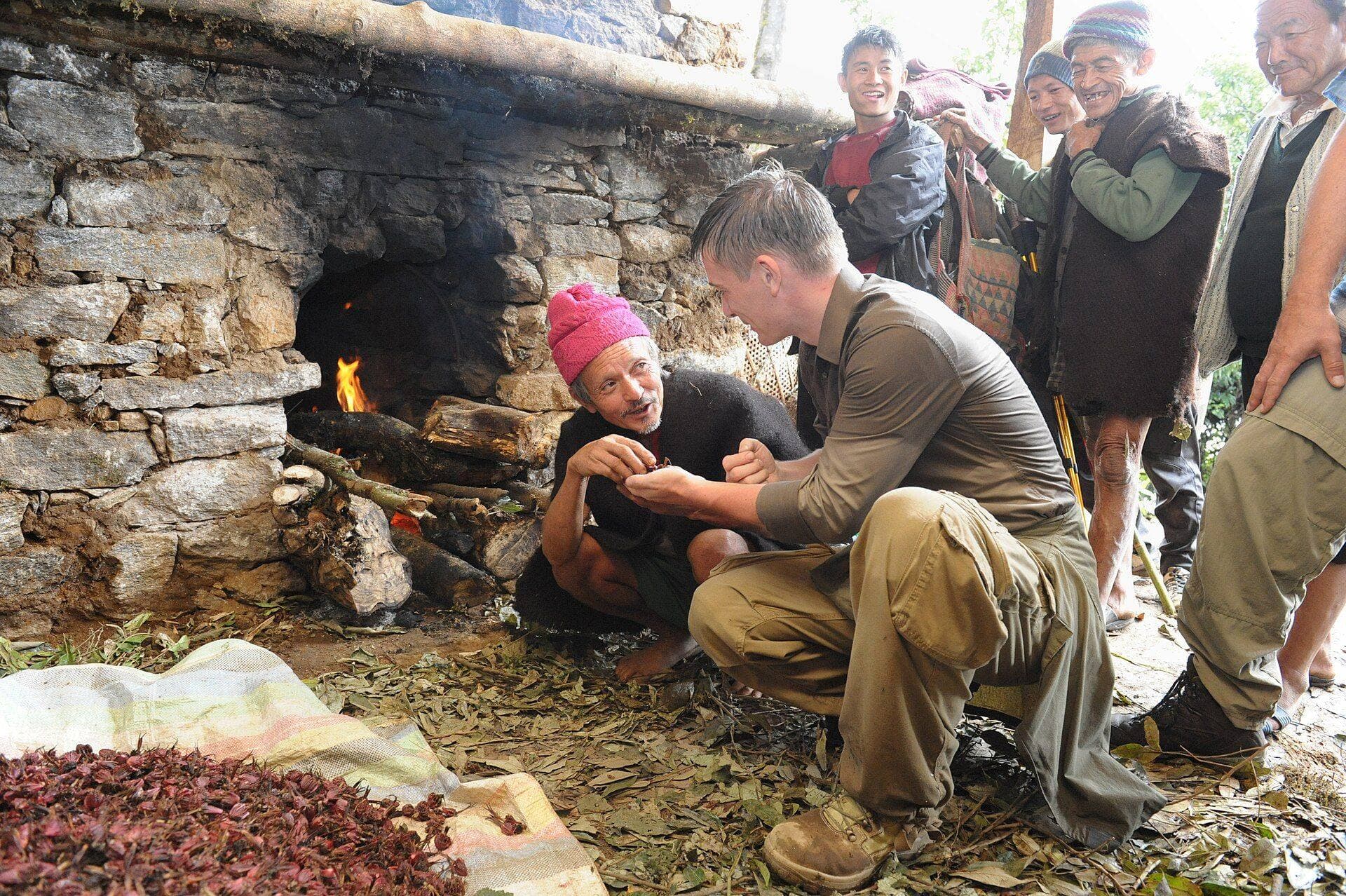
Bhatti-dried black cardamom is cured over a wood fire in a traditional Nepali kiln, where smoke contacts the pods directly and gives them their signature smoky aroma. Machine-dried, or improved indirect drying, heats the pods through flue pipes instead, retaining more colour and volatile oil with far less smoke.
That single difference, direct smoke or not, drives most of what you argue about with your supplier: aroma strength, colour, oil content, and whether a lot clears a UK buyer’s spec. It is not a quality ranking. Neither method is “better”; they produce two different products, and the right one depends on the market you sell into.
What Bhatti drying actually is
A Bhatti is a wood-fired drying chamber used across eastern Nepal: Ilam, Taplejung, Panchthar and Sankhuwasabha. Fresh large cardamom (Amomum subulatum) capsules hold far too much moisture to store or ship, so they are cured within hours of harvest, on the farm.
In a traditional Bhatti, capsules sit on racks above a fire and hot gases pass directly over them. The pods absorb smoke as they dry, which is exactly where the campfire note in badi elaichi comes from.
This is also why black cardamom tastes nothing like green cardamom. Green cardamom (Elettaria cardamomum) is dried without smoke contact. Alainchi, kali elaichi, badi elaichi (whatever your market calls it) is a smoke-cured spice by tradition, and that is its whole culinary identity in biryani, nihari and garam masala. Its wider culinary and traditional uses are covered separately in our guide to black cardamom benefits.
The trade-off nobody mentions
Direct-fire drying is hard to control. Run it too hot or too long and you get sooty surfaces, scorched pods, uneven colour and volatile oil driven off rather than preserved. Comparative studies in Nepal have found traditional direct drying tends to reduce colour, flavour and oil content relative to improved systems. The romance of the method does not guarantee the result.
What “machine-dried” black cardamom really means
In this trade, “machine-dried” almost never means an industrial electric dehydrator. It usually means an improved Bhatti: still wood-fired, but with indirect heating, where hot flue gases run through a pipe arrangement and heated air dries the pods without bathing them in smoke.
Published Nepali agricultural research puts a typical improved Bhatti at 200–400kg of fresh capsules per batch, 17–24 hours drying time, producing a maroon capsule colour and roughly 2–2.4% volatile oil. These are indicative working figures, not a guaranteed spec.
Improved drying is not a shortcut or an adulteration. It is a controlled version of the same wood-fired process, trading smoke intensity for colour, consistency and retained oil.
Bhatti-dried vs machine-dried: what changes in the pod
Large cardamom carries roughly 2–4% volatile oil, and that oil is dominated by 1,8-cineole, commonly 60–75% of it depending on cultivar and region. Cineole is the camphor-like top note you smell when a sack opens. Aggressive direct-fire drying costs you some of it; controlled drying protects it.
| Attribute | Traditional Bhatti (direct smoke) | Improved / machine-dried (indirect) |
|---|---|---|
| Heat contact | Smoke and flue gas pass directly over pods | Heated air via flue pipes; little smoke contact |
| Aroma profile | Strong, smoky, campfire-forward | Cleaner, resinous, cineole-forward |
| Typical colour | Dark brown to sooty black, can be uneven | Even maroon to deep brown |
| Volatile oil | More variable; can be driven off if overheated | Better retained; ~2–2.4% reported in improved units |
| Batch consistency | Varies by operator and firing | More repeatable batch to batch |
| Surface residue | Visible soot possible on the ridges | Clean ridges, minimal deposit |
| Best fit | Biryani and masala houses wanting bold smoke | Blenders, retail packs, smoke-sensitive buyers |
Neither column is a defect list. Read it as a spec sheet and pick the column your customer actually wants.
Smoke, PAH, and what UK and EU buyers should know
This is where importers get misinformed, so here is the position as written in law.
Polycyclic aromatic hydrocarbons (PAHs) form whenever food is smoked. Commission Regulation (EU) 2023/915 sets maximum levels for dried spices at 10.0 µg/kg benzo(a)pyrene and 50.0 µg/kg for the sum of PAH4, under entry 5.1.10, which then states: “Except cardamom and smoked Capsicum spp.”
Two caveats. Regulatory exclusions get reviewed, and PAHs in smoked foods are an active file. And a statutory exemption is not a commercial one: UK and EU retailers frequently write their own PAH ceilings into supply contracts anyway.
So if you sell into the UK, ask for the drying method in writing and test if your customer’s spec demands it, not because the law forces you to, but because your buyer might.
Which drying profile does your market want?
Pakistan and the Gulf. Bold, smoke-forward pods generally win. In biryani, nihari and heavy garam masala blends, black cardamom is carried by long cooking, and a timid pod disappears. Traditional Bhatti product usually suits these buyers.
UK and EU. Preference tilts toward cleaner, controlled lots, partly for buyer specs, partly because retail-facing packaging rewards even maroon colour and low surface soot. Improved-dryer product tends to fit better.
Blenders and mills anywhere. Once a pod is ground, appearance stops mattering and oil content starts paying. Controlled drying is usually the better value per kilo.
If you serve several of these markets, do not accept one blended profile. Specify per lot.
How to test a lot before you buy
Run these six checks on any sample, whichever method the seller claims:
- 1. Open the bag and smell it cold. Bhatti-dried reads smoke-first. Improved-dried reads resinous and camphor-like, with smoke behind it.
- 2. Rub a pod on white paper. Heavy black smear means surface soot and over-firing, not strength.
- 3. Check colour evenness across a handful. Mixed sooty-black and pale pods signals uneven firing or blended lots.
- 4. Split a pod. Seeds should be dense, sticky and dark, filling the capsule. Loose, dusty, rattling seed clusters mean age or overheating.
- 5. Ask for moisture on the lot, not the consignment. We ship below 9%; anything drifting above roughly 10–12% is a storage and mould risk.
- 6. Ask which dryer produced it. A supplier who cannot say whether a lot came from a traditional or improved Bhatti is not close enough to the farm to know.
Grade separately from drying method. Bold, Medium and Fine describe pod size; they say nothing about how the lot was cured. State both on the purchase order.
People also ask
Is black cardamom supposed to taste smoky?
Yes. Smoke is the defining characteristic of black cardamom, not a flaw or contamination. It comes from wood-fired curing at origin. Intensity varies with drying method, so if a lot tastes too mild or too harsh for your blend, ask for the other drying profile rather than switching origin.
Why is my black cardamom sooty and black?
Heavy soot usually indicates over-firing in a traditional direct-fire Bhatti, or drying too close to the fire. It is a processing issue, not a sign of strength or superiority. Rub a pod on white paper: a dark smear means surface deposit that will carry into your ground blend.
Is machine-dried black cardamom lower quality?
No. Improved indirect drying typically retains more volatile oil and gives more even colour than uncontrolled direct-fire drying. It delivers less smoke, which is a flavour difference rather than a quality defect. Judge on oil content, colour evenness, moisture and aroma instead of on the method name.
Can I buy black cardamom without a strong smoky flavour?
Yes. Ask specifically for improved-dryer or indirect-dried lots. The pods keep their natural resinous, cineole-forward character with far less smoke, which suits retail packing, lighter blends and buyers working to their own PAH specifications. Specify it on the purchase order, since most default farm lots are traditionally cured.
Frequently asked questions
What is the minimum order quantity?
Our MOQ is a single 25kg jute sack, so you can trial one drying profile before committing to larger volumes. Pallet and container quantities are available once you have confirmed which profile your market prefers. Mixed-profile orders are possible across separate lots.
Can I get samples before ordering?
Yes. We send 200–500g samples to qualified trade buyers, and we will send Bhatti-dried and improved-dried side by side so you can compare aroma and colour directly. Sample lots carry the same lot reference as production stock, so what you approve is what ships.
Which grades do you supply?
Bold, Medium and Fine, sorted by pod size. Bold and Medium suit buyers who want whole visible pods in biryani or retail packs. Fine is the value grade for mills and blenders, where size stops mattering after grinding. Each grade is available in either drying profile.
How do you ship to Pakistan, the Gulf and the UK?
Trial volumes move by air freight from Kathmandu. Container volumes ship by sea, and we can route directly rather than through Indian re-export hubs. Lead times and Incoterms are quoted per destination, with UK consignments documented for customs and buyer compliance checks.
What documents and certifications come with a shipment?
Every consignment carries a Nepali certificate of origin, a phytosanitary certificate, a commercial invoice and packing list, and a per-lot report covering moisture and grade. Drying method is stated on the lot documentation. Halal paperwork and additional residue testing are available on request.
The bottom line
Bhatti-dried black cardamom and improved-dried product are two deliberate specifications of the same crop, not a premium tier and a budget tier. Traditional direct-fire curing buys you smoke. Controlled indirect drying buys you colour, consistency and retained oil.
Decide which one your customer is actually paying for, then write it on the order alongside the grade, and buy it from the people who cured it. Most Nepali crop is cleaned, cut and graded at Birtamod in Jhapa before moving on, and every handover blurs which dryer actually produced your lot. Most of the world’s crop is Nepali before it is anything else, as we set out in Nepal vs India vs Bhutan large cardamom.