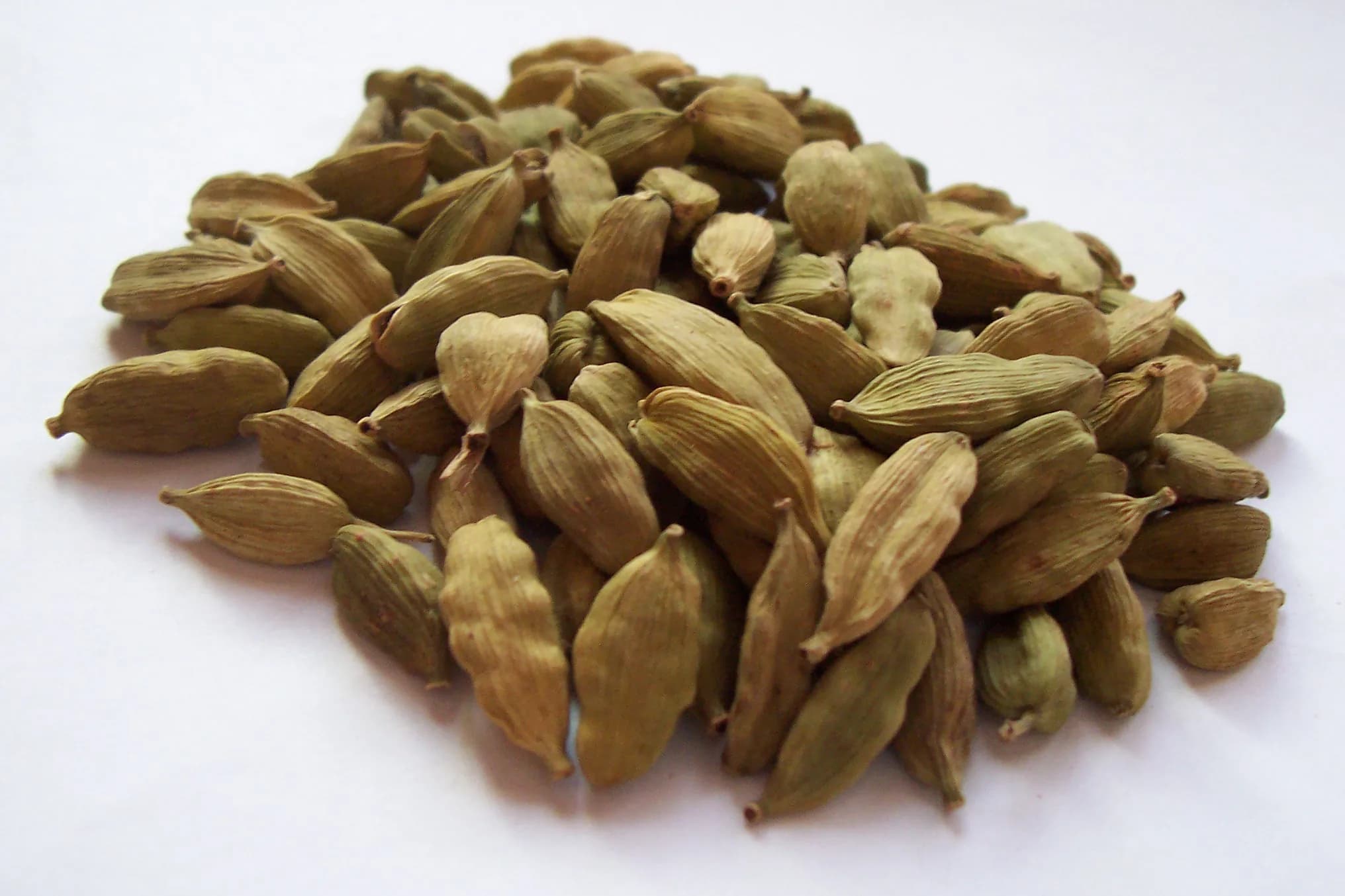
Green cardamom is the spice most people mean when they say cardamom. This page covers the plant, the pod and how to use it; for every type of cardamom side by side, start with our guide to what cardamom is.
What is green cardamom?
Green cardamom is the dried seed pod of Elettaria cardamomum, a leafy plant in the ginger family, Zingiberaceae. When a recipe just says “cardamom”, this is almost always the one it means.
It goes by several names. True cardamom separates it from the other plants sold as cardamom. Small cardamom is the name used in the Indian spice trade, as against large, or black, cardamom. In Hindi and Urdu it is elaichi, and more specifically choti elaichi (small cardamom) or hari elaichi (green cardamom).
The pod is roughly 10 to 15mm long, pale to bright green, smooth and slightly three-sided. Inside, three chambers hold around 15 to 20 small, dark, sticky seeds, and those seeds carry the flavour. How to crack, measure and cook with the pod itself is covered in our guide to cardamom pods.
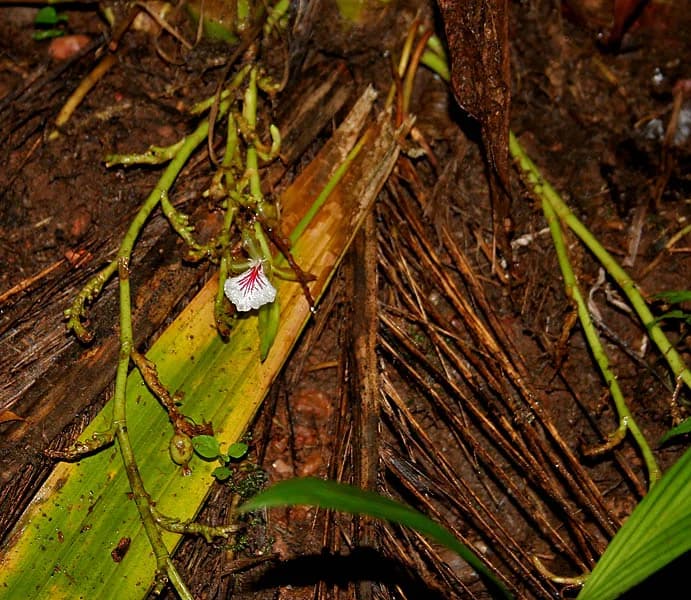
The plant grows from underground stems, like ginger, and sends up tall stems of long, narrow leaves. The flowers and pods do not grow on those leafy stems: they form on separate stalks that rise from the base of the plant, close to the ground.
Green cardamom is often confused with black cardamom, but they are different plants. Black cardamom is larger, darker and smoky, and is used mainly in savoury cooking. The two are compared in detail in black cardamom versus green cardamom.
Why is green cardamom green?
Green cardamom stays green because of how it is harvested and dried. The pods are picked by hand just before they are fully ripe, then dried slowly at moderate heat, which holds on to the green colour.
On the plant, the pods ripen a few at a time along each stalk, so pickers go over the same plants several times in a season, taking only the pods that are ready. Picked too early, the pods shrivel; left to ripen fully, they start to split and lose colour.
Drying is the step that decides the colour. In the main growing regions, pods are dried in heated curing rooms rather than in the open, so the heat stays gentle and even. Pods that are dried too hot, dried in the sun or simply kept too long turn pale, yellowish or brown, and usually taste flatter as well. A bright, even green is a sign of careful drying and reasonably fresh stock.
Black cardamom is different from the start: a separate plant, dried over an open wood fire in a kiln, which is why its pods are dark, wrinkled and smoky. How that drying works, and how it compares with smoke-free machine drying, is set out in bhatti-dried versus machine-dried black cardamom.
Bleached and white cardamom
Pale, creamy cardamom sold in some Western shops is usually green cardamom that has been bleached. It was traditionally preferred for pale cakes and sweets where green flecks were unwanted, and it is milder than unbleached pods. “White cardamom” can also mean a different plant altogether, which our guide to the types of cardamom explains.
Where green cardamom grows
Green cardamom is native to the forests of the Western Ghats in southern India. Today it is grown mainly in Guatemala and India, with smaller crops in Sri Lanka, Tanzania and Papua New Guinea.
Guatemala is often cited as the largest producer and exporter, and exports most of its crop, much of it to the Middle East. India grows a large crop too, but much of it is used at home. Global figures are harder to pin down than you might expect: the UN's FAOSTAT database reports cardamom together with nutmeg and mace.
| Country | Main growing regions | Notes |
|---|---|---|
| Guatemala | Alta Verapaz, in the northern highlands | Often cited as the largest producer and exporter; most of the crop is exported |
| India | Kerala (especially Idukki), Karnataka, Tamil Nadu | The plant's native home; a large share is used within India |
| Sri Lanka | The central hill country | A smaller, long-established crop |
| Tanzania | Mainly the Usambara and Uluguru mountains, and Zanzibar | Small production |
| Papua New Guinea | The highlands | Small production |
The plant is an understorey crop. It grows best in the shade of taller trees, in warm, humid hill forest with heavy, well-spread rainfall, typically somewhere between 600 and 1,500 metres. It does not tolerate frost, drought or strong sun.
It can be grown as a houseplant for its scented leaves, but NC State Extension notes that it rarely flowers indoors, so a pot plant is unlikely to give you pods.
How green cardamom is graded
Green cardamom is graded mainly by size, colour and how full the pods are. Bigger, greener, heavier pods sit at the top of the scale.
Size is measured across the pod, in millimetres, by passing pods through sieves. Colour and the share of split, empty or damaged pods are judged by eye. Many buyers also look at weight per litre: two sacks of the same size of pod can differ a good deal in how many seeds they hold, and heavier means fuller.
Trade grade names vary by country. In India, the larger grades carry names such as Alleppey Green Extra Bold and Alleppey Green Bold, and smaller and mixed grades follow. Other producers use their own size and colour grades, so a grade name means little without the sizes and standards behind it.
| What graders look at | Better | Lower |
|---|---|---|
| Size | Large, evenly sized pods | Small or mixed sizes |
| Colour | Even, bright to deep green | Pale, yellowed, brown or patchy |
| Plumpness | Full and heavy for the size | Flat, light or shrivelled |
| Whole vs split | Closed, whole pods | Split, open or broken pods |
| Seed colour | Dark brown to black, slightly sticky | Pale, brown or dry |
| Aroma | Strong and immediate when cracked | Faint, dusty or musty |
How to choose good green cardamom
At home, the same checks apply to a single jar. Look for pods that are bright to olive green, plump, closed and heavy for their size. Crack one: it should smell strong straight away, and the seeds should be dark and slightly sticky. Our guide to choosing good cardamom pods has a fuller checklist.
What does green cardamom taste like?
Green cardamom tastes sweet, floral and citrusy, with a cool, eucalyptus-like note and a clean finish. It is strong and aromatic, but not hot.
The bright top notes are the first to go, which is why old or long-cooked cardamom tastes flatter and more medicinal. Each note, and the compound behind it, is broken down in our guide to what cardamom tastes and smells like.
How to use green cardamom
Green cardamom works in sweet and savoury cooking alike: chai and coffee, rice and curries, milk puddings, and baking. Use whole or cracked pods for anything that simmers, and ground seeds for anything baked.
It is one of the most widely travelled spices. In India it flavours everything from tea to biryani; in the Gulf it is brewed with coffee; in Scandinavia it is the defining spice of sweet buns and breads.
| Cuisine or drink | Dish | How it's used |
|---|---|---|
| Indian | Chai | Cracked pods simmered with the tea and milk |
| Indian | Biryani and pulao | Whole pods cooked with the rice and meat |
| Indian | Kheer, gulab jamun | Crushed seeds in the milk, or in the sugar syrup |
| Indian | Korma | Whole pods warmed in ghee at the start, sometimes ground into the sauce |
| Gulf and Middle Eastern | Arabic coffee | Plenty of crushed cardamom brewed with lightly roasted coffee |
| Gulf and Middle Eastern | Spiced rice dishes | Whole pods cooked with the rice, meat and other whole spices |
| Nordic | Cardamom buns, sweet breads, pastries | Freshly ground seeds in the dough and the butter filling |
| Western baking | Cakes, cookies, muffins | Ground, whisked into the dry ingredients |
| Persian | Tea, rice, sweets | A pod or two in the teapot; ground in rice puddings and pastries |
| Drinks | Coffee, lattes, hot chocolate | A pinch of ground cardamom with the coffee grounds or in the milk, or a spoon of homemade cardamom syrup |
Whole pods: crack and simmer
For chai, rice, curries and warm milk, crack the pods lightly under the flat of a knife and let them simmer. Lift them out before serving, or warn your guests. How many to use for each dish is in our guide to how to use cardamom pods.
Seeds: crush fresh
For desserts and spice blends, split the pods, tip out the seeds and crush them in a mortar just before use. This is the strongest form, and it spreads the flavour evenly with no husk in the mouth.
Ground: for baking
For cakes, buns and cookies, ground cardamom mixes evenly into the dough. It fades quickly once ground, so grind your own if you can, as in these cardamom cookies. About 10 to 12 pods make a teaspoon; conversions, uses and storage are in our guide to ground cardamom.
Green cardamom vs black cardamom
Green and black cardamom are different plants with different flavours, and they are rarely interchangeable. Green is the sweet, floral one; black is smoky and savoury.
| Green cardamom | Black cardamom | |
|---|---|---|
| Size | About 10 to 15mm | About 18 to 28mm |
| Colour | Pale to bright green, smooth | Dark brown, wrinkled and ridged |
| Flavour | Sweet, floral, citrus, eucalyptus | Smoky, camphor, menthol, resin |
| Main use | Chai, coffee, sweets, baking, rice | Curries, biryani, dal, garam masala |
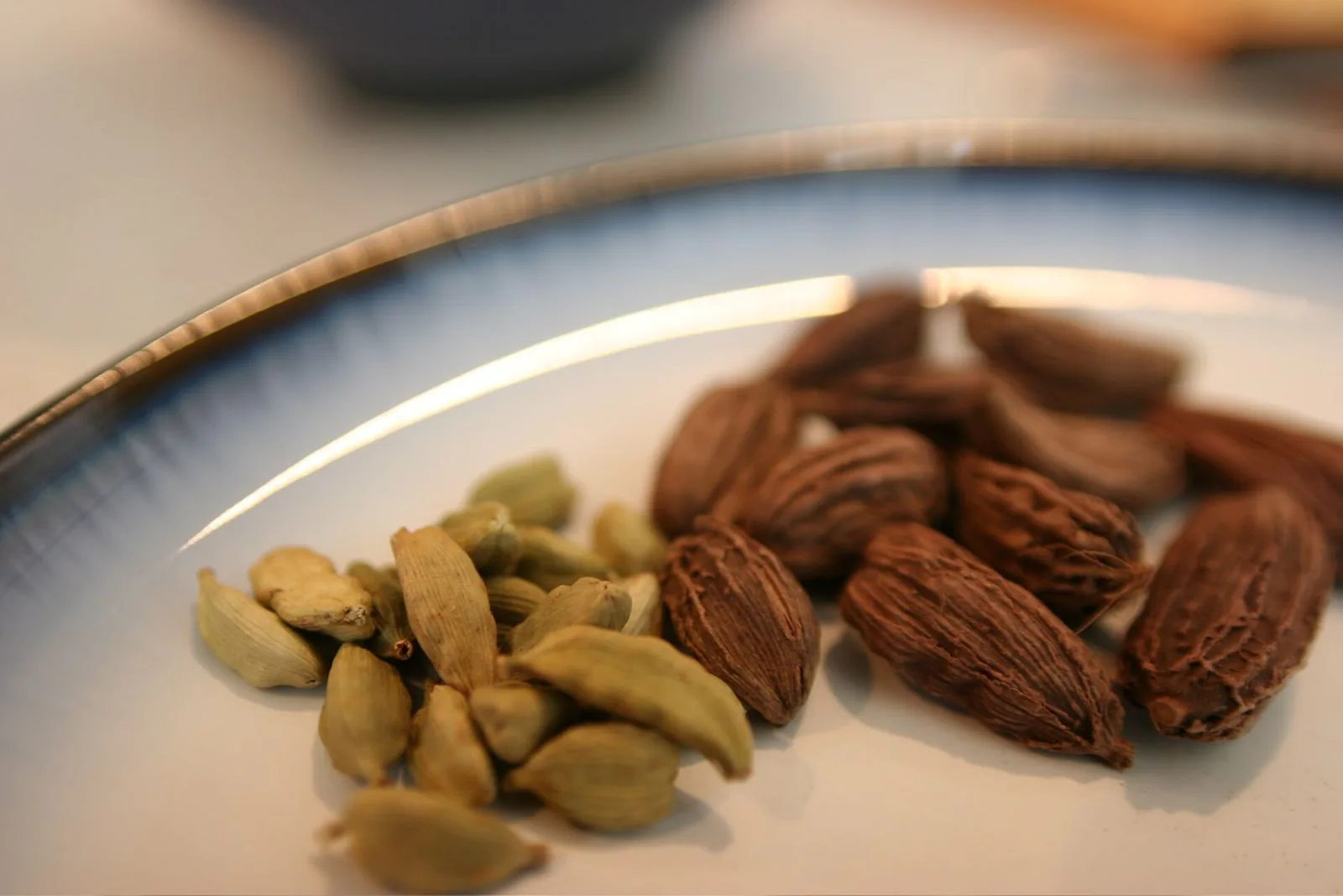
Which to use, and whether one can stand in for the other, is covered in our full comparison of black and green cardamom.
A grower's note: green cardamom's cousin in Nepal
We grow black cardamom, green cardamom's close relative in the ginger family, in Sankhuwasabha in eastern Nepal, at 1,100 to 1,500 metres. The two plants have more in common than their pods suggest.
Both are shade plants. Both want moisture, shelter and damp ground under taller trees. And both carry their pods low: not on the tall leafy stems you see first, but on short stalks at the base of the plant, close to the soil. On our farm the black pods sit in tight clusters at the foot of each clump, half hidden in fallen leaves, and every one is picked by hand.
The difference people taste comes as much from drying as from the plant. Green cardamom is dried gently, with low, even heat, to keep its colour and its bright, floral aroma. We dry black cardamom over a wood fire, which darkens the husk and gives it its smoke. You can read how our pods are grown and dried in our complete guide to black cardamom.
Knowing that work from the field explains why green cardamom costs what it does. Its pods ripen a few at a time, so they are picked pod by pod in several rounds, then dried with care, and demand for them runs from India to the Gulf to Scandinavia.
How to store green cardamom
Keep green cardamom as whole pods, in an airtight jar, somewhere dark and cool. Stored like that, pods hold their flavour for a year or more; ground cardamom fades within months.
Keep the jar away from the hob and out of sunlight, and out of the fridge, where condensation gets in each time it comes out. Buy in amounts you will use within the year rather than in bulk.
To check a jar, look first, then crack one pod. Pods that have faded to pale or yellowish, and smell weak or musty when cracked, are past their best. Storage for whole pods and for ground cardamom is covered in more detail on their own pages.
Frequently asked questions
What is green cardamom?
Green cardamom is the dried seed pod of Elettaria cardamomum, a ginger-family plant native to southern India. The small, pale green pods hold dark, sticky seeds with a sweet, floral, citrusy flavour and a cool eucalyptus note. It is also called true cardamom, small cardamom, choti elaichi or hari elaichi, and it is the cardamom most recipes mean.
What is green cardamom used for?
Green cardamom flavours chai, coffee and Arabic coffee, rice dishes such as biryani, milk puddings such as kheer, Indian sweets, and baking, from Nordic cardamom buns to cakes and cookies. Whole or cracked pods suit anything that simmers; freshly ground seeds suit baking and desserts. It is used in both sweet and savoury cooking.
Is green cardamom the same as cardamom?
Usually, yes. When a recipe in English just says cardamom, it means green cardamom. But the word also covers other plants, most importantly black cardamom, which is a different species with a smoky flavour, and several others sold in Asia and Africa. If a recipe means black cardamom, it will normally say so.
Why is green cardamom green?
Because of how it is harvested and dried. The pods are picked by hand just before they are fully ripe, then dried slowly at moderate heat, which holds on to their green colour. Sun-drying, over-drying and age all turn the pods pale or brown. Black cardamom is a different plant, dried over a wood fire, which is why it is dark.
What is the difference between green and black cardamom?
They are different plants. Green cardamom is small, smooth and pale green, with a sweet, floral flavour for chai, coffee and baking. Black cardamom is larger, dark and ridged, dried over wood fires, with a smoky, camphor-like flavour for savoury dishes. Our side-by-side guide to black cardamom versus green cardamom covers the details.
Where does green cardamom come from?
Green cardamom is native to the forests of southern India. Today most of it comes from Guatemala and India, with smaller crops in Sri Lanka, Tanzania and Papua New Guinea. In India it is grown mainly in Kerala, Karnataka and Tamil Nadu. It needs warmth, shade, high humidity and plenty of rain.
What does green cardamom taste like?
Sweet, floral and citrusy, with a cool, eucalyptus-like note and a clean finish. It is strong and aromatic rather than hot. The bright top notes fade with age and long cooking. Our guide to what cardamom tastes and smells like explains each note and the compounds behind it.
Can you eat green cardamom pods?
Yes. The husk is thin and edible, and many spice blends grind the whole pod. A softened pod in rice or curry is harmless to eat, just fibrous and very strong, so most people push whole pods aside. Our guide to cardamom pods covers how to crack them and how many to use.
Is white cardamom the same as green cardamom?
Often, yes. In Western shops, white cardamom is usually green cardamom that has been bleached pale, for cakes and sweets where colour matters, and it tastes milder. In Thai and some other Asian cooking, white cardamom can mean a different plant with naturally pale pods. Check the botanical name on the packet.
Why is green cardamom so expensive?
Because it takes a lot of hand work. The pods ripen a few at a time, so plantations are picked by hand in several rounds, pod by pod, and then dried slowly and carefully to keep the colour. Yields are small for the land and labour involved, and demand is high from India to the Gulf to Scandinavia.
Sources
- Royal Botanic Gardens, Kew, Plants of the World Online: Elettaria cardamomum
- North Carolina Extension Gardener Plant Toolbox: Elettaria cardamomum
- Food and Agriculture Organization of the United Nations: FAOSTAT crops and livestock products