This page is about one thing: what cardamom actually tastes and smells like, and why. If you want the basics first, the plants, the pods and where they grow, start with our guide to what cardamom is.
What does green cardamom taste like?
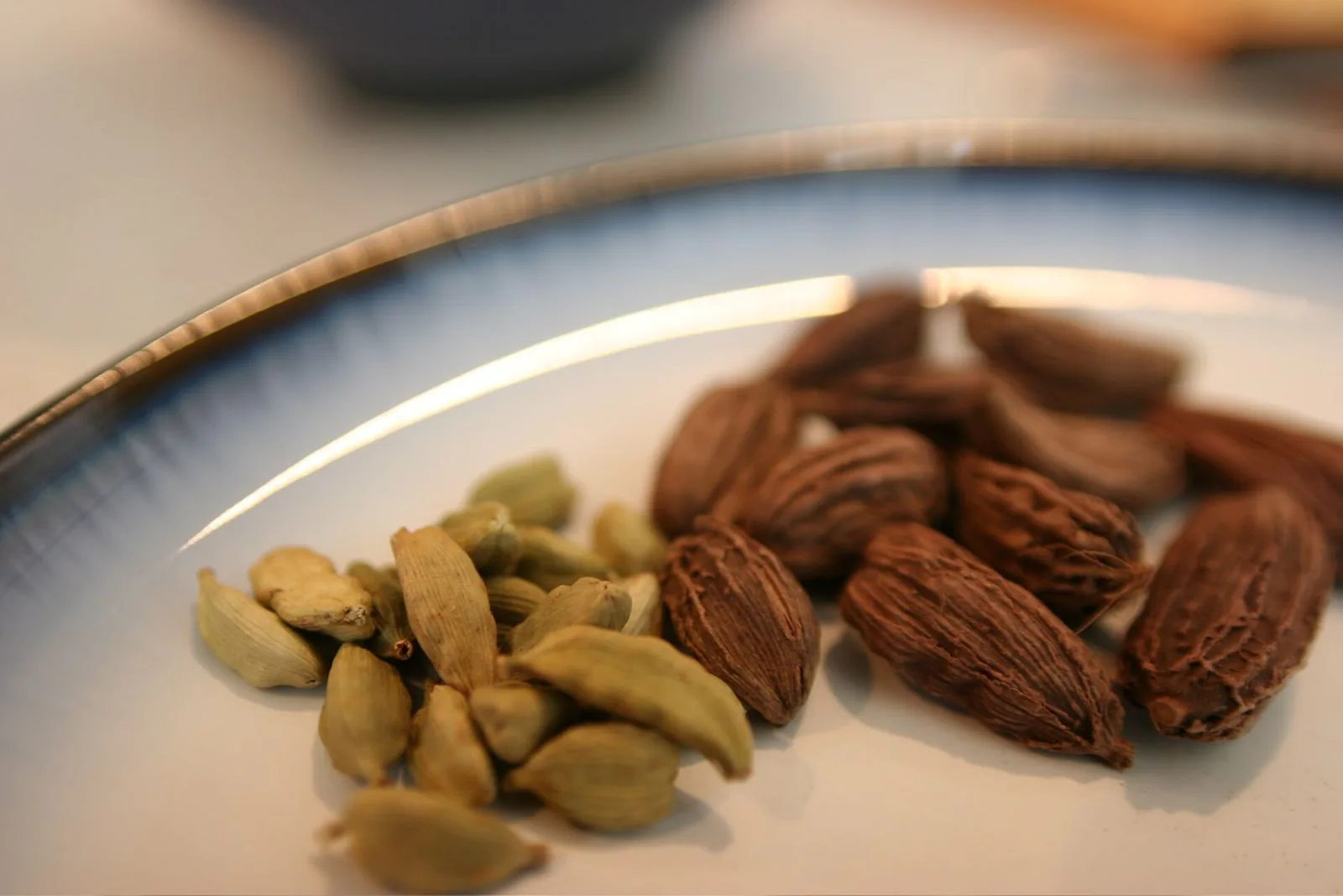
Green cardamom tastes sweet, floral and citrusy, with a cool eucalyptus lift and a clean finish. It is the cardamom most recipes mean, and the cardamom taste most people know from chai, Nordic buns and Arabic coffee.
The first thing you notice is perfume: something between lemon peel, lime zest and flowers. That brightness sits at the front of the mouth and fades quickly, which is why cooks call green cardamom a top note. Behind it comes a faint resinous warmth, and a gentle sweetness even when there is no sugar in the dish.
The finish is cool and clean, like a breath after eucalyptus. That cooling note is what separates cardamom from the other sweet baking spices. Cinnamon and nutmeg are warm all the way through; cardamom starts warm and ends fresh.
Used well, green cardamom lifts a dish rather than announcing itself. A pinch in a cake batter makes it taste brighter and more fragrant without anyone naming the spice. Used heavily, the cooling note takes over and the taste turns medicinal, which is covered below.
What does black cardamom taste like?
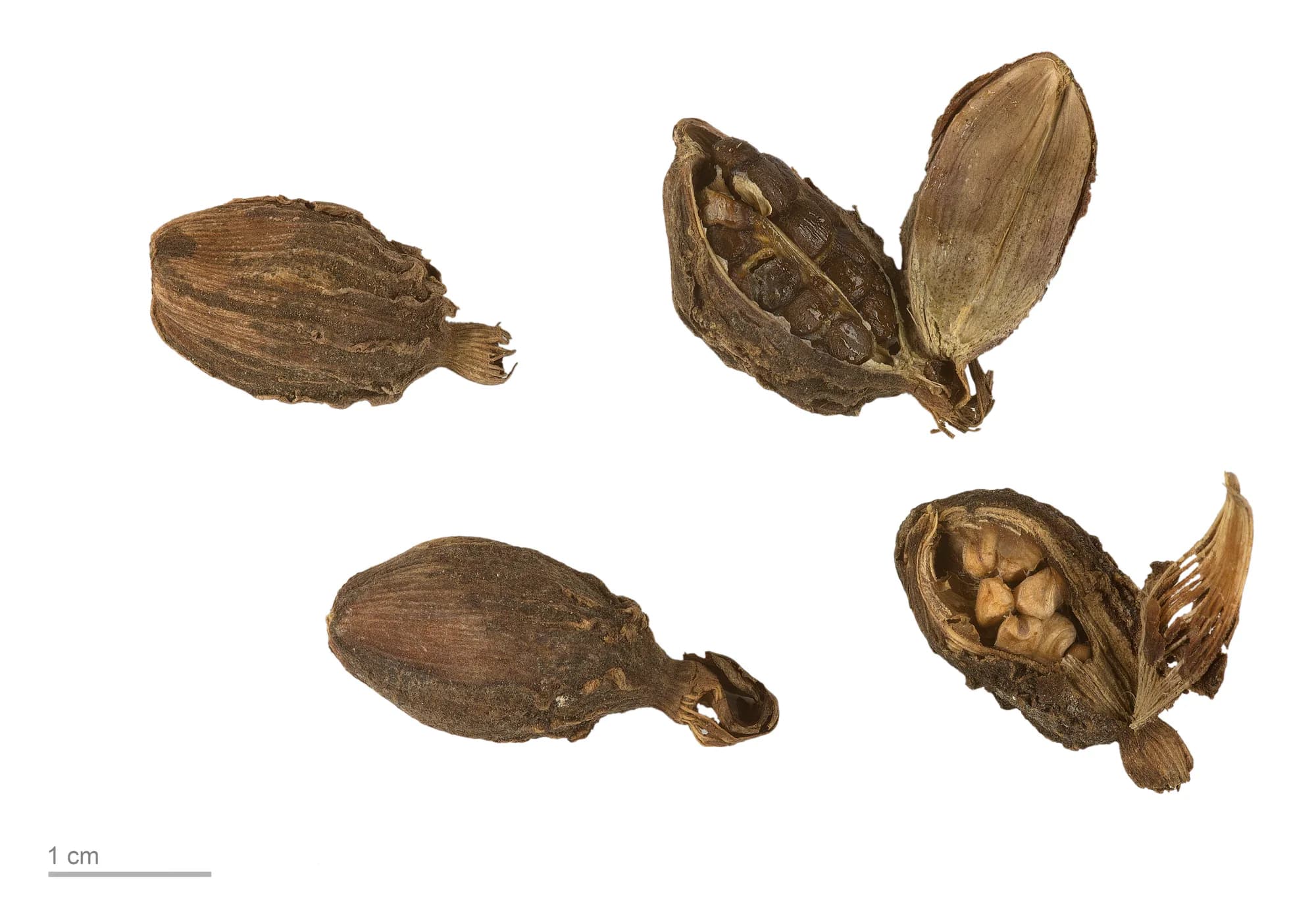
Black cardamom tastes of woodsmoke first, then camphor, cool menthol and pine resin, with a savoury depth underneath. Where green cardamom is a top note, black cardamom is a base note.
The smoke is not part of the plant. It comes from drying the fresh pods over a wood fire in a traditional kiln called a bhatti. Pods dried with indirect heat keep the camphor and resin but carry far less smoke, which is the difference we set out in bhatti-dried versus machine-dried black cardamom.
Under the smoke, the cooling note is stronger than in green cardamom, because 1,8-cineole makes up an even larger share of black cardamom's oil. That is where the camphor and menthol come from. In a slow-cooked curry or pot of rice, these notes blend into a deep, savoury warmth rather than a distinct aroma.
For how black cardamom is grown, cured and cooked, see our complete guide to black cardamom.
The tasting notes, and where they come from
Each part of cardamom's flavour can be traced to a group of aroma compounds in the oil around its seeds. The table below matches each note to its source.
| Note | Green cardamom | Black cardamom | Where it comes from |
|---|---|---|---|
| Floral | Strong, perfumed | Faint | Alpha-terpinyl acetate and linalool, both far richer in green |
| Citrus | Clear lemon and lime peel | In the background | Limonene and related compounds in green cardamom's oil |
| Eucalyptus, cooling | Bright, on the finish | Strong | 1,8-cineole (eucalyptol), in both |
| Sweet | Noticeable, rounded | Very little | Alpha-terpinyl acetate, a sweet, floral-herbal compound |
| Camphor, menthol | Light | Pronounced | 1,8-cineole, which dominates black cardamom's oil |
| Smoke | None | Strong in bhatti-dried pods | Wood-fire drying in the bhatti, not the plant |
| Resin, pine | A faint warmth | Clear | Alpha-terpineol and the pinenes, prominent in black |
| Savoury | None | A distinct base note | Not one compound: smoke, resin and camphor together, which read as savoury in fat and meat |
The green cardamom figures come from a 2021 study of 22 cardamom samples from southern India, the black cardamom figures from an analysis of black cardamom oils from Nepal.
What does cardamom smell like?
Green cardamom smells perfumed and fresh: lemon peel, eucalyptus and a floral sweetness, a little like fresh mint mixed with citrus. Black cardamom smells like a campfire with pine and camphor in it. Whole pods smell faint until cracked, because the aroma sits in oils around the seeds.
The cardamom smell is often stronger than its taste, and the reason is in the pod. The aromatic oils are held in and around the seeds, sealed inside a husk. A whole pod in a jar gives off only a hint. Crack it and the oils meet the air at once, and the smell fills the room.
Green cardamom's smell leans floral and citrus, with the eucalyptus note underneath. Black cardamom's leans the other way: smoke first, then camphor and pine, with very little that reads as floral.
Smell also tells you how fresh a pod is. A good pod, cracked, smells strong straight away. A pod that smells of very little has lost its oils to age, heat or light, and it will taste of very little too.
What does cardamom taste similar to?
Nothing tastes exactly like cardamom, but several spices share one part of it. The table below shows where each one overlaps and where it parts company.
| Spice | How it compares to cardamom |
|---|---|
| Cinnamon | Sweet and warm like cardamom, but woody, with no cooling or floral note |
| Ginger | A relative in the same plant family, sharing a citrus-warm quality. Ginger has real heat and none of the floral note |
| Clove | Just as strong, but sharper and numbing, without cardamom's brightness |
| Nutmeg | Sweet, warm and nutty, with no citrus or cooling note |
| Star anise | Tastes of liquorice, as fennel does. Cardamom does not |
| Eucalyptus and mint | Share the cooling note. Eucalyptus has the same compound, 1,8-cineole; mint's cool comes mainly from menthol |
| Lemon zest | Shares the citrus top note, but lacks the floral and cool |
| Juniper | Piney and resinous, closer to black cardamom than to green |
| Bay leaf | Also rich in 1,8-cineole, so it shares black cardamom's cool, savoury side, without the smoke |
The honest answer is that nothing tastes quite like it. Cardamom's combination of sweet, floral, citrus and cool is unusual, which is why recipes that leave it out taste different rather than simply milder.
Is cardamom spicy?
No. Cardamom is strong, but it is not hot. It contains no capsaicin, the compound that makes chillies burn.
What some people read as heat is actually the opposite: a cooling sensation from 1,8-cineole, the same compound that gives eucalyptus and bay their cool. It can feel intense in a large amount, but it never burns.
That makes cardamom a good choice for people who avoid spicy food. In normal cooking amounts it adds aroma, not heat, which is why it appears in rice puddings, milky drinks and children's bakes across South Asia and Scandinavia.
Why does cardamom sometimes taste soapy or medicinal?
Usually because of how it was used, not because the cardamom is bad. The same compounds that make it taste fresh in a small amount taste soapy or medicinal in a large one. Here are the common causes, and the fix for each.
- Too much. Cardamom is potent, and its cooling note turns medicinal when it dominates. Fix: start with less than the recipe says, then add more.
- A seed chewed raw. Biting a whole seed releases its oils all at once, a full hit of 1,8-cineole. Fix: crack pods and let them infuse, or grind the seeds finely so the flavour spreads.
- Black cardamom in something sweet. Camphor and smoke clash with sugar and cream, and the result tastes like cough medicine. Fix: use green cardamom for anything sweet.
- Old ground cardamom. The bright citrus and floral notes fade first, leaving the harsher ones behind. Fix: buy whole pods and grind the seeds as you need them.
- Personal sensitivity. Some people simply find cardamom soapy, however it is used. Fix: pair it with orange or coffee, which soften the cooling note, or leave it out.
How cooking changes the taste
How you use cardamom changes its taste as much as which cardamom you buy. Heat, fat and time each pull out different notes. How to crack and measure pods is covered in our guide to cardamom pods.
| Form or method | What happens to the flavour | Best for |
|---|---|---|
| Whole pod, simmered | Slow, gentle release; mellow and rounded | Rice, stews, stocks |
| Cracked pod | Faster and fuller, as the seeds are exposed | Curries, tea, warm milk |
| Seeds, crushed fresh | Brightest; citrus and floral notes at their most vivid | Baking, desserts, coffee |
| Ground powder | Even and convenient, but flatter as it ages | Baking, spice blends |
| Toasted dry | Deeper and nuttier; some brightness lost | Spice blends, garam masala |
| Bloomed in hot oil or ghee | Aroma carried through the whole dish; black cardamom's smoke comes forward | Curries, dal, biryani |
| Steeped in milk | Soft, round and sweet; fat carries the floral notes | Kheer, chai, custards |
| Baked | Warm and rounded; the cool edge softens | Buns, cakes, cookies |
Why fresh-ground tastes stronger
The flavour lives in volatile oils, which start escaping the moment a seed is broken. Seeds ground just before use still hold them all. Shop-bought powder has been losing them since the day it was milled, and the delicate citrus and floral notes go first. How to grind your own is in our guide to ground cardamom.
Why it fades in long cooking
The same volatile oils evaporate with heat and time, so green cardamom's top notes fade in a long simmer. Add it towards the end, or bloom whole pods at the start and accept a softer result. Black cardamom copes better, because its resin and smoke are heavier and hold on through hours of cooking.
Green, black, white and tsaoko: how they compare
Four pods are commonly sold as cardamom, and each tastes different.
| Type | Taste in a few words | Use |
|---|---|---|
| Green | Sweet, floral, citrus, cool | Sweets, drinks, baking |
| Black | Smoky, camphor, pine resin | Slow-cooked savoury dishes |
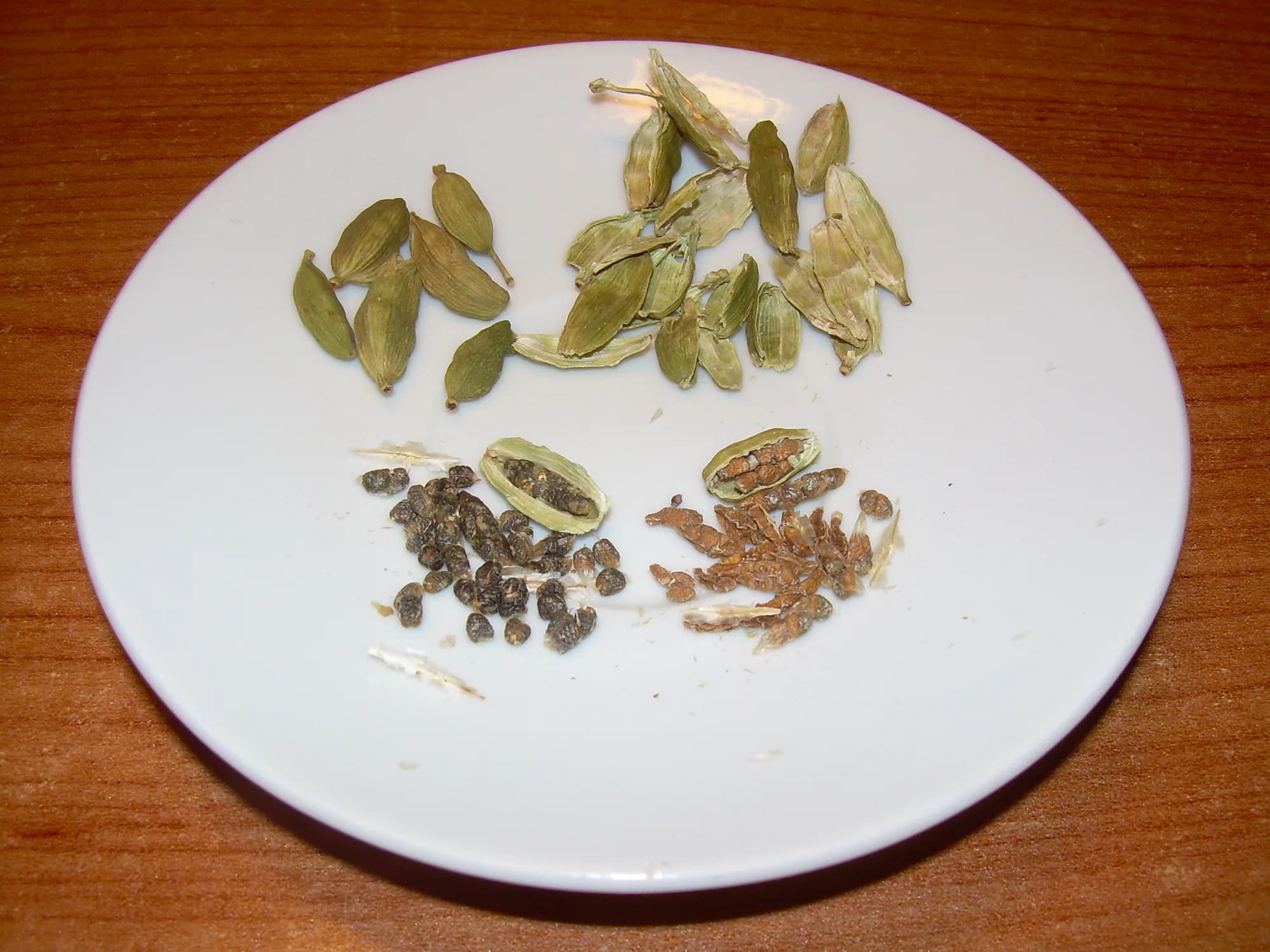
| White | Bleached green: a milder green. Siam cardamom: mild, camphor-like | Pale bakes; Thai cooking |
| Tsaoko | Musky, medicinal, dried citrus peel | Pho broth, Chinese braises |
White cardamom means two different things, which explains its two descriptions. The full types table, with botanical names and origins, is on our guide to what cardamom is, and tsaoko is set against black cardamom in black cardamom versus tsaoko.
A grower's note: what fresh cardamom smells like
We grow black cardamom in Sankhuwasabha, in eastern Nepal, and the spice in your jar smells nothing like the pod on the plant.
A freshly cut black cardamom pod at harvest smells fruity, green and sharply resinous. There is no smoke in it at all. The pods are reddish and plump, around 80% water, and they soften quickly, so they go from the field to the drying house the same day.
The smoky smell arrives only in the bhatti, where the pods dry on racks above a wood fire. Over the drying, the fruity green smell gives way to smoke, camphor and resin. The same pods dried with indirect heat smell of camphor and resin, with far less smoke, which shows how much of black cardamom's character is made in the drying rather than grown.
A well-dried pod, cracked open, should smell strongly and straight away of smoke, camphor and pine resin. The seeds inside should be dark, glossy and slightly sticky. If a cracked pod smells of little, or of something musty, it was either dried badly or has been stored too long.
How to taste cardamom properly
This takes two minutes and teaches more than any description. It also tells you whether your jar is still good.
- Smell a whole pod. You will notice only a faint scent, because the husk keeps the oils in.
- Crack it and smell again. The aroma jumps: citrus and flowers from green, smoke and camphor from black.
- Chew one seed. A sharp, cooling rush, close to eucalyptus, and slightly numbing. This is 1,8-cineole at full strength.
- Taste a pinch of ground cardamom. Softer and flatter than the fresh seed, with the floral notes muted.
- Steep a cracked pod in hot water for five minutes. The water tastes gently sweet and fragrant, the way cardamom tastes in a finished dish.
Three signs a jar has gone stale: a cracked pod smells of almost nothing; the seeds are pale, dry and loose rather than dark and sticky; and ground cardamom tastes dusty rather than bright.
What goes with cardamom?
Green cardamom goes with citrus, coffee, chocolate, nuts and warm spices; black cardamom goes with meat, onions, rice and lentils. These are the cardamom flavour pairings that turn up again and again across cuisines.
| Cardamom | Pairs well with | Example |
|---|---|---|
| Green | Orange, lemon | Orange cake, lemon biscuits |
| Green | Coffee, chocolate | Arabic coffee, chocolate truffles |
| Green | Rose, pistachio, saffron | Kulfi, kheer |
| Green | Vanilla, ginger, cinnamon | Cardamom buns, masala chai |
| Green | Apple, pear | Poached pears, apple crumble |
| Black | Lamb, goat, chicken | Biryani, meat curries |
| Black | Onion, cumin, clove, bay leaf, cinnamon | Garam masala, the tempering for dal |
| Black | Rice, lentils | Pulao, dal |
For the savoury side in practice, see how to use black cardamom in biryani. For a smoky, warming cup, here is how to brew black cardamom tea.
Frequently asked questions
What does cardamom taste like?
Green cardamom, the common kind, tastes sweet, floral and citrusy, with a cool eucalyptus note and a clean finish. Black cardamom tastes of woodsmoke, camphor and pine resin, with a cooling menthol edge. Neither is hot. Cardamom is strong rather than spicy, so a small amount flavours a whole dish.
What does cardamom smell like?
Green cardamom smells perfumed and fresh, of lemon peel, eucalyptus and flowers, a little like fresh mint mixed with citrus. Black cardamom smells like a campfire, with pine and camphor behind the smoke. Whole pods smell faint until you crack them, because the aroma is held in oils around the seeds.
What flavor does cardamom add to food?
Green cardamom adds a bright, sweet, floral and citrusy lift with a cool edge, which is why it suits cakes, buns, chai and coffee. Black cardamom adds a smoky, resinous depth that sits underneath meat, rice and lentils. Both are strong, so they are used in small amounts to shape a dish rather than dominate it.
What does black cardamom taste like?
Black cardamom tastes of woodsmoke first, then camphor, cool menthol and pine resin, with a savoury depth. The smoke comes from drying the pods over a wood fire, not from the plant itself. It is used whole in slow-cooked savoury dishes such as biryani, curries and dal, and it does not suit desserts.
Is cardamom spicy?
No. Cardamom is not hot: it contains no capsaicin, the compound that makes chillies burn. What people notice instead is a cooling sensation from 1,8-cineole, the same compound that gives eucalyptus its cool. Cardamom is strong and aromatic rather than fiery, so in normal cooking amounts it suits people who avoid spicy food.
Does cardamom taste like cinnamon?
Not really, though both are sweet, warm baking spices and they are often used together. Cinnamon is woody and sweet with no cooling note. Green cardamom is brighter, more floral and citrusy, with a eucalyptus freshness that cinnamon lacks. Swapping one for the other changes a recipe noticeably, so treat them as partners rather than substitutes.
Does cardamom taste like licorice?
No. The liquorice taste of star anise, anise and fennel comes from a compound called anethole, which is not a significant part of cardamom's aroma. Cardamom's character comes from 1,8-cineole and related compounds instead, which make it cool, floral and citrusy. If a spice blend tastes of liquorice, something other than the cardamom is responsible.
Why does cardamom taste like soap?
Usually because there is too much of it, or because a whole seed was bitten into and released its oils all at once. Old ground cardamom can also taste soapy or medicinal, because its bright top notes fade first. Some people simply perceive it as soapy. Using less, cracking pods rather than chewing seeds, and grinding fresh usually help.
What does cardamom taste good with?
Green cardamom goes well with orange, lemon, coffee, chocolate, rose, pistachio, saffron, vanilla, ginger, cinnamon, apples and pears, which is why it turns up in buns, cakes, chai and Arabic coffee. Black cardamom goes with lamb, goat, chicken, onion, cumin, clove, bay leaf, rice and lentils, which is why it belongs in biryani, curries and dal.
How can I tell if cardamom is fresh?
Crack a pod and smell it: fresh cardamom releases a strong aroma straight away. The seeds inside should be dark and slightly sticky, not pale, dry and loose. Green pods should be an even green rather than yellowed, and black pods dark brown rather than dull and dusty. Ground cardamom that smells faint has gone stale.
Sources
- Frontiers in Sustainable Food Systems (2021): Essential oil profile diversity in cardamom accessions from southern India
- Satyal, Dosoky, Kincer and Setzer, Natural Product Communications (2012): Chemical compositions and biological activities of Amomum subulatum essential oils from Nepal
- Royal Botanic Gardens, Kew, Plants of the World Online: Elettaria cardamomum