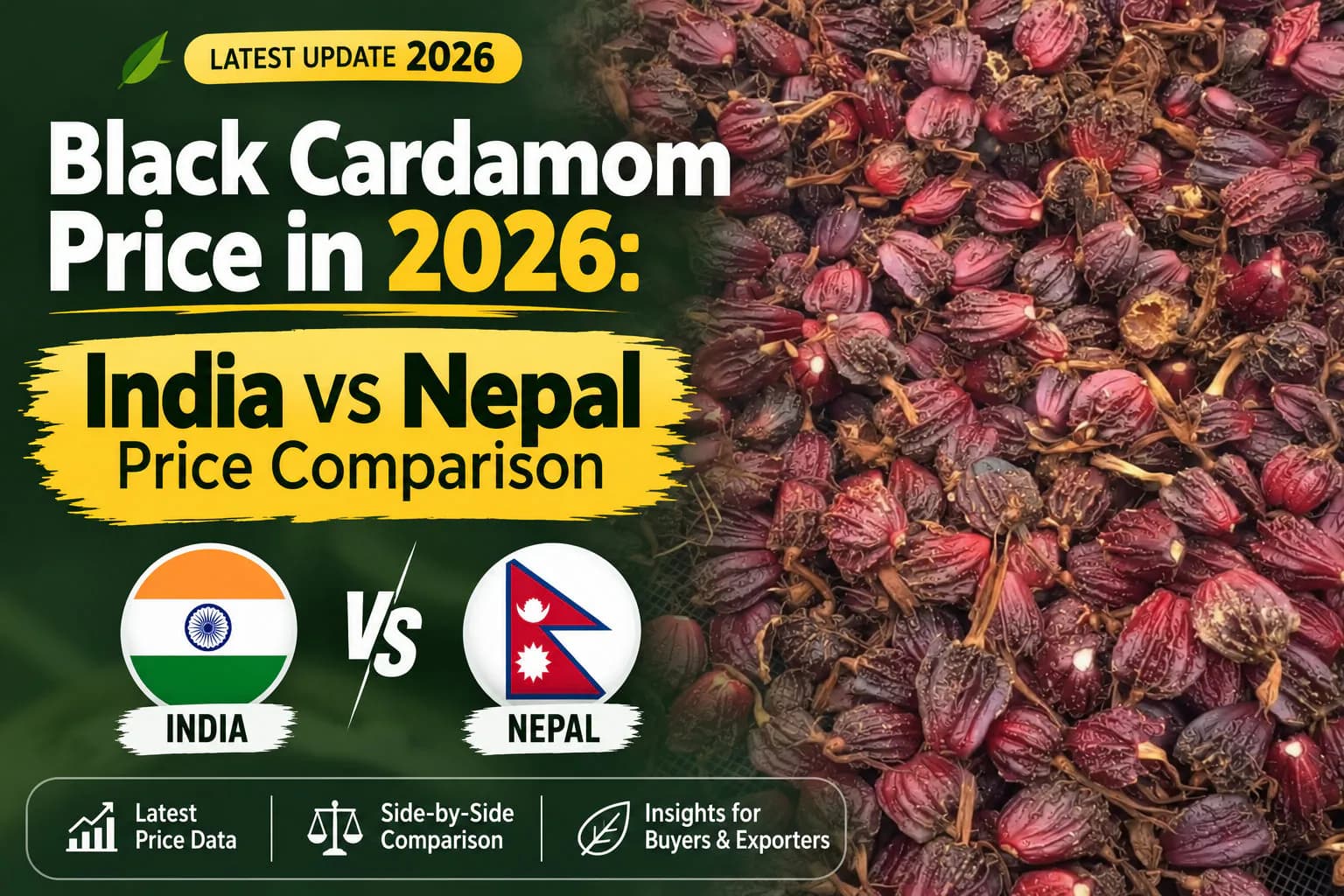
If you’ve been quoted a black cardamom price from an Indian trader and a Nepal exporter and they don’t match, you’re not being misled. You’re looking at two different points in the same supply chain, and this season the gap has moved more than usual.
This guide lines the two up side by side, in NPR, INR, and USD, so you can tell which one you’re actually paying for.
We export directly out of Sankhuwasabha, Nepal, and the Nepal figures below come straight from growers we buy from, not from a rate card. The India figures are cross-checked against the Spices Board of India’s public auction data.
What Actually Moves the Price
Black cardamom (Amomum subulatum) doesn’t trade on a single ticker the way rice or wheat might. It’s a shade-grown Himalayan spice, and a handful of things push the number up or down on any given quote. This season’s jump is a good example of several of them hitting at once.
Pod size is normally the biggest lever. Large, heavy pods (the Badadana grade in Indian auction listings, roughly our Bold grade) sell at a real premium over smaller pods.
Moisture content is the one buyers skip and shouldn’t. Pods dried above 10–11% moisture weigh more on the scale but hold less actual spice, and they’re the ones that mould in a container.
Supply tightness is what’s driving this season specifically. When growers are getting nearly double last year’s rate, it usually means less crop is reaching the market, not that demand suddenly spiked.
Black Cardamom Price in Nepal (2026)
Nepal grows more black cardamom than any other country, mostly across the hill districts of Sankhuwasabha, Taplejung, and Panchthar, where the plant grows under forest canopy between 800 and 2,200 metres.
| Level | Current (Aug 2026, estimated*) | Last Season |
|---|---|---|
| Farmgate (Sankhuwasabha) | NPR ~2,375/kg (INR ~1,484/kg, USD ~15.57/kg) | NPR ~1,290/kg |
| FOB Kathmandu (export) | USD ~19.00–21.00/kg (NPR ~2,950–3,265/kg) | USD 13.00–19.00/kg |
| CIF Dubai (landed) | USD ~21.50–25.00/kg (NPR ~3,280–3,815/kg) | USD 16.50–23.00/kg |
The current-season farmgate figure is grower-reported: a mann (40kg) now fetching close to NPR 95,000, against roughly NPR 51,600 (NPR 1,290/kg) last season.
Nepal doesn’t have a centralised public auction board the way India does, so there’s no official rate to quote; this is what growers on the ground are actually being paid, and it will vary somewhat lot to lot and village to village.
The FOB and CIF figures are our own calculated estimate, not a confirmed live quote. We’ve built them up from this season’s farmgate rate plus the typical cost stack below, rather than simply scaling last season’s FOB by the same percentage the farmgate price moved.
That distinction matters: freight, documentation, and packaging costs don’t double just because the raw pod price does, so a straight proportional scale-up would overstate the real number. For a confirmed price against your grade and volume, visit black-cardamom-price-per-kg.
What Gets Added Between Farmgate and FOB
| Cost Component | Typical Range (NPR/kg) | Notes |
|---|---|---|
| Farmgate (raw, ungraded) | 2,375 | This season’s grower-reported rate |
| Processing & moisture-correction loss | ~7–10% of raw cost | Wet pods lose weight during final drying and grading |
| Local collection & transport to Kathmandu | 40–60 | Village to processing/export point |
| Grading, sorting & export packaging | 60–90 | Sorting into grade bands, jute sacks or export cartons |
| Lab testing & certification | 30–50 | Phytosanitary certificate, certificate of origin, moisture lab report |
| Exporter margin & handling | ~10–15% of subtotal | Overhead, working capital, shipment risk |
| Estimated FOB Kathmandu | ~2,950–3,265 | Roughly USD 19.00–21.00/kg at current rates |
Airfreight to Dubai typically adds a further USD 2.50–4.00/kg on top of FOB. This piece stays fairly fixed regardless of how much the raw spice price moves, which is exactly why CIF doesn’t rise at the same rate as farmgate did this season.
Black Cardamom Price in India (2026)
Almost all of India’s black cardamom comes from Sikkim. Siliguri, just across the border in West Bengal, is where most of it gets traded: a hub, not a growing area.
Here’s what the Spices Board of India’s daily large-cardamom price list showed on 30 July 2026:
| Market | Grade | INR/kg | NPR/kg | USD/kg |
|---|---|---|---|---|
| Singtam, Sikkim | Badadana (large) | 1,450 | 2,320 | 15.22 |
| Singtam, Sikkim | Chotadana (small) | 1,350 | 2,160 | 14.17 |
| Gangtok, Sikkim | Badadana (large) | 1,500 | 2,400 | 15.74 |
| Gangtok, Sikkim | Chotadana (small) | 1,350 | 2,160 | 14.17 |
| Siliguri, WB | Badadana (large) | 1,825 | 2,920 | 19.15 |
| Siliguri, WB | Chotadana (small) | 1,650 | 2,640 | 17.31 |
Notice Siliguri prices above both Sikkim markets. That’s not a quality gap. It’s trading margin, the cost of the pods changing hands one more time before reaching a buyer. Worth watching: Nepal’s current farmgate price of roughly NPR 2,375/kg now sits almost level with the Singtam and Gangtok auction rates, a gap that’s normally much wider.
Regional Prices Across Northeast India
Assam, Guwahati, Nagaland, and Arunachal Pradesh show up constantly in black cardamom price searches, but none of them grow much cardamom. They’re trading and retail markets, and nearly everything moving through them started in Sikkim or Nepal.
| Region | Role | What Drives the Price There |
|---|---|---|
| Sikkim | Primary growing region | Sets the base auction price |
| Guwahati, Assam | Regional trading hub | Tracks Siliguri, plus local margin |
| Nagaland | Consumption market | Retail-driven, above wholesale |
| Arunachal Pradesh | Small growing pockets + consumption | Localised, less standardised |
If a quote comes from one of these markets, ask what level of the chain it reflects. Farmgate, auction, and retail prices for the same pods can differ by 40% or more even in a normal season.
India vs Nepal: The Real Comparison
With Nepal’s farmgate price rising sharply, the usual India-vs-Nepal gap has compressed. That doesn’t change why buyers choose one over the other. It changes how big the savings is right now.
| Factor | Nepal (Direct Export) | India (Sikkim/Siliguri Market) |
|---|---|---|
| Typical buyer | International importers | Domestic traders, mills |
| Traceability | Single-origin, traceable to district | Often mixed-origin by the time it reaches Siliguri |
| Documentation | Phytosanitary certificate + certificate of origin per shipment | Varies by trader |
| Price transparency | Grower-quoted, updated per season | Daily public auction data |
Here’s the part that still surprises first-time buyers: a good share of what trades through Siliguri is Nepal-grown cardamom that already crossed the border once, picking up a margin (and losing its origin identity) on the way. Buying direct from Nepal skips that layer, even in a season where the farmgate price itself has climbed.
Why the Price Jumped This Season
Growers we spoke with point to a tighter harvest, and it lines up with a pattern we’ve seen building for a couple of seasons. Viral crop disease, chirke and furkey, has been cutting yields in parts of Sankhuwasabha and Sikkim alike, which squeezes supply on both sides of the border at once.
Currency has added a second push for anyone buying in USD. The Nepalese rupee weakened against the dollar over the past year, which, a little counterintuitively, can make Nepal’s export pricing look more competitive in USD terms even as the local NPR price climbs.
Whether this eases once the new harvest clears in November, as it usually does, depends on how this season’s crop actually comes in. We’d rather say that plainly than promise a number we can’t back up yet.
A Quick Currency Note
Nepal’s growers and traders think in NPR; export quotes are usually given in USD; India’s auction system runs in INR. As of 18 August 2026, the Nepal Rastra Bank puts 1 USD at roughly NPR 152.5, and since the Nepalese rupee is pegged to the Indian rupee at a fixed 1.6:1 ratio, that also works out to roughly 1 USD ≈ INR 95. These move daily, so check the current rate before finalising any cross-border comparison, since a few rupees of movement matters at real volume.
Wholesale vs Retail
Everything above is farmgate, wholesale, or auction pricing, not what a home cook or small retailer pays at the counter. By the time black cardamom is packaged and shelved, retail price typically runs 1.5–2.5x the wholesale rate, and this season that gap will likely widen further given how much the raw price has moved.
Conclusion
Here’s what all of this comes down to: black cardamom price in 2026 depends far more on which point in the supply chain you’re looking at than on which side of the border it’s from.
India’s Sikkim and Siliguri markets currently sit in the INR 1,300–1,825/kg range on public auction data. Nepal’s farmgate has moved sharply this season to around NPR 2,375/kg, and our best estimate for export-ready pricing works out to roughly USD 19–21/kg FOB, USD 21.50–25/kg CIF Dubai.
The gap between the two markets, which used to be wide, has narrowed this year, mostly because Nepal’s growers are being paid noticeably more than they were twelve months ago.
If you’re buying at volume, the number that should matter most isn’t a headline “black cardamom price” you found in a search result. It’s a current, grade-specific quote tied to a real shipment date, because this crop’s price moves fast enough that anything older than a few weeks can already be stale. That’s true whether you’re sourcing through an Indian trader or direct from a Nepal exporter.
Frequently Asked Questions
Is black cardamom the same thing as large cardamom in Indian markets?
Yes. Black cardamom, large cardamom, and badi elaichi all mean the same plant, Amomum subulatum. It's unrelated to small green cardamom (Elettaria cardamomum), which comes mainly from Kerala and trades on a completely different, much pricier market.
Which country actually grows more black cardamom?
Sikkim produces roughly 90% of India's black cardamom. Nepal's crop comes mainly from Sankhuwasabha, Taplejung, and Panchthar. Between the two, they supply most of the world's black cardamom.
Does the exchange rate genuinely change what I pay?
For export-grade purchases, yes. Nepal quotes in USD, India in INR, so a shift in either currency moves your landed cost even when the underlying spice price hasn't changed at all.
Can I buy straight from a grower instead of a trader?
In Nepal, yes. Several exporters, including us, work directly with grower clusters in Sankhuwasabha and can document single-origin sourcing. In India, Sikkim's Spices Board auction offers some direct access, though most buyers still go through Siliguri traders.
Why did the Nepal farmgate price nearly double this season?
Growers point mainly to a tighter harvest from viral crop disease affecting yields, alongside currency movement that's shifted how the price looks to USD buyers. It's a real, reported jump rather than a data error, worth confirming directly if you're planning a purchase.