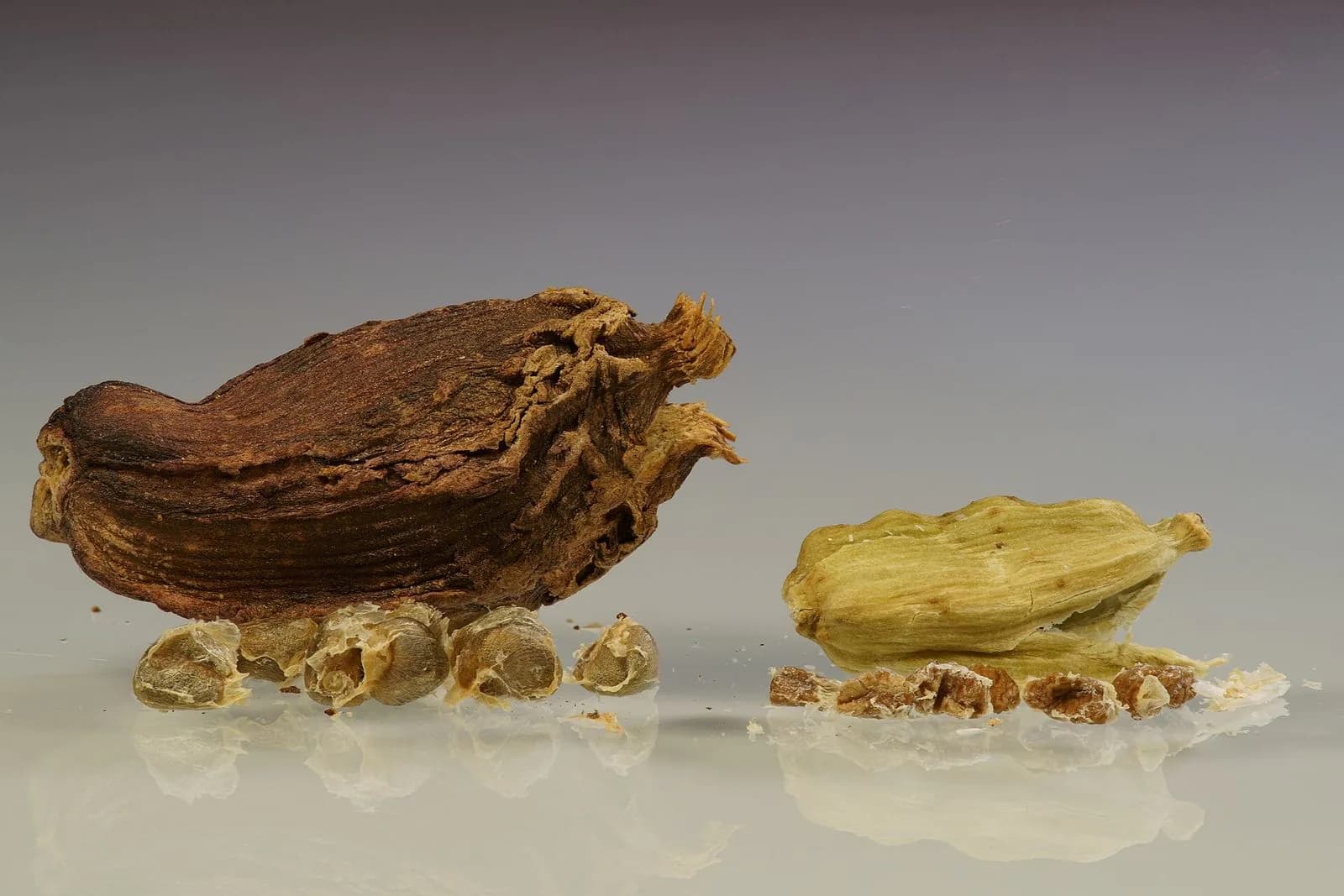
Black cardamom and green cardamom share a name, a family, and a shelf in the spice aisle, and that is where the similarities end. They are different species, grown a continent apart in different climates, cured differently, priced differently, and used in almost opposite ways. Confusing the two ruins recipes in the kitchen and ruins margins in an import order. Here is the full side-by-side.
The two cardamoms at a glance
If you only read one section, read this table. It settles most black vs green cardamom questions in one screen, and everything below it is the detail behind each row.
| Attribute | Black cardamom | Green cardamom |
|---|---|---|
| Botanical name | Amomum subulatum | Elettaria cardamomum |
| Also known as | Large cardamom, badi elaichi, kali elaichi, hill cardamom | True cardamom, small cardamom, choti elaichi, hal |
| Main origins | Nepal, Sikkim (India), Bhutan | Kerala & Karnataka (India), Guatemala, Sri Lanka |
| Pod | 18–28mm, dark brown to black, ridged, tough husk | 10–15mm, pale green, smooth, papery husk |
| Flavour | Smoky, resinous, camphor and menthol, savoury depth | Sweet, floral, citrus-eucalyptus, bright |
| Typical use | Biryani, curries, stocks, braises, spice blends (garam masala) | Desserts, chai, gahwa coffee, baking, garnish |
| Indicative price | ~USD 13–19/kg FOB | ~USD 45–90/kg, grade dependent |
Two different plants entirely
The single most common misconception in enquiries we receive is that black cardamom is green cardamom that has been dried longer, roasted, or left to mature. It is not. The two are separate genera within the ginger family (Zingiberaceae), and you can verify both species in Kew's Plants of the World Online database. A third pod muddies this further: Lanxangia tsaoko, the Chinese spice also sold in English as black cardamom, which we set against ours in black cardamom versus tsaoko. Every other pod sold under the name is set out in our guide to what cardamom is.
Green cardamom (Elettaria cardamomum) is native to the Western Ghats of southern India and is now grown at scale in Guatemala, today the world's largest producer, plus Kerala, Karnataka, Tamil Nadu, and Sri Lanka. The small pods are picked individually just before full ripeness and cured at low temperatures to preserve their green colour and volatile oils. Where it grows, how it is graded and how to cook with it are in a full guide to green cardamom.
Black cardamom (Amomum subulatum) is native to the eastern Himalayas and grows under forest shade at 1,100–1,500m in Nepal, Sikkim, and Bhutan. Nepal is the world's largest producer (production data is published in FAOSTAT), and our own pods come from a single growing cluster in Sankhuwasabha, in the Arun Valley. You can read about the origin on our about page.
Flavour and aroma
Both spices lean on the same core aroma compound (1,8-cineole, the eucalyptus note), but the supporting cast is completely different, and that is what makes them non-interchangeable.
- Green cardamom is bright and perfumed: floral, sweet, citrusy, with a cool menthol finish. It reads as a top note, the first thing you smell in a chai, a kulfi, or a cup of Gulf-style gahwa.
- Black cardamom is deep and grounding: smoky, resinous, faintly camphorous, with an almost meaty savouriness. It reads as a base note. You notice it as body and warmth in a slow-cooked dish rather than as a distinct aroma on top.
A useful shorthand for menu development and product formulation: green cardamom behaves like vanilla or citrus zest, an aromatic highlight. Black cardamom behaves like bay leaf, star anise, or smoked paprika, a structural background spice. Each note, and the compound behind it, is traced in our guide to what cardamom tastes like.
How each is used in the kitchen
Where green cardamom wins
- Sweets and baking: kheer, kulfi, Scandinavian cardamom buns, baklava, rice puddings.
- Hot drinks: masala chai, Turkish and Gulf coffee (gahwa), where it is often ground with the beans.
- Delicate savoury dishes: korma, pilaf finishes, spice-forward marinades where brightness matters.
Where black cardamom wins
- Biryani and pulao: whole pods simmered in the rice give the smoky backbone Gulf and South Asian palates expect. Dosage, timing, and grade choice are covered in how to use black cardamom in biryani.
- Curries, dal, and braises: added whole to hot oil at the start (tadka) and fished out or left in the pot.
- Stocks and broths: yakhni, nihari stock, and slow-simmered meat broths, where a single pod adds depth without sweetness.
- Spice blends: garam masala, ras el hanout variants, and commercial meat-masala formulations, where it is ground seeds-and-husk.
The grades matter differently, too. Because black cardamom pods are used whole and visible in biryani, pod size drives price. The Bold, Medium, and Fine bands are specified on our products and grades page. Spice mills grinding for blends buy Fine grade, because size is irrelevant once the pod is milled.
Can you substitute one for the other?
The honest answer: rarely, and never in sweets. Swapping black cardamom into a dessert or a chai is the most common (and most catastrophic) cardamom mistake, the smoke and camphor flatten everything else in the cup.
| You need | You have | Verdict |
|---|---|---|
| Green, for a dessert or drink | Black cardamom | Don't. Use ground coriander seed + a pinch of cinnamon instead, or omit. |
| Black, for a curry or biryani | Green cardamom | Workable in a pinch, use 2–3 green pods per black pod and add a bay leaf for depth. The smoky note will be missing. |
| Either, in a ground spice blend | The other one | Possible at reduced quantity, but re-taste the blend, the profile will shift noticeably. |
The two are separate species rather than grades of one, so they are not interchangeable by ratio. Both, and the other pods sold as “black cardamom”, are set out in the glossary. If you have run out of black cardamom mid-recipe, our guide to black cardamom substitutes ranks the closest swaps.
Price: why green costs more per kg
Green cardamom is one of the most expensive spices in the world, by most counts third after saffron and vanilla. Auction prices at the Indian spice exchanges routinely put good green grades at three to five times the per-kg price of black cardamom. The drivers are labour (individual pod-picking at precise ripeness), delicate curing, and relentless demand from the Gulf coffee and confectionery trade. You can cross-check declared trade values by HS code on ITC Trade Map.
Black cardamom's economics are different: bigger pods, hardier perennial plants, simpler kiln drying, and a savoury end-market that buys on grade and moisture rather than on colour. In 2026, Himalayan black cardamom trades at roughly USD 13–19/kg FOB Kathmandu depending on grade. We publish and maintain a full breakdown, farmgate to FOB to CIF Dubai, with a worked 500kg landed-cost example, in our companion guide, black cardamom price per kg in 2026.
Which should you buy?
For a home kitchen, the answer is simple: both, in small quantities, green for sweets and drinks, black for the curry pot.
For a commercial buyer, the decision is about your end product:
- Blenders and mills: black cardamom (Fine grade) gives the most flavour per dollar in savoury masala formulations.
- Restaurants, caterers, and biryani chains: Bold or Medium black cardamom, bought whole; presentation matters in the rice.
- Cafés, confectioners, and bakeries: green cardamom, which we do not export; buy it from a South Indian, Guatemalan, or Sri Lankan source.
- Wholesalers serving Gulf and South Asian retailusually both, from separate origins. For the black side, single-origin Nepali lots with lab-verified moisture and PAH results are the premium play; our shipping lanes and document pack are detailed on the export markets page.
Frequently asked questions
Is black cardamom the same as green cardamom?
No. They come from two different plants in the ginger family. Green cardamom (Elettaria cardamomum) is a small, sweet, floral pod grown mainly in India's Western Ghats, Guatemala, and Sri Lanka. Black cardamom (Amomum subulatum), also called large cardamom or badi elaichi, is a bigger, dark, ridged pod grown in the eastern Himalayas (Nepal, Sikkim, and Bhutan), with a smoky, resinous, camphor-like flavour.
Can I substitute black cardamom for green cardamom?
Not in most recipes. Green cardamom's sweet, floral notes suit desserts, coffee, chai, and delicate rice dishes; black cardamom's smoky depth would overwhelm them. In savoury slow-cooked dishes (biryani, curries, stocks, braises), the two can sometimes stand in for each other, but expect a very different result. Treat them as two separate spices, not grades of one.
Why is green cardamom more expensive than black cardamom?
Green cardamom is one of the world's costliest spices, often 3–5x the per-kg price of black cardamom, because it is harvested pod by pod at precise ripeness, cured gently to keep its colour and volatile oils, and demand from Gulf coffee (gahwa) and confectionery markets is intense. Black cardamom's larger pods, hardier plants, and simpler kiln-drying keep its cost per kg lower, which is exactly what makes it attractive for savoury bulk applications.
Which cardamom is used in biryani?
Traditionally both. Black cardamom goes in whole at the start to build a smoky, savoury base in the rice and masala, while green cardamom contributes its sweet aroma to the finishing layers and garnish. If a biryani recipe simply says "cardamom", the whole pods simmered in the rice are usually black cardamom.