| Fact | Detail |
|---|---|
| Botanical names | Elettaria cardamomum (green), Amomum subulatum (black) |
| Family | Zingiberaceae, the ginger family |
| Part used | The dried seed pods and the seeds inside them |
| Native to | Southern India (green), the eastern Himalayas (black) |
| Flavour | Green: sweet, floral, citrus. Black: smoky, camphor, resin |
| Main aroma compounds | 1,8-cineole (eucalyptol), the cooling note in both. In green cardamom, alpha-terpinyl acetate is usually present in even larger amounts |
| Forms | Whole pods, loose seeds, ground |
| Often called | The third most expensive spice by weight, after saffron and vanilla |
| Pronunciation | KAR-duh-mum |
| Also spelled | Cardamon, cardamum |
All cardamom guides
- What cardamom tastes like: the flavour and aroma of green and black cardamom, and what causes them.
- Cardamom pods: what the pod is, how to crack it and how many to use.
- Ground cardamom: how to use the powder and how much equals one pod.
- Green cardamom: the sweet, floral pod for chai, coffee and baking, and where it grows.
- Black cardamom: the smoky Himalayan pod for curries, rice and braises.
What is cardamom? The spice, the plant and the pod
Cardamom is a spice made from the dried seed pods of several related plants in the ginger family. The word covers the plant, the pod and the small dark seeds inside it, and in everyday Western cooking it almost always means green cardamom.
What is cardamom spice made from?
The plants are leafy perennials that grow from underground stems called rhizomes, the same way their relatives ginger and turmeric do. Their tall, reed-like shoots carry only leaves. The flowers, and then the pods, form on short stems that come up from the base of the plant, so the spice is harvested close to the ground rather than picked from branches.
What is a cardamom pod?
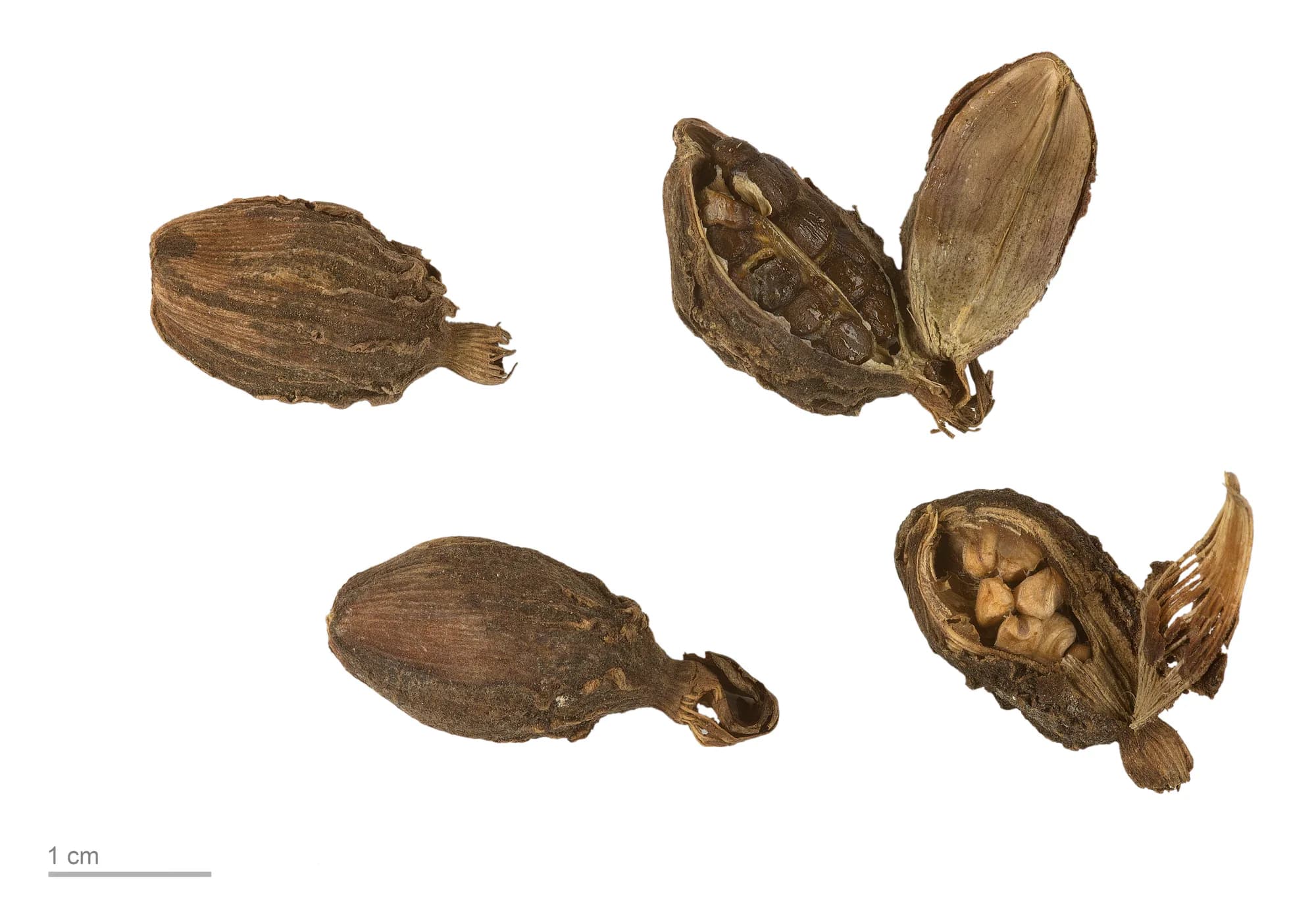
A cardamom pod is the plant's dried fruit: a husk, papery on green cardamom and tough and ridged on black, divided into three chambers that hold small, sticky, aromatic seeds. The seeds carry most of the flavour. The husk protects them, which is why whole pods keep their scent for so long.
Cardamom seeds can be used loose, ground to a powder, or left in the pod and dropped whole into a pot. For black cardamom, which part carries which flavour, and whether to eat it, is covered in black cardamom seeds versus pods.
What do cardamom pods look like?
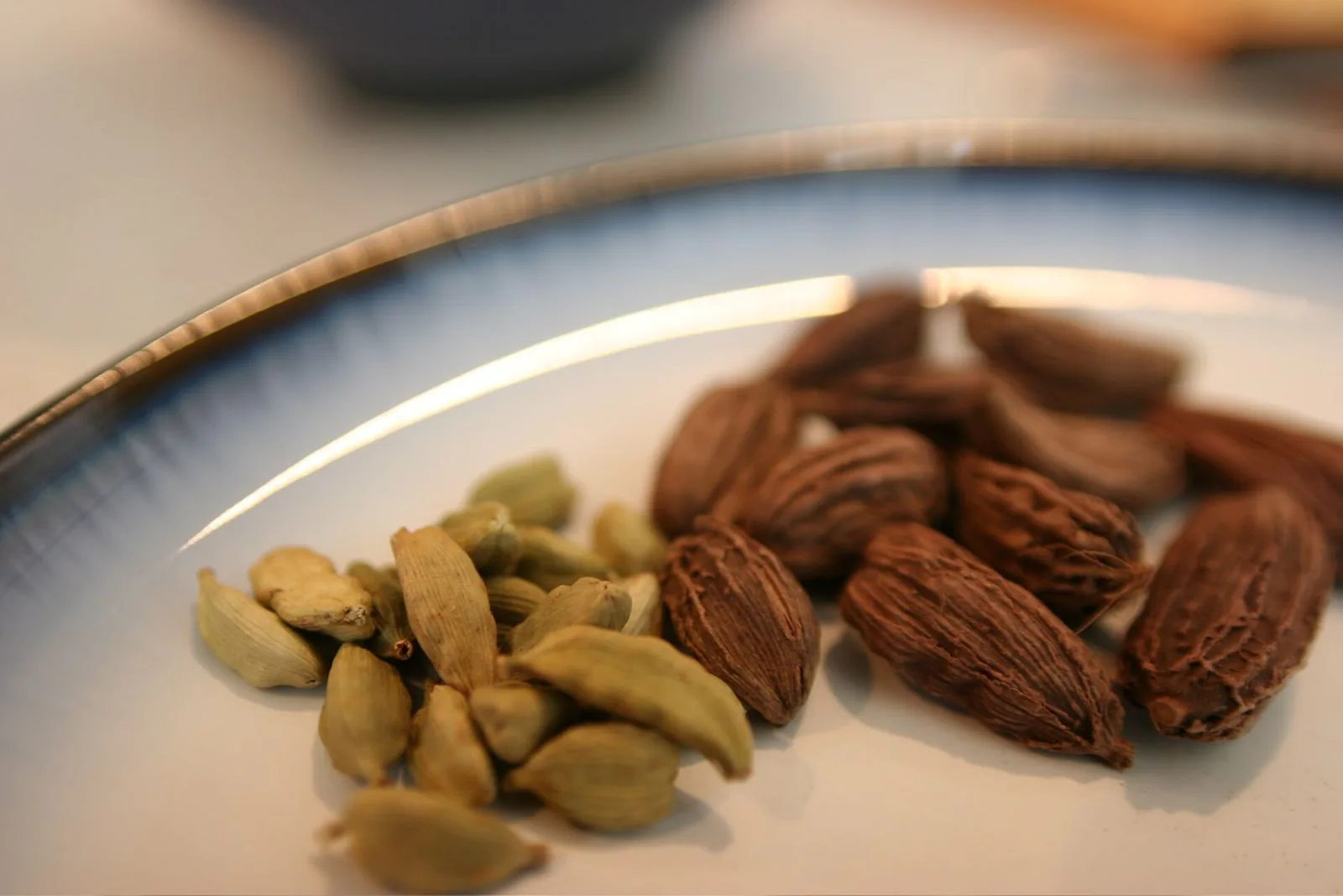
Green cardamom pods are small, about 10 to 15mm long, pale green and smooth, with a rounded three-sided shape that tapers at both ends. Black cardamom pods are roughly twice as long, 18 to 28mm, dark brown to near black, with a tough, deeply wrinkled husk that looks like shrunken leather. White cardamom pods are green pods bleached to a pale cream colour. Inside all of them, the seeds are small and dark brown to black.
One name, several plants
Botanists split the cardamoms across several genera. The two that matter most in the kitchen are Elettaria, the genus of green cardamom, and Amomum, the genus of black cardamom. Other pods sold as cardamom come from Lanxangia, Wurfbainia and Aframomum, all in the same family. The accepted names are listed in Kew's Plants of the World Online, for Elettaria cardamomum and for Amomum subulatum.
The name has travelled a long way. English took it from Latin cardamomum, which came from the Greek kardamomon, a blend of kardamon, a kind of cress, and amomon, an Indian spice plant. In Hindi and Urdu, cardamom is elaichi, the word you will see on many South Asian packets.
The types of cardamom
There are two main types of cardamom, green and black, and at least five other pods sold as cardamom somewhere in the world. They are separate species, not grades of one spice. The table below sets out the types of cardamom you are likely to meet.
| Type | Botanical name | Where it grows | Flavour | Main uses |
|---|---|---|---|---|
| Green cardamom | Elettaria cardamomum | Guatemala, India, Sri Lanka | Sweet, floral, citrus, eucalyptus | Chai, Arabic coffee, sweets, baking, biryani |
| Black cardamom | Amomum subulatum | Nepal, Sikkim and Darjeeling (India), Bhutan | Smoky, camphor, menthol, resin | Biryani, meat curries, dal, garam masala |
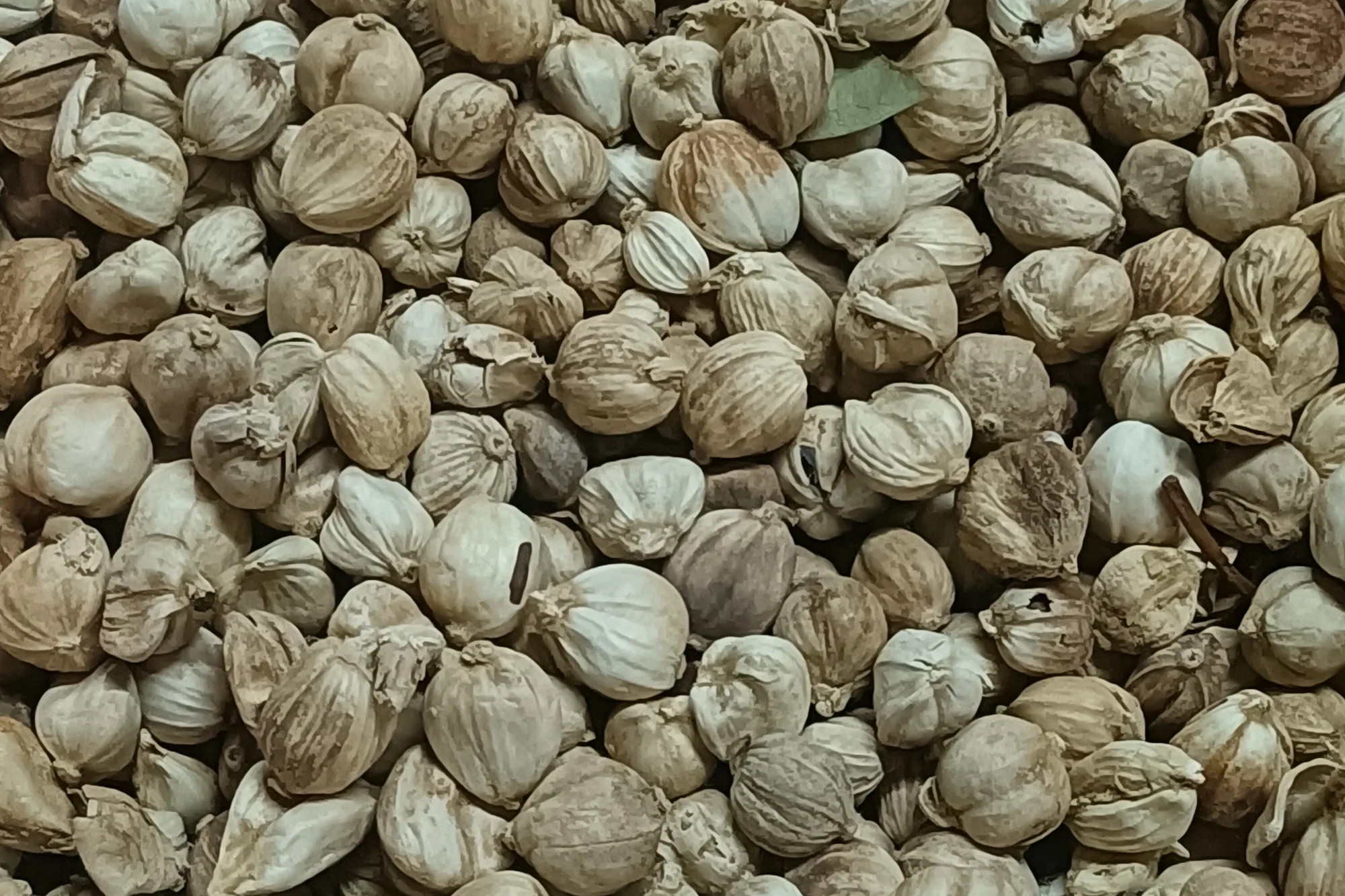
| White cardamom | Usually bleached Elettaria cardamomum; sometimes Siam cardamom (see below) | As for green or Siam cardamom | Milder than green | Pale cakes and sweets; Thai cooking |
| Tsaoko (cao guo) | Lanxangia tsaoko | Yunnan, northern Vietnam, Laos | Musky, medicinal, dried citrus peel | Pho broth, Chinese braises, hot pot |
| Siam cardamom | Wurfbainia vera | Cambodia, Thailand, southern Vietnam, Sumatra | Mild, camphor-like | Thai curry pastes |
| Ethiopian cardamom (korarima) | Aframomum corrorima | Ethiopia, Eritrea | Warm, resinous, peppery | Berbere and mitmita spice blends, coffee |
| Java or round cardamom | Wurfbainia compacta | Java and Sumatra, Indonesia | Mild, peppery, camphor-like | Indonesian curries and soups |
Black cardamom is the one we grow. It is the large, dark, smoke-dried pod of the eastern Himalayas, used in savoury cooking across South Asia, and the story of how it is grown, cured and cooked is in our complete guide to black cardamom. The other pod sold in English as black cardamom is tsaoko, which we set side by side with ours in black cardamom versus tsaoko.
Black cardamom is not dried green cardamom
Black cardamom is a different plant from green cardamom, not a riper, older or roasted version of it. No amount of drying turns a green pod black, and no recipe trick makes one taste like the other.
The confusion is easy to understand: black cardamom is dried over wood fires, which makes “smoked green cardamom” sound plausible. But the two pods already differ on the plant: a fresh black cardamom pod is reddish and ridged, a fresh green one is smooth and green.
- Size: black pods are roughly 18 to 28mm long, about twice the length of a 10 to 15mm green pod.
- Colour: black is dark brown to near black with a wrinkled, ridged husk; green is pale green and smooth.
- Flavour: black tastes of smoke and camphor; green tastes sweet, floral and citrusy.
- Use: black goes into savoury, slow-cooked dishes; green goes into sweets, drinks and lighter dishes.
The full comparison, including when one can stand in for the other, is in black cardamom versus green cardamom.
A grower's note from Nepal
We grow black cardamom in Sankhuwasabha district, in the Arun valley of eastern Nepal, at 1,100 to 1,500 metres. Here it is a forest crop, not a field crop.
Our plants grow in the shade of Nepalese alder, Alnus nepalensis. The trees keep the ground cool and damp, and their roots and fallen leaves feed the soil. Without that canopy, cardamom here would scorch and dry out.
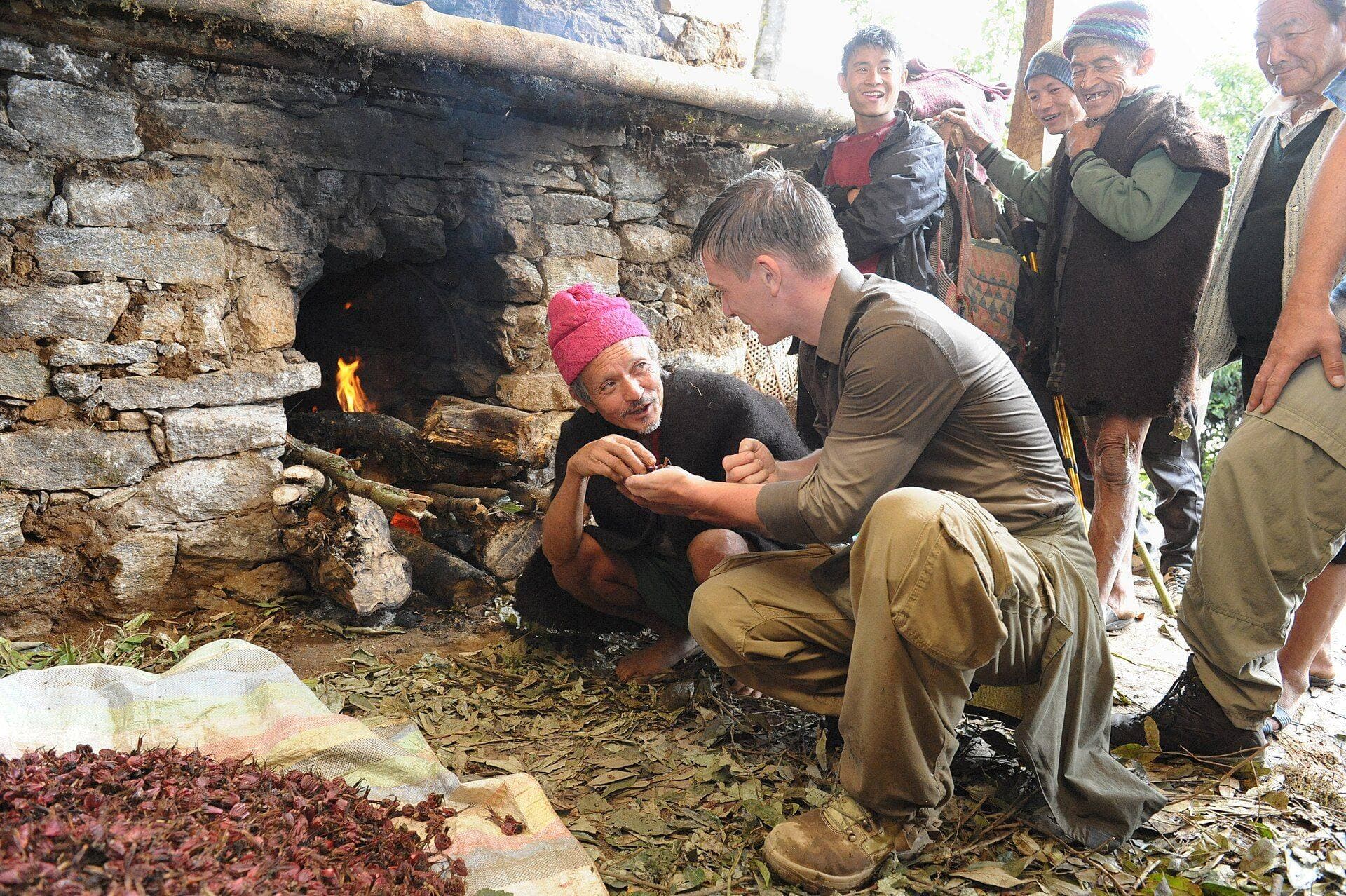
What surprises most visitors is where the pods are. They do not hang from branches. They grow in tight clusters at the base of each clump, right at ground level and half hidden in leaf litter, so harvesting means crouching down and cutting each cluster by hand. We harvest in September and October, and no machine does any of it for us.
Fresh pods are reddish, plump and around 80% water. They go into a bhatti, a traditional kiln where the pods sit on a rack above a wood fire until they are dry. That fire is where black cardamom's smoky flavour comes from. The smoke is part of the process, not part of the plant: the same pods dried with indirect heat taste of camphor and resin, with far less smoke.
Nepal grows over half of the world's black cardamom, most of it in the eastern hill districts around us. Much of it is sold abroad under other countries' names, which is one reason so few cooks know where their black cardamom was grown.
What does cardamom taste and smell like?
The cardamom flavour most people know is green: sweet, floral and citrusy, with a cool eucalyptus lift. It is a bright top note, the first thing you notice in a cup of chai. Black cardamom tastes of woodsmoke, camphor, cool menthol and resin, a savoury base note that gives depth to slow-cooked food rather than perfume.
The smell follows the taste. Crack a green pod and it smells perfumed and fresh; crack a black one and it smells smoky, like a campfire with pine in it. Both carry the same cooling compound, 1,8-cineole, which is why each has a faint eucalyptus edge. We go through what cardamom tastes and smells like, in detail, including why it sometimes tastes soapy.
What is cardamom used for?
Cardamom is used to flavour sweet and savoury food and drinks, from chai and Arabic coffee to biryani, curries, Nordic buns and cakes. Green cardamom does most of the sweet work; black cardamom does savoury work. If a recipe needs it and the jar is empty, our guide to cardamom substitutes has a swap for each dish.
| Cuisine or drink | Dish | Which cardamom |
|---|---|---|
| Indian | Chai, kheer, biryani, garam masala | Green in chai and kheer; black and green together in biryani and garam masala |
| Middle Eastern and Gulf | Arabic coffee (qahwa), spiced rice dishes | Green, often ground with the coffee |
| Nordic | Cardamom buns, sweet breads, cakes | Green, usually freshly ground |
| Chinese and Vietnamese | Red-braised meats, hot pot, pho broth | Tsaoko |
| Nepali | Milk tea, pulao and festive rice, meat curries | Green (sukmel) in tea and sweets; black (alainchi) in rice and meat |
| Ethiopian | Berbere spice blend, coffee | Korarima |
| Western baking | Cakes, cookies, pastries, fruit crumbles | Green, ground |
In sweet food
Green cardamom is one of the great baking spices. It goes into Indian kheer and kulfi, Swedish kardemummabullar buns, Middle Eastern pastries, and cakes and cookies across Europe and North America. It pairs well with orange, coffee, chocolate, pistachio and rose. Keep black cardamom out of desserts: its camphor turns bitter and medicinal against sugar and cream.
In savoury food
This is where black cardamom earns its place. A cracked pod bloomed in hot oil gives smoky depth to biryani, pulao, meat curries, dal and stews, and it is a standard part of garam masala. Green cardamom works in savoury food too, lifting kormas and rice dishes with its brightness. How much to use, and when, is covered in our guide to black cardamom in biryani, and for every other dish in how to use black cardamom.
In drinks
Green cardamom is the backbone of masala chai and of Gulf-style Arabic coffee, where the seeds are often ground with the beans. In Nepal, sukmel goes into everyday milk tea, while in the hills a cracked black pod makes a smoky, warming cup. If you want to try that, here is how to brew black cardamom tea. For coffee at home, a jar of cardamom syrup for coffee is the easiest place to start.
Pods, seeds or ground: which should you buy?
Buy whole pods if you can. The husk protects the seeds, so whole cardamom pods keep their aroma far longer than ground cardamom, which starts to fade within weeks of grinding and is noticeably flat after a few months. For cracking, pod counts and storage in detail, see how to use cardamom pods.
How to use pods and seeds
To crack a pod, press it under the flat of a knife or the base of a glass until the husk splits. For curries, rice and tea, drop the cracked pod in whole. For baking, pick out the seeds, which should be dark and slightly sticky, and grind them in a mortar or spice grinder just before use.
Ready-ground cardamom makes sense when you bake often and use it quickly, or when a recipe needs a smooth texture. Buy small amounts and replace it when it stops smelling strong. How much powder equals a pod, and how to grind your own, is in our guide to ground cardamom.
How to spot fresh pods
- Colour: green pods should be an even, bright green, not yellowed or grey. Black pods should be dark brown, not dull and dusty.
- Aroma: a cracked pod should smell strong immediately. Little or no smell means old stock.
- Shape: plump and full, not flat, hollow or split.
- Seeds: dark and slightly sticky, not pale, dry and loose.
How to store cardamom
Keep pods whole, in an airtight jar, somewhere dark and cool, away from the cooker. Heat, light and air all drive off the aromatic oils, so a jar on a sunny windowsill is the quickest way to waste it.
Is cardamom good for you?
Cardamom is a culinary spice, not a medicine, and nothing on this page is medical advice. In the amounts used in cooking, it is an ordinary food ingredient, eaten every day by people across South Asia, the Middle East and Scandinavia.
What is cardamom good for, traditionally?
Cardamom has a long history of household use. It has traditionally been used:
- after a heavy meal, chewed or in tea, for digestion;
- to freshen the breath, which is why pods are handed round after meals in many South Asian homes;
- in warming winter drinks, especially in the Himalayan hills.
Scientists have studied cardamom and its essential oil, but most of the research is small, early, or done in the laboratory rather than in people. It does not add up to proven health effects. If you are thinking of taking cardamom supplements or oils, ask a doctor or pharmacist first.
For the household traditions in more detail, see our article on black cardamom's traditional uses.
Why is cardamom so expensive?
Cardamom is expensive because nearly every step is done by hand, and most of the harvest's weight is lost before it reaches a shop.
- Hand picking: green cardamom is picked pod by pod as each one ripens, over several rounds. Black cardamom is cut cluster by cluster at ground level.
- Slow plants: a new planting takes around three years to give a real crop.
- Drying: fresh pods are about 80% water, so drying removes around three quarters of the weight that was picked.
- Demand: the Gulf and South Asia buy cardamom in large volumes all year, for coffee, tea, rice and sweets.
Green cardamom costs considerably more than black, because its picking and curing are gentler and slower, and because its buyers want an even colour.
Where does cardamom grow?
Cardamom grows in warm, humid, shaded hill forests in the tropics and subtropics. Green cardamom comes mainly from Central America and South Asia; black cardamom comes from the eastern Himalayas.
Green cardamom is native to the Western Ghats of southern India. Today the largest exporter is Guatemala, which accounts for more than half of the cardamom the UK imports according to the CBI, the Dutch government's trade-promotion agency, followed by India, with Sri Lanka a smaller producer.
Black cardamom grows in the eastern Himalayas: eastern Nepal, the Indian state of Sikkim and the Darjeeling hills, and southern Bhutan. Nepal is the largest producer. Production figures are published in FAOSTAT, but only within a combined “nutmeg, mace and cardamoms” category, so they cannot be used on their own to compare cardamom growers.
All cardamoms need shade, humidity and warmth without frost. Green cardamom can be kept as a houseplant for its scented leaves, but according to NC State Extension it is unlikely to flower indoors, so do not expect pods. How cardamom is farmed in Nepal is covered in our guide to cardamom farming in Nepal.
Cardamom in other languages
Cardamom goes by many other names. Green cardamom is elaichi in Hindi and Urdu, sukmel in Nepali, hayl in Arabic and kardemumma in Swedish, and is also sold as true cardamom or small cardamom. Black cardamom is also called large cardamom, brown cardamom, badi elaichi or alainchi.
Most languages have one word for green cardamom and describe black cardamom as the large or black version of it. Where two languages share a word, they share the spice.
| Language | Green cardamom | Black cardamom |
|---|---|---|
| Hindi and Urdu | elaichi or choti elaichi (छोटी इलायची) | badi elaichi (बड़ी इलायची), also kali elaichi |
| Nepali | sukmel or sukumel (सुकमेल) | alainchi (अलैंची) |
| Arabic | hayl or hel (هيل) | – |
| Swedish | kardemumma | svart kardemumma |
| German | Kardamom | schwarzer Kardamom |
| French | cardamome | cardamome noire |
| Spanish | cardamomo | cardamomo negro |
Frequently asked questions
What is cardamom?
Cardamom is the aromatic seed pod of several plants in the ginger family. The two main types are green cardamom (Elettaria cardamomum), which is sweet, floral and citrusy, and black cardamom (Amomum subulatum), which is smoky and camphor-like. It is sold as whole pods, loose seeds or ground, and used in curries, rice, chai, coffee and baking.
What is cardamom used for?
Cardamom flavours both sweet and savoury food. Green cardamom goes into chai, Arabic coffee, rice puddings, Nordic cardamom buns and cakes. Black cardamom goes into biryani, meat curries, dal and garam masala. Across South Asia the pods are also chewed after meals to freshen the breath, and a related pod, tsaoko, flavours Vietnamese pho broth and Chinese braises.
What does cardamom taste like?
Green cardamom tastes sweet, floral and citrusy, with a cooling eucalyptus note, and reads as a bright top note in drinks and desserts. Black cardamom tastes of woodsmoke, camphor, menthol and resin, and works as a savoury base note in slow-cooked dishes. Both contain the compound 1,8-cineole, which gives each its cool edge.
Is cardamom good for you?
Cardamom is a culinary spice, not a medicine. It has traditionally been taken after meals for digestion, chewed to freshen the breath and added to warming winter drinks. Researchers have studied it, but the evidence is limited and does not establish any health effect. Enjoy it for its flavour, and ask a doctor before taking cardamom supplements or oils.
What is the difference between green and black cardamom?
They are different plants. Green cardamom (Elettaria cardamomum) grows in southern India, Guatemala and Sri Lanka, has small, smooth, pale green pods and tastes sweet and floral. Black cardamom (Amomum subulatum) grows in Nepal, Sikkim and Bhutan, has larger, dark, ridged pods dried over wood fires, and tastes smoky. Use green in sweets and drinks, black in savoury dishes.
What is white cardamom?
It means two different things. In Western shops, white cardamom is usually green cardamom bleached pale for baking where colour matters, which also mutes its flavour. In Thai and some other Asian cooking it can mean Siam cardamom (Wurfbainia vera), a different plant with naturally pale pods. Check the botanical name or the country of origin on the packet.
Are cardamom pods edible?
Yes, though most people do not eat them whole. Green cardamom pods can be ground husk and all, but the husk is fibrous, so many cooks use only the seeds. Black cardamom husks are tough, so the pods flavour a dish and are then removed or pushed aside. Biting into a whole pod is harmless, just very strong.
Can I use ground cardamom instead of pods?
Yes, in most recipes, and in baking ground cardamom is usually easier. Grind the seeds from whole pods yourself if you can, because ready-ground cardamom loses its aroma much faster. Where a recipe calls for whole pods, as in biryani or chai, add ground cardamom later in the cooking and start with a small pinch, since it releases its flavour all at once.
Why is cardamom so expensive?
Cardamom is picked by hand, pod by pod or cluster by cluster, and new plants take around three years to give a real crop. Drying then removes most of the weight, because fresh pods are about 80% water. Demand from the Gulf and South Asia is strong and steady. Green cardamom is often called the third most expensive spice by weight, after saffron and vanilla.
How do you pronounce cardamom?
Cardamom is pronounced KAR-duh-mum, with the stress on the first syllable. You will also see and hear cardamon, with an n at the end, which is a common variant spelling rather than a different spice. Cardamom, ending in m, is the standard spelling in dictionaries and on most spice jars, and both words mean exactly the same thing.
Sources
- Royal Botanic Gardens, Kew, Plants of the World Online: Elettaria cardamomum
- Royal Botanic Gardens, Kew, Plants of the World Online: Amomum subulatum
- Food and Agriculture Organization of the United Nations: FAOSTAT
- North Carolina Extension Gardener Plant Toolbox: Elettaria cardamomum
- CBI, Netherlands Ministry of Foreign Affairs: The European market potential for cardamom
- Frontiers in Sustainable Food Systems (2021): Essential oil profile diversity in cardamom accessions from southern India