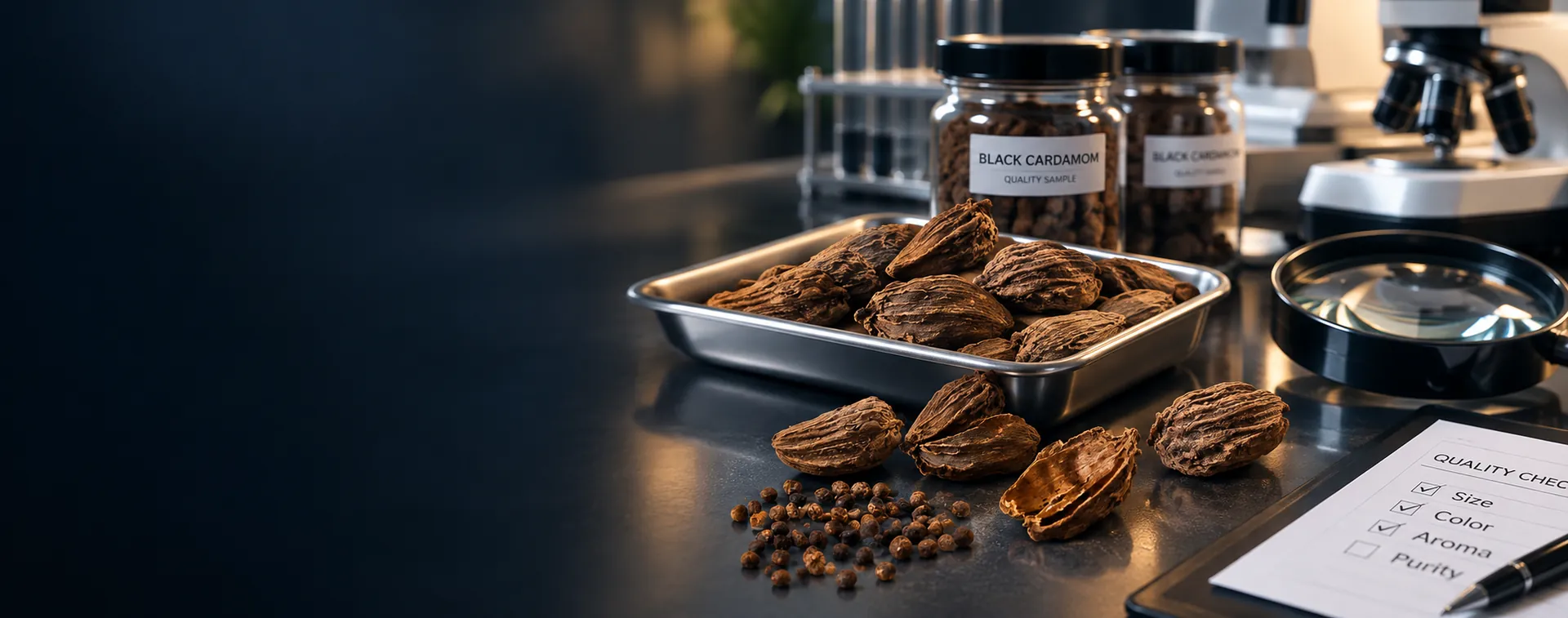
Black Cardamom Quality & Testing
Black cardamom quality: every lot tested before it ships, not after it arrives
Black cardamom quality is decided at origin, not at the border. The traditional supply chain assumes quality problems get solved at the destination: steam sterilising, UV treating, and mechanically cleaning a crop that was contaminated at origin. We think that is the wrong model.
Two numbers decide whether a consignment of black cardamom clears a border: aflatoxin and moisture. They are the same number twice over — aflatoxin is produced by moulds that grow on a crop that was not dried properly, so controlling moisture at curing is what keeps aflatoxin down. Everything else on this page follows from that.
Black Cardamom Quality Specs: The Same on Every Lot
- Aflatoxin B1
- below 5ppb (EU and GCC mandatory limit)
- Pesticide residues
- below EU and UAE MRL limits
- Origin
- Sankhuwasabha district, eastern Nepal
- Testing
- Per-lot ISO lab report, DFTQC or SGS Nepal
- HS code
- 0908.31.00
- Moisture
- ≤ 9% flue-dried / ≤ 12% Bhatti-cured
Aflatoxin limit per Commission Regulation (EU) 2023/915, Annex I.
Choose Your Cure: Two Drying Lines and What the Lab Report Shows
Line A: Closed-Flue Electric Black Cardamom
Closed-flue electric heat-pump dryers. Hot air never carries combustion products to the pod, so no smoke reaches the crop.
- Moisture
- ≤ 9%
- PAH
- Non-detect
- Protocol
- 45°C → 55°C → 65–75°C, 12–18 hours per batch
No smoke contact, so PAH is non-detect on the lab report. Indirect drying of this kind is the approach EFSA points to for spices where PAH formation is a concern.
Line B: Traditional Bhatti Black Cardamom
Wood-fired bhatti kilns on raised racks, the traditional eastern Nepali cure, run on our own managed facility rather than an open village fire.
- Moisture
- ≤ 12%
- PAH
- Tested, reported per lot
- Protocol
- Slow cure over managed wood fire, batch-coded per kiln load
PAH is tested and reported on every lot. EU Regulation 2023/915 sets dried-spice PAH limits that do not extend to cardamom, so Bhatti-cured lots remain saleable into the EU and UK.
These are two specifications of the same crop, not a premium tier and a budget tier. You nominate the line at quote time. More in Bhatti-dried vs machine-dried.
Black Cardamom Grades: Pay for the Pod Size You Actually Need
| Grade | Pod size | Bought by |
|---|---|---|
| Bold | 22–28 mm | Gulf retail and restaurant supply, gift and premium retail packs, anywhere the pod is seen whole on the plate. |
| Medium | 18–22 mm | The default wholesale grade: spice blenders, retail jar packers, and buyers who want bold-grade aroma without the size premium. |
| Fine | <18 mm | Masala manufacturers and grinders. Milling removes the size premium entirely, so paying for Bold to grind it is money burnt. |
Documents That Clear Customs: What Ships With Every Lot
- Per-lot laboratory report
Aflatoxin, moisture, pesticide residues and PAH, from DFTQC or SGS Nepal.
- Phytosanitary certificate
Issued by Nepal's Department of Agriculture after inspection.
- Certificate of origin
Issued by FNCCI, naming Nepal — not a re-export document.
- Commercial invoice and packing list
On company letterhead, with HS code and Incoterm.
- Fumigation certificate
Where your lane or buyer requires it.
Market-specific requirements differ. See UAE, EU, UK, USA and Saudi Arabia.
What We Don't Claim About Our Black Cardamom
We are not organic certified. Our cardamom is grown without synthetic pesticides or fertilisers and the residue reports show it, but that is a lab result, not a certification, and the two are not interchangeable. Certification is being pursued and this page will say so when it is awarded.
We do not hold ISO facility certification. The laboratory that tests our lots is accredited; our own packing operation is not yet independently certified, and we would rather say that than let an ISO reference on a lab report imply otherwise.
Black Cardamom Quality FAQ: Testing, Moisture, PAH and Lab Reports
Is your black cardamom aflatoxin tested?
Yes, every lot, before it ships. Aflatoxin is the single most common reason a spice consignment is rejected at a border, and it is a consequence of inadequate drying rather than of the crop. EU and GCC rules cap aflatoxin B1 in spices at <5 ppb; each lot is tested against that limit and the report travels with the consignment, so your incoming QA has the figure before the goods arrive rather than after.
What moisture level do you ship black cardamom at?
It depends which line you nominate, and both are lab-verified. The closed-flue electric line finishes at ≤ 9%, which suits a QA specification capping moisture under 10%. The traditional Bhatti line finishes at ≤ 12%. Moisture is the control that keeps aflatoxin down, which is why it is specified per line rather than quoted as one number.
Do you test black cardamom for PAH on smoke-dried lots?
Yes, and we report the figure rather than claiming its absence. Smoke contact is the entire point of the Bhatti line, so a 'PAH-free' claim would be incoherent. EU Regulation 2023/915 sets maximum PAH levels for certain dried spices and cardamom is not among the entries covered, so Bhatti-cured lots are not barred on PAH grounds in the EU or UK. The lab result goes in your file either way.
Can I see a black cardamom lab report before I order?
Yes. We send the current report as part of the quotation, before you commit to anything, and we courier a 200–500g sample of the specific grade you are considering so your own laboratory can verify it independently. Nothing leaves the warehouse until the lot matches the sample you signed off.
Who tests your black cardamom?
Per-lot testing is done by a third-party laboratory in Nepal — DFTQC or SGS Nepal — rather than in-house. A supplier's own numbers are worth less than an independent laboratory's, which is the point of paying for the report.