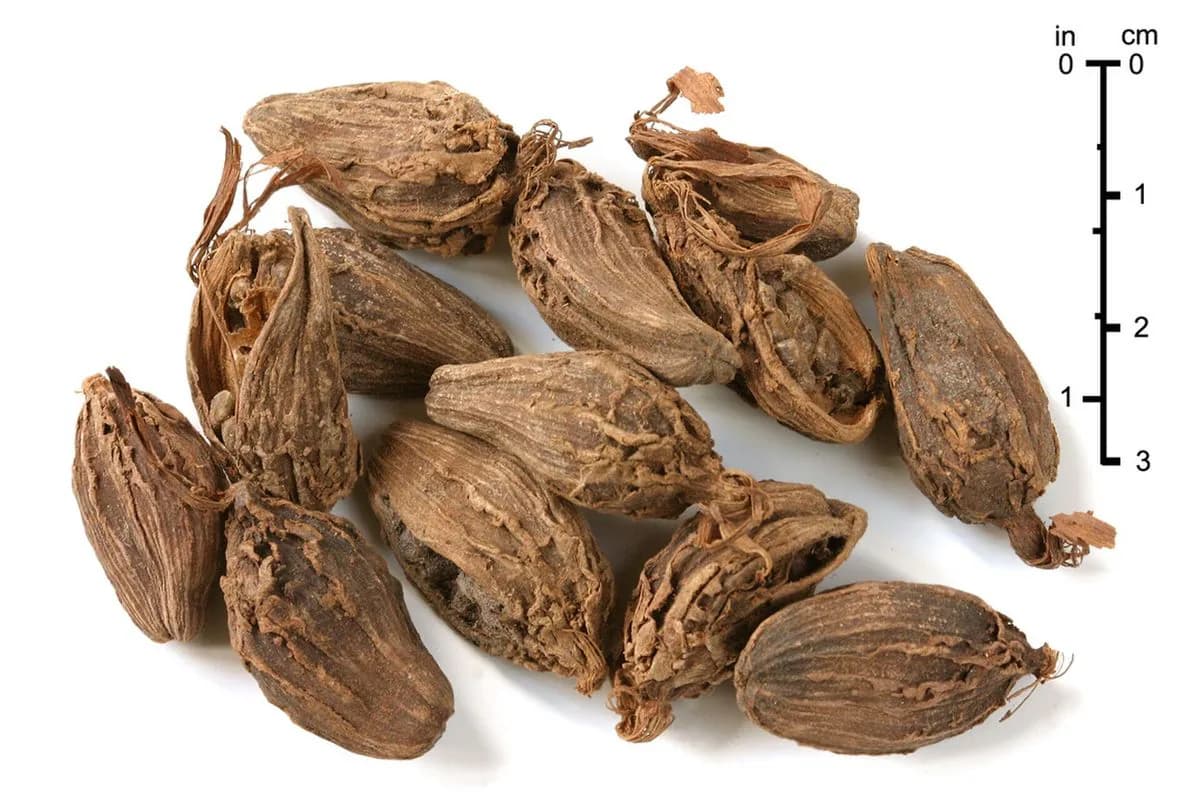
Black cardamom is the dried fruit of Amomum subulatum, a perennial in the ginger family grown in the eastern Himalayan hills and cured over heat rather than dried in the sun. That heat is the whole point: it gives the pod its smoky, resinous, camphor-forward character, which is nothing like the sweet floral green cardamom people confuse it with.
Nepal is the world's largest producer, at roughly 52% of global output. Four districts in the east of the country, Sankhuwasabha, Taplejung, Panchthar and Ilam, account for over 80% of the national harvest. We farm, cure and grade in the first of those, in the Arun River valley, between 1,100 and 1,500 metres.
This page is the orientation guide: the botany, the two different spices sold under the same English name, where the crop comes from, how it is cured, what it tastes like, how it is graded, how to cook with it and how to import it. Each section links out to a deeper article.
What black cardamom actually is
Black cardamom is the whole dried seed capsule of Amomum subulatum Roxb., a rhizomatous perennial herb in the Zingiberaceae, the same family as ginger and turmeric. The plant throws up leafy pseudostems two to three metres tall, but the fruit does not grow on them.
The flowers and pods form in short spikes at the base of the plant, at ground level, half hidden in leaf litter. Harvesting means bending down and cutting clusters by hand, which is one reason the crop has never mechanised. A new planting takes roughly three years from suckers to first commercial crop, then yields for fifteen to twenty years if the clump is maintained and gaps are refilled.
Each capsule holds 40 to 50 small black seeds in a sticky, aromatic mass, wrapped in a tough ribbed shell. The shell is not packaging to be discarded. It carries much of the smoke and resin, which is why the pod is used whole in cooking and why buyers specify pods rather than seed. For the whole family, green, black and the pods in between, see our guide to what cardamom is.
What is badi elaichi called in English?
Badi elaichi, kali elaichi and bari elaichi are all black cardamom in English, also sold as large cardamom. In Nepali, black cardamom is alainchi (also spelled alaichi), and green cardamom is sukmel.
| Name | Language | Means |
|---|---|---|
| Badi elaichi | Hindi and Urdu | Big cardamom: black cardamom |
| Bari elaichi | Hindi and Urdu, another spelling of badi | Big cardamom: black cardamom |
| Kali elaichi | Hindi and Urdu | Black cardamom |
| Alainchi (alaichi) | Nepali | Cardamom; in Nepal, usually the black pod |
| Sukmel | Nepali | Green cardamom |
| Choti elaichi | Hindi and Urdu | Small cardamom: green cardamom |
The names you will see
The spice is sold under a long list of names, and they nearly all refer to the same species. Badi elaichi and kali elaichi are the Hindi and Urdu names, literally big cardamom and black cardamom. Alaichi or alainchi is the general Nepali word for cardamom, so it is worth confirming which one a supplier means.
In English trade documents it appears as large cardamom, black cardamom, Nepal cardamom, greater cardamom or brown cardamom. Indian trade paperwork will often just say large cardamom. None of these names distinguishes it from the other black cardamom, which is the problem the next section solves.
The two black cardamoms, and how to tell them apart
Two unrelated pods are sold in English as black cardamom, and they are not substitutes. One is Amomum subulatum from Nepal, Sikkim, Darjeeling and Bhutan; the other is Lanxangia tsaoko, formerly classified as Amomum tsao-ko, from Yunnan, Sichuan, northern Vietnam and Laos, sold as tsaoko, cao guo or thao qua.
They sit in different genera, taste different, and belong to different cuisines. Subulatum is the pod in biryani, pulao, korma and garam masala. Tsaoko is the pod in pho broth, Lanzhou beef noodle soup, Sichuan hot pot bases and red-braised dishes.
Telling them apart in the hand
Size is the first tell. A subulatum pod is ovoid and compact, typically 18 to 28mm long depending on grade, dark reddish-brown to near black, with a shell that looks deeply wrinkled and finely striated, like shrunken leather. Squeeze it and it gives slightly.
A tsaoko pod is noticeably longer and more oblong, closer to an olive or a small date in outline. The colour is lighter, tan to grey-brown, the shell is thicker and woodier with three broad longitudinal ridges, and the pod feels hard and hollow, often rattling when shaken.
Then smell them. Cracked subulatum is smoke, camphor, menthol and pine resin. Cracked tsaoko is more medicinal and musky, with a bitter cooling edge and a note closer to dried citrus peel, and no woodsmoke.
Why the confusion matters
Retail listings mislabel these constantly, in both directions. An online shop selling black cardamom with a photograph of long ridged tan pods is selling tsaoko, whatever the title says. Importers who order on the English name rather than on species, size and origin get caught the same way.
Use the right one. If you are building a pho broth or a hot pot base, buy tsaoko, and do not let anyone tell you Himalayan large cardamom is the same thing. We grow and export Amomum subulatum only. We do not sell tsaoko, and we will say so rather than ship a near-enough substitute. The full side-by-side, including which dishes want which pod, is in black cardamom versus tsaoko.
Where black cardamom grows and who produces it
Black cardamom is a narrow-belt crop. It needs deep shade, high humidity, well-drained hill soil and a cool growing season, which in practice means the eastern Himalayan foothills between roughly 800 and 2,000 metres, with the best quality generally coming from the upper half of that range.
Nepal is the largest producer and has grown the crop in the eastern hills for over 150 years. Kathmandu Post reporting from June 2026 puts the Nepali share at roughly 52%, down from the 68% widely quoted a year earlier, and production data is published in FAOSTAT. Sankhuwasabha, Taplejung, Panchthar and Ilam produce over 80% of the national harvest. Most of the physical trade passes through Birtamod in Jhapa district, the main domestic auction and consolidation hub, where village lots are aggregated, sorted and sold on. How the crop is grown, the cultivars farmers plant and what they are paid at the farm gate are covered in our guide to cardamom farming in Nepal.
India is the second producer, concentrated in Sikkim, Darjeeling and parts of Assam and Arunachal Pradesh, with Sikkim historically the reference origin for quality. Bhutan produces a smaller volume from its southern districts. Between them, these three countries supply effectively the entire world market. For a straight origin comparison, see our breakdown of Nepali, Indian and Bhutanese large cardamom.
The Siliguri re-export route
For decades the standard path for Nepali cardamom ran east to Birtamod, across the border to Siliguri in West Bengal, into blending sheds where it was mixed with Sikkim and Bhutan material, and back out to the Gulf and Europe under an Indian certificate of origin. The farmer received farm-gate. The re-exporter kept the spread.
That route still moves a large share of the crop, and it is the single biggest reason importers cannot trace what they are buying. What changes when you buy at source, and the questions that separate a grower from a reseller, are set out in how to choose a black cardamom supplier in Nepal.
Harvest and curing
Black cardamom is harvested once a year, in September and October, when the capsules have filled and the shells have turned from pale green to bronze-brown. Everything that makes the spice distinctive happens in the next 24 hours, because the pods go straight from the field into a drying chamber rather than onto a sun terrace.
The plant flowers in spring, roughly March to May, in low spikes at the base of the clump. Pods fill through the monsoon under the shade canopy. We shade-grow under native alder, Alnus nepalensis, which fixes nitrogen and holds the cool humid microclimate the plant needs, so the alder is a working part of the system rather than decoration.
Pods are hand-cut at full maturity, spike by spike, then moved to the curing house within six hours of picking. Fresh capsules run around 80% moisture and start to ferment and blacken if they sit, which is where the musty, ammoniacal off-notes in cheap lots come from.
The two curing lines
We run two lines and the buyer chooses which one their lot comes off. They are not grades of each other. They are two different products.
Line A is a closed-flue electric heat pump, where the hot air never contacts combustion products. The protocol steps 45C, then 55C, then 65 to 75C, over 12 to 18 hours per batch. Finished moisture is at or below 9%, PAH comes back non-detect, and the profile is clean, resinous and camphor-forward, with the eucalyptol note fully forward and no smoke on top of it.
Line B is a traditional wood-fired bhatti on raised racks, in our own managed facility rather than an open village fire. Finished moisture is at or below 12%, PAH is tested and reported per lot, and the profile is deep, smoky and resinous, the character that survives a four-hour braise or a heavily spiced masala blend. Most Gulf and South Asian buyers want Line B. Most European food manufacturers want Line A. The full comparison, including what the smoke does to volatile oil and colour, is in bhatti-dried versus machine-dried black cardamom.
Flavour, aroma and chemistry
Black cardamom tastes of woodsmoke, camphor, menthol, pine resin and eucalyptus, with a cooling finish and a faint bitterness in the shell. It is a savoury, structural spice: it builds a base note under meat and rice rather than perfuming the top of a dish.
The dominant volatile is eucalyptol, also written 1,8-cineole, the same compound that gives eucalyptus and bay their cooling lift. Alpha-terpineol and terpinyl acetate sit behind it, adding a soft piney sweetness that keeps the cineole from reading as purely medicinal. Between them they explain the cooling sensation on the palate and the way the aroma arrives before the flavour.
The smoke is not a compound of the plant. It is deposited during bhatti curing, which is why a machine-cured pod from the same field tastes recognisably of the same species but without the campfire layer. Cineole is also volatile and light, so it is the first thing a badly stored or over-aged pod loses, leaving the resin and the bitterness behind.
Heat changes the balance again. A pod dropped into hot fat pushes the camphor and menthol forward within a minute, while an hour in a wet braise pulls the heavier resinous and woody notes into the liquid, which is why the same pod reads as sharp in a tarka and as deep and meaty in a stew.
Why it does not belong in desserts
Cineole-led spices go bitter and toothpaste-like against sugar and dairy. Black cardamom in a kheer, a custard or a cake reads as medicinal, and no amount of adjustment fixes it. That work belongs to green cardamom, Elettaria cardamomum, which is floral, sweet and fruity, and comes from a different plant grown in South India, Guatemala and Sri Lanka.
The two are not grades of one spice and not interchangeable in most recipes. We set them side by side, on flavour, price and application, in black cardamom versus green cardamom. If you have run out, our guide to black cardamom substitutes ranks what comes closest.
Grades and specifications
Black cardamom is graded on pod size first, then on colour, moisture, damage and foreign matter. Size is measured as pod length in millimetres, and the grade a buyer needs depends entirely on whether the pod will be seen on a plate, blended into a masala, or ground.
| Grade | Pod length | Who buys it |
|---|---|---|
| Bold | 22 to 28mm | The Gulf standard. Large, uniform pods for whole-spice retail, gift packing and foodservice |
| Medium | 18 to 22mm | The most common export grade, and the working size for spice packers and masala blenders |
| Fine | Under 18mm | Sound pods below Bold and Medium size, for spice mills and ground-powder lines where size is irrelevant |
Current grade sheets and pack specifications sit on our black cardamom products page.
The trade vocabulary you will meet elsewhere
Buyers dealing with Indian and Nepali intermediaries will hear a different set of terms. Badadana means the large-pod grade and Chotadana the small-pod grade, roughly mapping to Bold and Fine, though neither carries an agreed millimetre range. Grade names without measurements are opinions, so ask for the numbers.
Tail-on means the dried floral remnant and stalk are still attached; tail-cut or scissor-cut means they have been trimmed, usually by hand with scissors. Tail-cut lots look cleaner, weigh slightly less per pod, and generally price higher. Specify which you want, because a tail-on lot bought as tail-cut will come in heavy on foreign matter.
What to write on a purchase order
Write the species, not just the common name: Amomum subulatum, whole pods, crop year. Then set the numbers. Moisture at or below 12% for bhatti-cured, at or below 9% for closed-flue. Aflatoxin B1 below 5ppb, total aflatoxins to your market's limit. Pesticide residues within EU and UAE MRLs. PAH tested and reported per lot, method stated.
Add the physical terms: grade and millimetre range, tail-cut or tail-on, maximum foreign matter, maximum damaged and immature pods, packing, and whether fumigation is required. Then name the documents you expect at shipment, covered below.
How to use black cardamom in cooking
Use black cardamom whole, early, and in fat. It is an infusing spice, not a finishing one, and it needs both heat and time to release the resin and smoke that are its whole reason for being in the pot.
Start at one pod per kilogram of meat, or per 500g of dry rice, and adjust from there. Two pods in a family-sized curry is confident seasoning; four is a mistake you will taste for the rest of the meal. The pod is powerful, and it does not fade the way green cardamom does. Timings and pod counts for every dish are in our guide to how to use black cardamom.
Whole pods
Crack the pod lightly with the flat of a knife or the base of a pan before it goes in. A crack lets the oils out without releasing all the seeds into the dish. Bloom it in hot ghee or oil with the other whole spices for 30 to 60 seconds at the start of the cook, until it smells of smoke rather than of nothing, then build the dish on top. When to crack, when to use seeds alone, and whether to eat them, is in black cardamom seeds versus pods.
Fish the pods out before serving, or warn people. Biting into a whole black cardamom is unpleasant and memorable. In biryani and pulao, cooks traditionally leave them in and let diners push them aside. The application detail, including layering and quantities, is in our guide to black cardamom in biryani.
Ground
Ground black cardamom, seeds and shell together, is a garam masala component and a rub ingredient. Toast the whole pods dry for a minute before grinding to sharpen the aroma. Grind small batches, because the powder goes flat fast.
Beyond South Asian cooking, it works in Moroccan tagines with lamb, in Levantine and Gulf stews, in dal and lentil soups, and in stocks where you want depth without chilli heat.
In tea
A cracked pod in the pot is standard household practice across the Nepali hills, and it makes a smoky, savoury cup rather than a sweet one. It is not a green cardamom substitute in masala chai, and it turns medicinal if you over-steep it. Pod counts, steep times and the husk-versus-seed problem are covered in how to brew black cardamom tea.
Storage and shelf life
Whole black cardamom pods hold their character for two to three years if stored properly, because the shell protects the volatile oils. Ground powder loses the top of its aroma within four to six weeks and is noticeably flat by three months.
Store whole pods airtight, in the dark, away from the cooker and out of the fridge. Glass or food-grade PE with a tight seal beats a paper bag or a loose-lidded tin. Heat and light drive off cineole, and humidity brings mould risk on bhatti lots carrying 11 to 12% moisture.
For bulk, keep 25kg jute sacks off the floor on pallets, in a dry ventilated store, away from strong-smelling goods. Cardamom picks up neighbouring odours, and a container shared with the wrong cargo will show up in the cup.
How to tell a pod has gone
Look first. A live pod is dark reddish-brown to near black with a slight sheen; a dead one is dull, greyish and dusty-looking. Then crack one. Fresh, it releases smoke, camphor and resin immediately and the inner seeds are glossy black and slightly tacky.
A stale pod cracks with little smell at all, and the seeds inside are matte, dry and separate loosely. The shell also tells you: a good pod is leathery and gives slightly under pressure, while an old one is brittle and shatters. Brittle plus odourless means the lot has been sitting for years, whatever the packing date says.
Traditional uses
In Ayurvedic practice and in Himalayan households, black cardamom has a long history of use for digestion and for the chest and throat, usually as a decoction, a chewed seed, or a component of a spice mix taken after food. In Nepal it turns up in home remedies for cold weather and heavy meals more often than in any formal preparation.
This is culinary and cultural context, not medical advice, and nothing here is a health claim. We grow and export a food ingredient. We do not make therapeutic claims about it, and buyers should not put any on a label without their own regulatory sign-off in the destination market.
For the traditional-use background in more detail, including how the spice is used in household practice across the eastern hills, see our article on black cardamom benefits and traditional uses.
Buying and importing black cardamom
The price you pay depends mostly on how many hands the crop passes through before it reaches yours. A Nepali lot typically moves farm-gate, village collector, Birtamod trader, Siliguri re-exporter, and each step takes a margin.
Buying at origin removes those steps. The honest version of that argument is not that direct is always cheaper on the invoice, because origin buying moves freight, documentation and quality risk onto you. It is that you know the district, the crop year and the curing line, and the margin that used to sit in Siliguri is split between the farmer and you. Current market levels are broken down in black cardamom price per kg.
Incoterms in outline
Farm-gate is what the grower receives, and it is the number to compare origins on. The terms themselves are defined by the ICC Incoterms rules. FOB Kathmandu adds grading, packing, inland transport, documentation and handling to the point of loading. CIF adds freight and insurance to your named port, and is the figure to compare against a domestic wholesaler's landed price, not FOB.
Air freight from Kathmandu runs 3 to 5 days to Dubai, 4 to 6 to Jeddah, 5 to 7 to Hamburg and Felixstowe, and 7 to 10 to the US coasts.
Documentation
The HS code is 0908.31.00, cardamoms, neither crushed nor ground. Every shipment we send carries a phytosanitary certificate from the Nepal Department of Agriculture, a certificate of origin from FNCCI in Kathmandu, ISO lab reports from DFTQC or SGS Nepal covering aflatoxin B1 below 5ppb, moisture, PAH and pesticide residues within EU and UAE MRLs, plus a fumigation certificate.
Order sizes and samples
The trial minimum is 25kg, wholesale pricing starts at 500kg, and the best freight rates come in at 2,000kg and above. Qualified buyers get a free 200 to 500g sample, couriered in 5 to 7 business days, cut from the shipping lot rather than a showpiece batch.
The questions that matter are whether a counterparty grows or resells, which district and crop year the lot is from, whether they can name the curing line, and whether the lab report is per lot or a generic annual certificate. The full checklist sits on our black cardamom supplier page, and the Gulf customs and clearance side is in importing black cardamom into the UAE.
Frequently asked questions
The questions below cover what buyers and cooks ask us most often. Short answers here; the linked articles above carry the detail.
What is black cardamom?
Black cardamom is the smoke-cured dried fruit of Amomum subulatum, a perennial in the ginger family grown in the eastern Himalayas. The pods are dark, ridged and roughly 18 to 28mm long, with a smoky, resinous, camphor-like flavour. It is a savoury spice, used in biryani, curries, stews and garam masala.
What is badi elaichi called in English?
Badi elaichi is black cardamom in English, also sold as large cardamom. Kali elaichi and bari elaichi are other names for the same pod, Amomum subulatum. In Nepali it is alainchi, also spelled alaichi, while green cardamom is sukmel in Nepali and choti elaichi in Hindi and Urdu.
Is black cardamom the same as green cardamom?
No. They are different species from different plants: black cardamom is Amomum subulatum from Nepal, Sikkim and Bhutan, and green cardamom is Elettaria cardamomum from South India, Guatemala and Sri Lanka. Black is smoky and savoury, green is sweet and floral. They are not substitutes in most recipes.
Is black cardamom the same as tsaoko?
No. Tsaoko, also spelled cao guo or thao qua, is Lanxangia tsaoko, a different genus grown in Yunnan, Sichuan, northern Vietnam and Laos. Its pods are longer, lighter and woodier, and it is the pod used in pho and hot pot. Retail listings mislabel the two constantly, so buy on species, not on the English name.
What does black cardamom taste like?
Woodsmoke, camphor, menthol, pine resin and eucalyptus, with a cooling finish and a slight bitterness from the shell. The dominant volatile is eucalyptol, or 1,8-cineole. It is a base note, not a top note, so it builds depth under meat and rice rather than perfuming a dish.
Can I substitute black cardamom with something else?
Not cleanly. Green cardamom is the wrong flavour entirely and will make a dish sweet and floral. The closest improvisation in a savoury braise is a small amount of smoked paprika plus a bay leaf and a clove, which gets you smoke and a cooling note but not the resin. Better to buy the right pod.
How many black cardamom pods should I use?
Start at one pod per kilogram of meat, or per 500g of uncooked rice. Two pods is confident seasoning in a family-sized curry; four will dominate everything else in the pot. Crack the pod, bloom it in hot fat with the other whole spices at the start of the cook, and remove it before serving.
Why is Nepali black cardamom different?
Nepal is the largest producer, at roughly 52% of world output, and the eastern districts sit at the altitude and humidity the crop wants. What varies is handling: time from field to curing house, whether the bhatti is a managed facility or an open fire, and whether the lot is traceable to a district and crop year or blended anonymously in Siliguri before export.
What moisture and aflatoxin levels should I specify?
Specify moisture at or below 12% for bhatti-cured pods and at or below 9% for closed-flue machine-cured, aflatoxin B1 below 5ppb, and pesticide residues within EU and UAE MRLs. Ask for PAH tested and reported per lot with the method named, and insist that the lab report references your lot rather than the year.
What is the HS code for black cardamom?
0908.31.00, cardamoms, neither crushed nor ground. Ground cardamom moves under 0908.32. The code covers both black and green cardamom, so it does not identify species on its own. Confirm the full national tariff line with your customs broker, because destination countries extend the six-digit code differently and duty rates vary by trade agreement.
How do I buy black cardamom direct from Nepal?
Send your target grade, millimetre range, curing line, volume and destination port, and ask for a sample against those numbers. Our trial minimum is 25kg, wholesale pricing starts at 500kg, and qualified buyers get a free 200 to 500g sample couriered in 5 to 7 business days.
Working with us
We are a grower and direct exporter, not a trading desk. The cardamom on this site comes off our own farms in Sankhuwasabha, is cured on one of our two lines within six hours of picking, is graded and tested here, and ships from Kathmandu with the full document set attached to the lot.
The useful next step is a sample. Tell us the grade you are after, whether you want the smoke of a bhatti lot or the clean profile of a closed-flue lot, and which port you work through, and we will courier 200 to 500g cut from real stock along with the lab report for that lot. Request a sample and we will come back with pricing against your specification.