This page is about the pod itself: what is inside, how to judge it, and how to cook with it. For the spice as a whole, the plants and where they grow, start with our guide to what cardamom is.
What are cardamom pods?
Cardamom pods are the dried fruits of the cardamom plant, a relative of ginger. Each one is a husk wrapped around the seeds that carry the flavour.
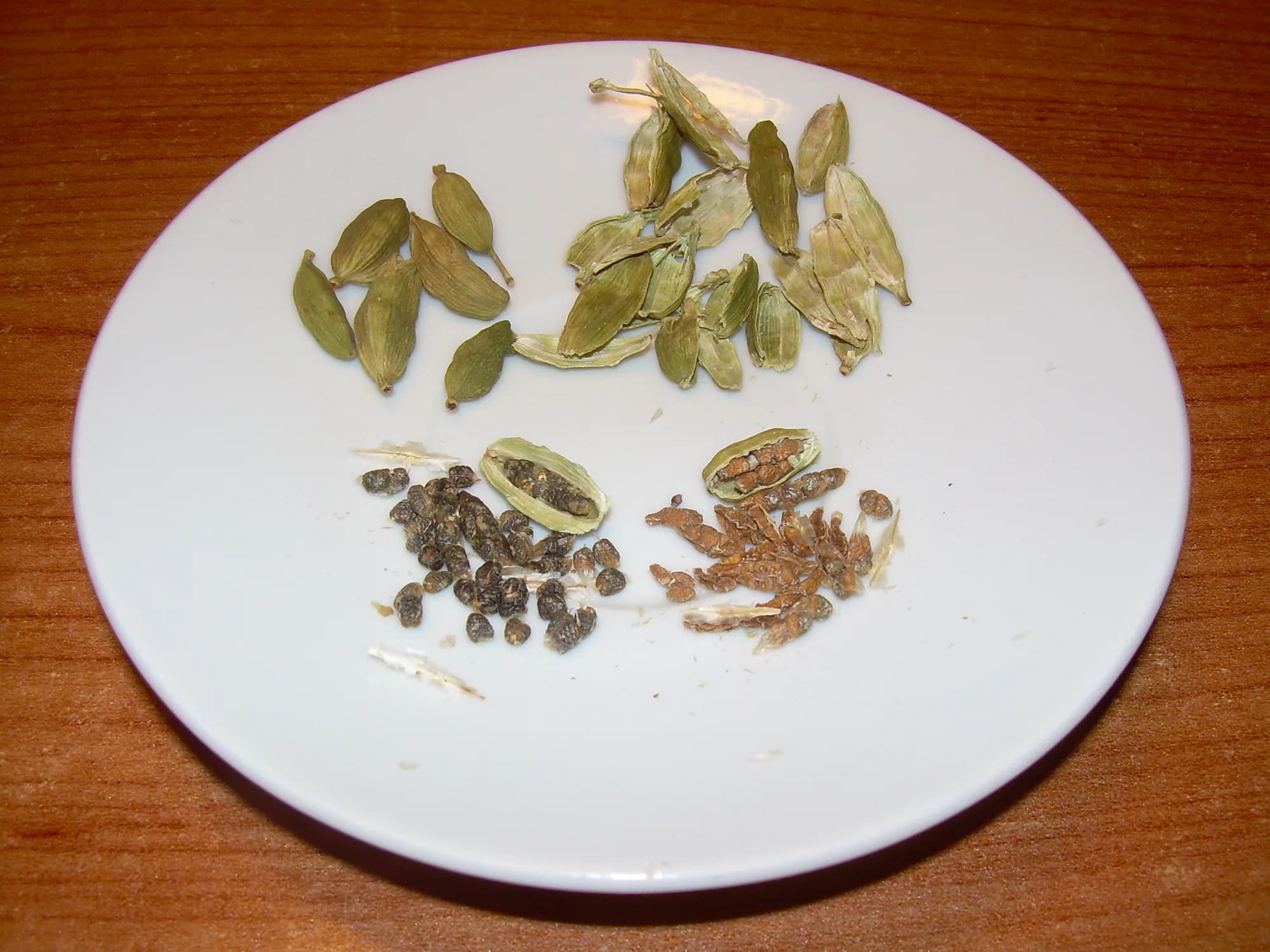
The husk is thin and papery on green cardamom, and it divides into three chambers packed with small, dark, sticky seeds. Botanically the pod is a capsule, the fruit of Elettaria cardamomum.
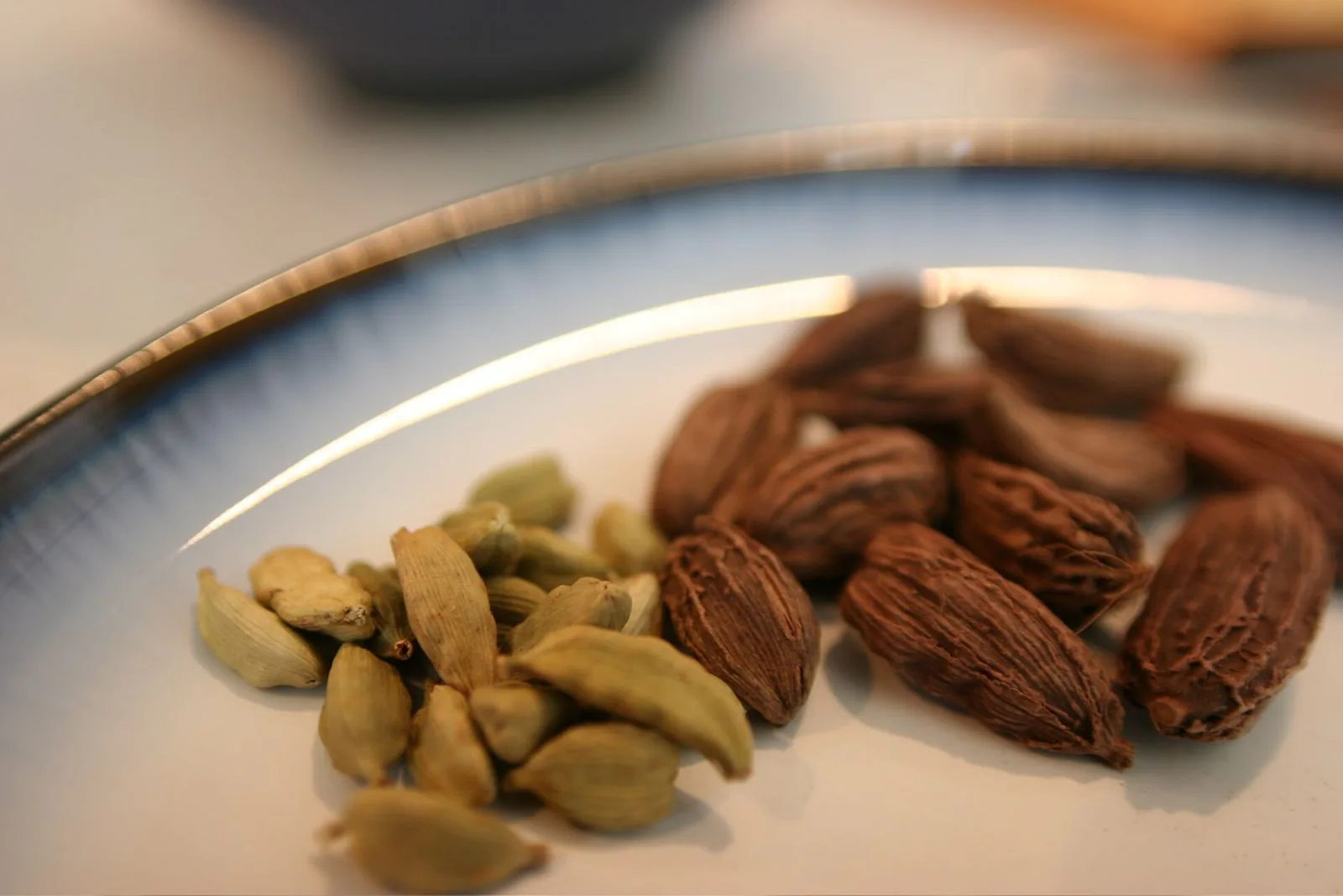
Green cardamom pods are the ones most recipes mean: about 10 to 15mm long, pale green, smooth and slightly three-sided, each holding around 15 to 20 seeds. In Hindi and Urdu they are elaichi, so a recipe calling for elaichi pods means green cardamom pods.
Black cardamom pods are a different plant: larger, at 18 to 28mm, dark, ridged and smoky. What is inside them, and whether to eat it, is covered in black cardamom seeds versus pods.
White cardamom pods are usually green pods bleached pale for baking; the other meaning of white cardamom is explained on our guide to the types of cardamom.
Green cardamom pods: how to choose good ones
Good green cardamom pods are bright to olive green, plump, closed and heavy for their size, with dark, sticky seeds and a strong smell when cracked. Pale, split or light pods have lost much of their flavour.
Colour is the quickest guide. Green pods are dried gently to keep their colour, and an even green says they were dried with care and have not sat in the light for long. Yellowed or brownish pods are older, or were dried badly.
Weight matters as much as looks. A plump pod that feels heavy is full of seeds; a light, papery one is mostly husk. The final test is to crack one: the smell should be strong and immediate, and the seeds inside dark brown to black and slightly sticky.
In India, green cardamom is graded by pod size and weight, with names such as Alleppey Green Extra Bold and Alleppey Green Bold for the larger grades. Bigger, heavier, greener pods are the most sought after, but a small, well-filled pod can taste as good as a large one.
| Check | Good pod | Poor pod |
|---|---|---|
| Colour | Even, bright to olive green | Pale, yellowed or brownish |
| Shape | Plump and closed | Flat, shrivelled or split open |
| Weight | Heavy for its size | Light and papery |
| Smell when cracked | Strong and immediate | Faint or musty |
| Seeds | Dark brown to black, slightly sticky | Pale, grey or brown, dry and loose |
How to use cardamom pods
Use cardamom pods whole for gentle flavour, cracked for most cooking, or seeds only, crushed fresh, for the strongest taste. Which one depends on the dish.
Whole cardamom pods
Drop whole cardamom pods into rice, stock, milk or tea, and let them simmer. The flavour comes out slowly, so whole pods suit anything that cooks for 20 minutes or more. Lift them out before serving, or leave them for people to push aside.
Cracked pods
Press the pod under the flat of a knife until it splits. The seeds are now exposed, so the flavour comes out faster and stronger. This is the standard for chai, curries and pulao: 5 minutes of simmering in chai, or 30 to 60 seconds in hot oil or ghee at the start of a curry. Cracked pods are also what flavours cardamom syrup for lattes.
Seeds only
Split the pod, tip out the seeds and crush them in a mortar just before use. This is the strongest form, and the right one for desserts, baking and spice blends, where you want the flavour spread evenly and no husk in the mouth.
Each method changes the taste as well as the strength; the differences are set out in what cardamom tastes and smells like.
How to crack cardamom pods
Press each pod under the flat of a knife until the husk splits. It takes a second, and there is no need to crush it.
- Lay the pod on a board, on one of its flat sides.
- Press down with the flat of a wide knife, or the end of a pestle, until you feel the husk give and split. Very fresh pods can be split between finger and thumb.
- Catch the seeds: crack pods over a small bowl or a folded piece of paper, so loose seeds are not lost.
- For seeds only, peel the husk open along its seams and tip the seeds out.
- Use them straight away. The aroma starts to fade as soon as the seeds meet the air.
How many cardamom pods to use
Start with 1 to 2 pods per cup of chai or rice, and 3 to 4 per 500g of meat. Cardamom is strong, so it is easier to add more next time than to rescue a dish with too much.
| Dish | Quantity | Pods | Whole, cracked or seeds |
|---|---|---|---|
| Chai | Per 250ml cup | 1 to 2 | Cracked |
| Coffee | Per cup | 1 | Cracked, or seeds ground with the beans |
| Rice | Per cup of dry rice | 1 to 2 | Whole or lightly cracked |
| Curry | Per 500g meat | 3 to 4 | Cracked |
| Kheer or rice pudding | Per litre of milk | 4 to 6 | Seeds, crushed |
| Cake or buns | Per batch with 500g flour | 10 to 12 | Seeds, freshly ground |
| Spice blend | By weight | About 10% of the blend | Seeds, or whole pods ground |
Cardamom pods vs seeds vs ground
Whole pods keep their flavour longest; freshly ground seeds taste strongest; shop-bought ground cardamom is the most convenient and the weakest. Most cooks keep pods and grind as needed.
| Form | Flavour strength | Keeps for | Best for |
|---|---|---|---|
| Whole pods | Strong, released slowly | A year or more | Rice, chai, stock, curries |
| Decorticated seeds | Strong, but fades sooner | A few months | Grinding for baking and blends |
| Freshly ground seeds | Strongest | Use the same day | Desserts, baking, coffee |
| Shop-bought ground | Weakest, flatter | Weeks to a few months once open | Everyday baking |
Cardamom pods to ground conversion: about 10 to 12 green pods give roughly 1 teaspoon of ground cardamom. Freshly ground seeds are stronger than shop-bought, so start with a little less than a recipe written for ground cardamom asks for.
Cardamom seeds
Cardamom seeds are the small, dark seeds inside the pod, and they hold almost all of its flavour. A green pod contains around 15 to 20 of them.
The flavour sits in aromatic oils in and around the seeds. That is why a whole pod smells faint and a cracked one fills the room: the husk is a sealed container, and the seeds are what it protects.
Decorticated cardamom is seeds sold with the husks already removed. It saves the work of shelling, but without the husk the seeds lose their aroma faster, so buy it in small amounts and grind it soon.
To crush cardamom seeds, pound them in a mortar for 20 to 30 seconds, or grind them in a spice grinder. A pinch of sugar in the mortar helps grip the seeds if you are baking. About 1 teaspoon of seeds comes from 10 to 12 pods.
Can you eat cardamom pods?
Yes, green cardamom pods are edible, husk and all. Most people still push whole pods aside, because they are fibrous and strong.
The husk of a green pod is thin and papery. Many traditional spice blends grind the whole pod, husk included, and a pod softened in rice or a curry is harmless to eat. It is simply a chewy, intense mouthful, which is why cooks lift whole pods out or warn their guests.
Black cardamom pods are different: the husk is thick and tough, and it is removed before serving. Which part of a black pod to eat is covered in black cardamom seeds versus pods, and the two cardamoms are compared in black cardamom versus green cardamom.
How to store cardamom pods
Store cardamom pods whole, in an airtight jar, somewhere dark and cool. Kept like that, they hold their flavour for a year or more.
The husk protects the seeds, which is why whole pods last so much longer than ground cardamom, which starts fading within weeks of opening. Heat, light and air all drive off the aromatic oils, so keep the jar away from the hob and out of sunlight. The fridge is not needed, and damp can get into the jar each time it comes out.
The freshness test: crack one pod and smell it. A strong smell straight away means the jar is still good. Faint or musty means it is time for fresh pods.
A grower's note: how cardamom pods grow
Cardamom is a ginger-family plant, and its pods do not grow on the tall leafy stems you see first. They form close to the ground.
On green cardamom, the flowers and then the pods form along stalks that rise from the base of the plant. Depending on the type, those stalks trail along the ground, stand upright, or grow somewhere in between. NC State Extension describes the plant in more detail.
We grow black cardamom in Sankhuwasabha, in eastern Nepal, and there the pods sit in tight clusters right at the base of each clump, half hidden in fallen leaves. Every pod is picked by hand, which is a large part of why cardamom is a costly spice.
What happens next is why the two pods look so different. Green pods are picked just before they are fully ripe and dried gently, to keep their colour and their bright aroma. Our black pods are dried over a wood fire in a bhatti, which darkens and wrinkles the husk and gives black cardamom its smoke. The story of our own pods is in our complete guide to black cardamom, and if you want to try them in a cup, see black cardamom tea.
Frequently asked questions
What are cardamom pods?
Cardamom pods are the dried seed pods, or fruits, of the cardamom plant, a relative of ginger. Each pod has a thin husk around three chambers of small, dark, sticky seeds, and those seeds carry most of the flavour. Green cardamom pods are the most common; black cardamom pods are larger, darker and smoky.
How do you use cardamom pods?
Three ways. Drop whole pods into rice, stock, milk or tea and lift them out before serving. Crack them under the flat of a knife for a faster, stronger flavour, the usual way for chai and curries. Or split them, tip out the seeds and crush those fresh, which is strongest and best for baking and desserts.
Do you crack cardamom pods before cooking?
Usually, yes. A light crack splits the husk so the oils in the seeds can reach the liquid, which gives more flavour in less time. Leave pods whole only for long, gentle cooking such as a pot of rice or a slow-simmered stock. Crack them just before use, because the aroma starts fading as soon as the seeds are exposed.
Can you eat cardamom pods?
Yes, green cardamom pods are edible. The husk is thin and papery, and many spice blends grind the whole pod, husk and all. A softened pod in rice or curry is harmless to eat, just fibrous and strong, so most people push whole pods aside. Black cardamom husks are much tougher and are usually removed before serving.
How many cardamom pods equal 1 teaspoon of ground cardamom?
About 10 to 12 green cardamom pods give roughly 1 teaspoon of ground cardamom once the seeds are removed and ground. The exact number depends on how large and well filled the pods are. If you grind the seeds fresh, start with a little less than the recipe asks for, because fresh-ground cardamom is stronger than shop-bought.
What is the difference between green and black cardamom pods?
They come from different plants. Green cardamom pods are small, about 10 to 15mm, smooth and pale green, with a sweet, floral, citrusy flavour for chai, rice and baking. Black cardamom pods are 18 to 28mm, dark and ridged, dried over wood fires, with a smoky, camphor-like flavour for savoury dishes. They are not interchangeable in most recipes.
How long do cardamom pods last?
Whole cardamom pods keep their flavour for a year or more stored airtight, in the dark and away from heat, because the husk protects the seeds. Ground cardamom fades much faster, within weeks of opening, and is noticeably flat after a few months. To check a pod, crack it: a strong smell straight away means it is still good.
Should I use whole cardamom pods or seeds?
Use whole or cracked pods for anything that simmers, such as rice, curries, stock, milk and tea, and lift them out before serving. Use the seeds, crushed fresh, for baking, desserts and spice blends, where you want the flavour spread evenly and no husk in the mouth. Seeds give the strongest flavour for the amount used.
What are decorticated cardamom seeds?
Decorticated cardamom is green cardamom seeds sold with the husks already removed, so you can grind them straight away. They save time, but without the husk to protect them they lose their aroma faster than whole pods. Buy small amounts, keep them airtight, and grind them just before you use them.
How many cardamom pods do I use for chai?
Start with 1 to 2 cracked green cardamom pods per 250ml cup of chai, simmered with the tea and milk for a few minutes. For a pot of four cups, 4 to 6 pods is a good starting point. Crack the pods just before they go in, and strain them out before serving.
Sources
- Royal Botanic Gardens, Kew, Plants of the World Online: Elettaria cardamomum
- North Carolina Extension Gardener Plant Toolbox: Elettaria cardamomum