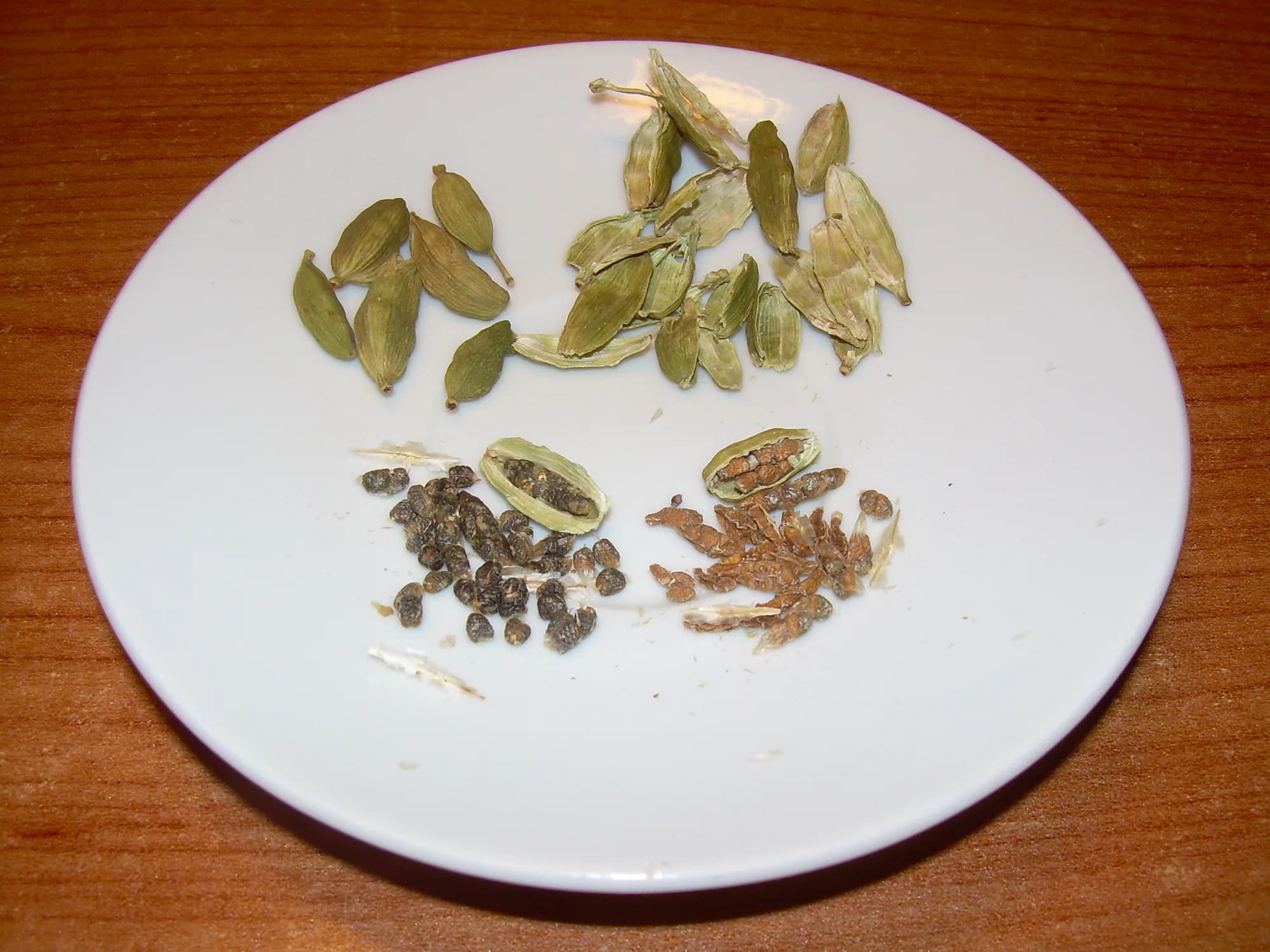
Ground cardamom is the easiest form of the spice to cook with and the quickest to lose its flavour. For the spice itself, the plants and where they grow, start with our guide to what cardamom is.
What is ground cardamom?
Ground cardamom is dried cardamom milled to a fine powder. Unless the label says otherwise, it is green cardamom, the sweet, floral spice of chai and Scandinavian buns.
It is made in one of two ways: from the seeds alone, or from the whole pod, husk and all, which gives more powder from the same pods.
You can usually tell which is which by eye. Seed-only powder is a grey-brown, often with darker flecks, and smells strong as soon as the jar opens. Powder with the husk ground in is paler, sometimes with a greenish or beige tint, and tastes milder and slightly woody, because the husk adds bulk but little aroma.
You will also see it sold as cardamom powder, and in South Asian shops as elaichi powder, from the Hindi and Urdu name for green cardamom. All three names mean the same thing. The plant behind it is Elettaria cardamomum.
Ground black cardamom comes from a different plant: smoky and camphor-like, for savoury blends rather than baking. Which parts of a black pod give which flavours is covered in black cardamom seeds versus pods.
How much ground cardamom equals a cardamom pod?
One green cardamom pod gives roughly 1/10 teaspoon of ground cardamom, about a generous pinch. About 10 to 12 pods make 1 teaspoon.
If a recipe asks for 6 pods and you only have powder, use about 1/2 teaspoon. If it asks for 1 teaspoon of ground cardamom and you have pods, crack 10 to 12 and grind the seeds.
| Pods (green) | Seeds (approx.) | Ground cardamom |
|---|---|---|
| 1 pod | 15 to 20 seeds | About 1/10 tsp, a generous pinch |
| 3 pods | 45 to 60 seeds | About 1/4 tsp |
| 6 pods | About 1/2 tsp of seeds | About 1/2 tsp |
| 10 pods | Just under 1 tsp of seeds | Just under 1 tsp |
| 10 to 12 pods | About 1 tsp of seeds | 1 tsp ground cardamom |
| 30 to 36 pods | About 1 tbsp of seeds | 1 tbsp ground cardamom |
Ground cardamom vs pods: which should you use?
Use ground cardamom where the spice has to disappear into the dish, as in baking. Use whole or cracked pods where the flavour can steep and the pods can be lifted out, as in rice, curries and tea.
A pod releases its aroma slowly, through the cracked husk, into hot liquid or fat. Powder releases it all at once, and stays in the dish, which makes it the natural choice for doughs, batters, spice rubs and anything you cannot strain.
Pods win on keeping: the husk seals the seeds in, so a jar of pods stays fragrant long after powder has gone flat. How to crack them and how many to use is covered in our guide to cooking with cardamom pods.
| Ground | Whole pods | |
|---|---|---|
| Flavour strength | Immediate; fades as the jar ages | Strong, released slowly |
| How long it keeps | Best within about 3 to 6 months of opening | A year or more |
| Convenience | Measure and add | Crack, or shell and grind |
| Best for | Baking, batters, doughs, spice rubs, porridge | Rice, curries, chai, warm milk, stock |
| Texture in the dish | Disappears; may cloud clear liquids | Fibrous husks to lift out or push aside |
How to make cardamom powder at home
Homemade cardamom powder takes about five minutes: shell green pods, grind the seeds, and sieve if you want it fine. It tastes noticeably brighter than most shop-bought powder.
- Shell the pods. Press each pod under the flat of a knife until it splits, then tip the dark seeds into a bowl. Our guide to cracking cardamom pods shows how.
- Toast, if you want to. Warm the seeds in a dry pan over a low heat for 1 to 2 minutes, shaking the pan, until they smell fragrant, then let them cool. The flavour turns a little deeper and less bright, so skip this for delicate desserts.
- Grind in a mortar and pestle, or in short bursts in an electric spice grinder so the seeds do not heat up.
- Sieve, for a fine powder. Shake it through a tea strainer and regrind anything left behind.
- Store it in a small airtight jar, dated, somewhere dark and cool.
Seeds only or with the husk?
Seeds only give the strongest, smoothest powder, the one for baking and desserts. The whole pod gives more powder from the same pods, but milder and slightly fibrous. A middle way: grind the seeds and drop the husks into the teapot or the rice pan.
The sugar trick
Cardamom seeds are slightly oily, and on their own they can clump and stick to the mortar. In many South Asian kitchens a spoonful of sugar is ground with the seeds to stop that: the crystals act as grit and keep the powder loose. It only suits sweet dishes, such as kheer, halwa, chai and baking, so leave it out of anything savoury.
Grind small batches
Grind only what you will use in the next few weeks. The aroma starts to fade as soon as the seeds are broken, so a large batch is weaker by the time you reach the bottom of the jar.
Why shop-bought ground cardamom often tastes weak
Mostly age. Cardamom's aroma sits in volatile oils, and once the seeds are ground those oils escape, so a jar that has sat for months has lost much of its smell.
The two main aroma compounds in green cardamom's essential oil are alpha-terpinyl acetate and 1,8-cineole. The husk keeps them sealed in; ground, every particle is exposed. Other things weaken a jar too:
- Time before you buy it. A jar may have been milled and shelved for months before it reaches you.
- The husk. Powder made from whole pods is milder than seed-only powder, because the husk adds bulk but little aroma.
- How you keep it. A jar by the hob or in the light loses its aroma faster than one in a dark cupboard.
How to check a jar. Good ground cardamom smells strong, sweet and cool the moment it is opened. It should be an even grey-brown, or greenish-beige if the husk is in, not faded. A musty or dusty smell means it is past its best.
How to use ground cardamom
Ground cardamom suits baking, sweet drinks, milk puddings and spice rubs: anywhere the spice should blend in. Start with these amounts and adjust to taste.
| Use | Amount | When to add | Tip |
|---|---|---|---|
| Cakes and muffins | 1/2 tsp per 250g flour | Whisk into the dry ingredients | Pairs well with orange, coffee or pear |
| Cookies | 1/2 tsp per 250g flour | Cream with the butter and sugar | Fat carries the aroma through the dough |
| Cardamom buns and sweet bread | 1 to 2 tsp per 500g flour | In the dough, and more in the butter filling | Fresh-ground makes the biggest difference here |
| Chai | A pinch, about 1/8 tsp per cup | In the last minute of simmering | Strain through a fine sieve |
| Coffee | A pinch, about 1/8 tsp per cup | Mixed with the grounds before brewing | The filter holds back the powder |
| Rice pudding or kheer | 1/2 tsp per litre of milk | In the last few minutes | Added late, it stays bright |
| Porridge or oats | A pinch per bowl | Stirred in while cooking | Good with banana, apple or honey |
| Spice rubs | 1/4 to 1/2 tsp per 500g meat | Mixed into the rub | Balance it with cumin, pepper or chilli |
| Garam masala | About a tenth of the blend | Ground with, or stirred into, the other spices | Grind small batches, as for the powder alone |
In baking
Mix ground cardamom with the flour or cream it with the butter, so it spreads evenly through the dough. Baking softens its cool edge into a warm, rounded sweetness. Grind your own for anything where cardamom is the main flavour, as in our cardamom cookies recipe.
In drinks
Add ground cardamom late, or brew it with the coffee, because long boiling dulls it. How the flavour changes with heat, milk and time is set out in what cardamom tastes and smells like.
How long does ground cardamom last?
Ground cardamom does not turn unsafe quickly, but it loses flavour: it is at its best for roughly 3 to 6 months after opening. Whole pods keep theirs for a year or more.
Kept dry, ground cardamom will not spoil, but it grows steadily weaker as its volatile oils escape, and the citrus and floral notes go first. Homemade powder is best used within a few weeks.
How to store it
- Airtight: a small jar with a tight lid.
- Dark: a cupboard or drawer, not an open rack in the light.
- Cool: not above the stove or beside the oven, where heat drives off the oils fastest.
- Not the fridge: condensation forms each time the cold jar comes out, and damp powder clumps and goes musty.
How to tell it is past its best
A faint smell means most of the aroma has gone, and the colour will look dull or faded. Taste a pinch: good cardamom has a cool, almost minty note on the tongue, and old powder has none. Damp clumps, mould or a sour smell mean throw it away.
A grower's note on what grinding does
Grinding is the moment cardamom starts to fade. Everything before it, growing, picking and drying, is about keeping the aroma in.
We grow and dry black cardamom in Sankhuwasabha, in eastern Nepal. The aroma lives in oils inside the seeds, and the husk protects them: a well-dried pod, kept whole and dry, holds its smell for a long time. Once the seeds are ground, those oils are open to the air, and they begin to escape.
That is why households in Nepal grind small amounts as they need them, rather than keeping a jar of powder. A few pods are cracked and pounded for the day's cooking, and the rest stay whole.
With black cardamom, what goes into the grinder changes the result as much as freshness does. The husk carries most of the smoke from the fire it was dried over, and the seeds carry the cool, menthol note. Grind more husk and the powder is smokier; grind more seed and it is cooler and sharper. Our complete guide to black cardamom explains how the pods are dried, and black cardamom tea is a good way to taste the difference.
Frequently asked questions
What is ground cardamom?
Ground cardamom is cardamom milled to a powder, almost always green cardamom. Some powders use the seeds only, which gives a darker, stronger powder; others grind the whole pod, husk and all, for a paler, milder one. It is also sold as cardamom powder or elaichi powder.
How much ground cardamom equals one pod?
One green cardamom pod gives roughly 1/10 teaspoon of ground cardamom, a generous pinch. Put the other way, about 10 to 12 pods make 1 teaspoon. Pods vary in size and in how full of seeds they are, so treat this as a starting point. Fresh-ground seeds are stronger than shop-bought powder, so use slightly less.
How do you make cardamom powder?
Crack green cardamom pods and tip out the seeds. Toast them gently in a dry pan if you like, then grind them in a mortar and pestle or a spice grinder. Sieve out coarse bits and keep the powder in a small airtight jar. Grind only what you will use within a few weeks.
Is ground cardamom the same as cardamom powder?
Yes. Ground cardamom and cardamom powder are two names for the same thing, and elaichi powder is the Hindi and Urdu name. What varies is how it was made: from seeds only, or from whole pods with the husk ground in. Seed-only powder is stronger.
Can I use ground cardamom instead of pods?
Yes. Use about 1/10 teaspoon of ground cardamom for each pod the recipe asks for, roughly 1/2 teaspoon for 5 pods. Add it later than you would add pods, because powder releases its flavour all at once. In rice or tea it will cloud the liquid slightly and cannot be lifted out.
Does ground cardamom go bad?
Not in the sense of becoming unsafe, as long as it stays dry. It loses flavour instead: the aroma sits in volatile oils that escape once the seeds are ground, so old powder tastes dusty and flat. Replace it when it smells faint or musty. Mould or a sour smell means throw it away.
How long does ground cardamom last?
Ground cardamom is at its best for roughly 3 to 6 months after opening, kept airtight, dark and cool. It will not spoil after that, but it grows steadily weaker. Whole pods keep their flavour for a year or more, because the husk protects the seeds. Homemade powder is best used within a few weeks.
Should ground cardamom include the husk?
It depends on what you want. Seed-only powder is stronger, darker and smoother, and the better choice for baking and desserts. Powder with the husk ground in is paler, milder and slightly woody, and a pod gives more of it. If a recipe was tested with seed-only powder, a husk powder will taste weaker.
What can I use ground cardamom in?
Cakes, muffins, cookies, cardamom buns and sweet breads; chai, coffee and hot milk; rice pudding, kheer and porridge; and savoury spice rubs and blends such as garam masala. It suits anything where whole pods would be awkward to fish out. Start small, because it is strong, and taste before adding more.
What can I use instead of ground cardamom?
The closest swap is seeds from whole green cardamom pods, ground fresh: about 10 to 12 pods for each teaspoon. Without any cardamom, cinnamon with a little nutmeg or ginger gives warmth, though not the same cool, floral note. Use about half the amount the recipe gives, then taste. Our cardamom substitute guide has amounts for each dish.
Sources
- Royal Botanic Gardens, Kew, Plants of the World Online: Elettaria cardamomum
- Frontiers in Sustainable Food Systems (2021), essential oil composition of cardamom accessions from southern India: full text