Updated 13 August 2026
Black cardamom price per kg, from farm gate to your warehouse.
Nepal farm-gate and FOB Kathmandu prices by grade, republished each month, with a calculator that takes it through to landed cost at your own port.
Black cardamom currently runs USD 13–19/kg FOB Kathmandu, by grade. That is the price on the quay before freight, insurance, duty or clearance — the number a buyer actually spends is the landed cost, which is what the calculator below works out.
Prices are republished monthly rather than left to age. Each month is a dated file, so this page can always tell you when the figure you are reading was set: last updated 13 August 2026.
These figures are indicative, not a quote. The FOB band is the one already published across this site; the split between grades is an estimate, and CIF and Indian auction benchmarks are not filled in at all. Treat everything here as a starting point for a conversation, not a quote. Ask for a proforma invoice for a real number.
Price by grade
| Grade | Pod size | Farm gate (NPR/kg) | FOB Kathmandu (USD/kg) |
|---|---|---|---|
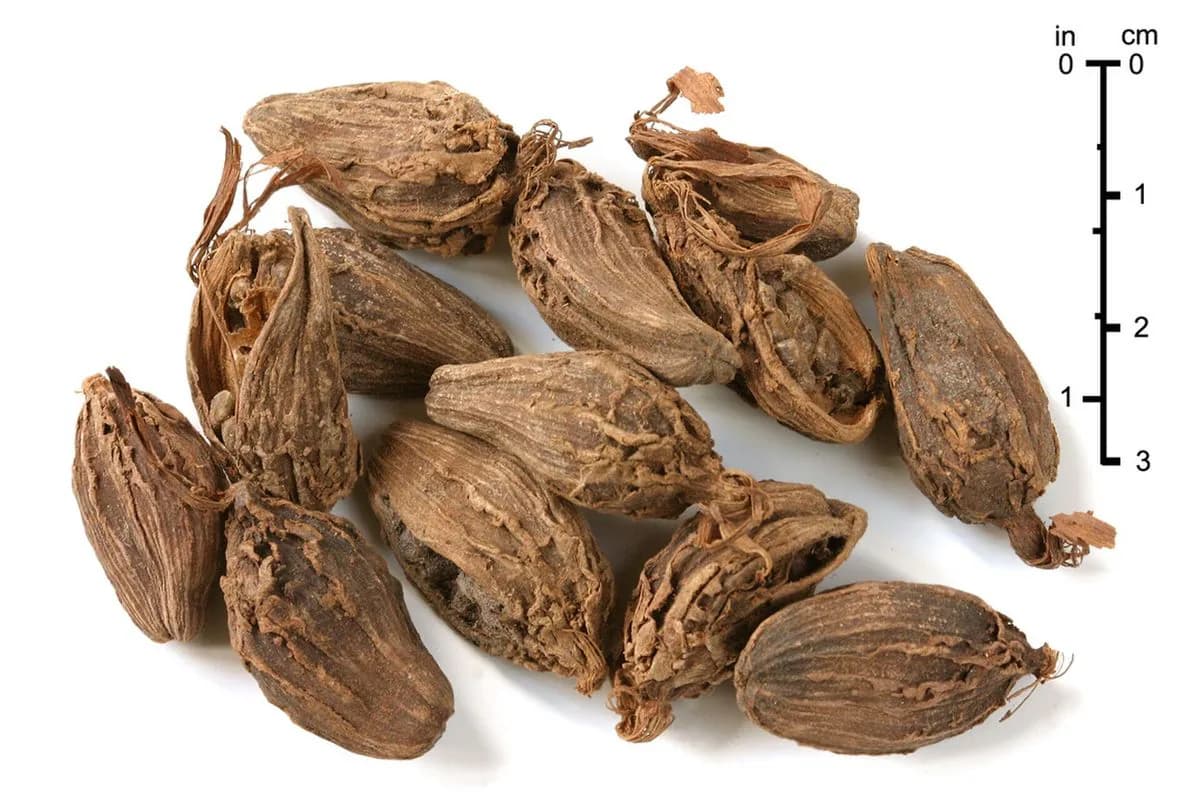
| Bold | 22–28 mm | Rs 2,600–2,900 | USD 17–19/kg |
| Medium | 18–22 mm | Rs 2,300–2,600 | USD 15–17/kg |
| Fine | <18 mm | Rs 1,900–2,300 | USD 13–15/kg |
NPR figures are per kg at the collection point. USD figures are per kg.
Twelve-month trend
Against the Indian auction benchmarks
Most Nepali crop is sold onward through Indian auction centres, so those rates are the closest thing this trade has to a public reference price. They are published by the Spices Board of India.
| Auction centre | Rate (INR/kg) |
|---|---|
| Siliguri, West Bengal | Not yet published here |
| Singtam, Sikkim | Not yet published here |
| Gangtok, Sikkim | Not yet published here |
Landed-cost calculator
FOB is not what the cargo costs you. Set your grade, volume, port and Incoterm, then replace the freight, duty and clearance defaults with your own forwarder’s rates — those fields are your assumptions, not our quotes.
What moves the price
- Harvest size and the monsoon
An annual crop from a narrow geography. A poor monsoon in the eastern hills shows up in the price within one season.
- Indian demand
Around 99% of Nepal's exports go to India first. When Indian stock runs low, Nepali farm-gate prices move within weeks.
- Grade
Bold pods (22–28 mm) carry a size premium. Once a pod is milled that premium disappears, so buying Bold to grind is money burnt.
- Currency
The Nepali rupee is pegged to the Indian rupee, so NPR pricing tracks INR movement rather than moving independently.
- Cure
Which line a lot is dried on changes its specification, not its grade. See Flue-Dried and Bhatti-Cured.
Common questions
How much does black cardamom cost per kg?
Indicatively USD 13–19/kg FOB Kathmandu, depending on grade, with Bold pods at the top of the band and Fine at the bottom. Landed cost is higher: add freight, insurance, duty and clearance for your port. Use the calculator on this page to model your own figure, then ask for a proforma invoice against your actual volume and Incoterm.
Why does the black cardamom price change so much?
Large cardamom is an annual crop from a narrow geography, so price moves with harvest size and monsoon performance, with demand from India and Pakistan, and with the Nepali rupee, which is pegged to the Indian rupee. Because almost all Nepali crop still moves through Indian markets, Nepali farm-gate prices track Indian demand closely — when Indian stock runs low, prices can rise sharply within weeks.
Is buying direct from Nepal cheaper than buying from India?
Usually, and the reason is the route rather than the quality. A lot that travels from a Nepali farm through a border hub to be re-graded, re-packed and re-exported picks up a margin at each step, none of which improves the cardamom. Buying at origin removes those layers. The comparison to make is landed cost against landed cost, not FOB against FOB.
What is the minimum order quantity?
One sealed 25kg jute sack for a trial order, 500kg for wholesale pricing. Samples of 200–500g are available to qualified buyers so you can check pod size, aroma and moisture before committing to volume.
Related: how the price breaks down farmgate to CIF · why the re-export route costs you more · grades and pack sizes