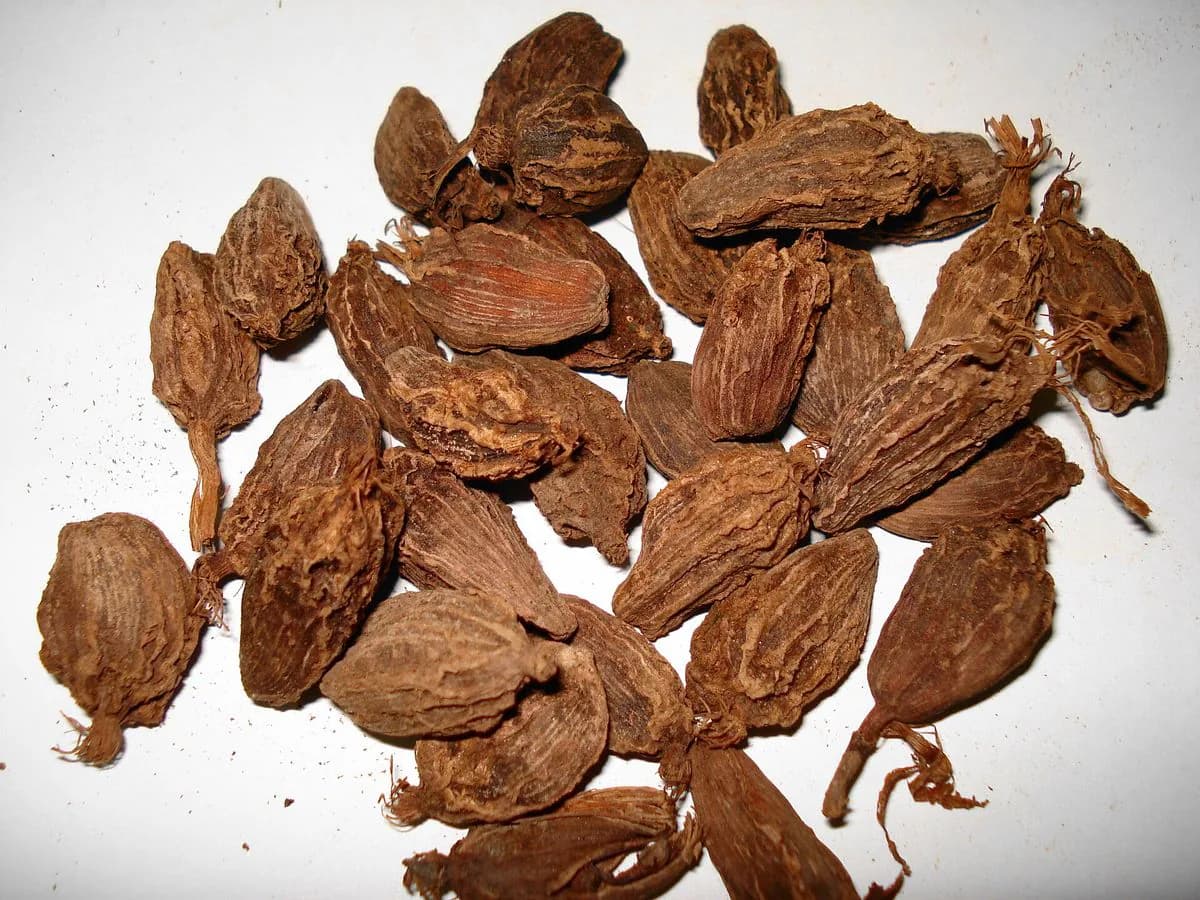
Yes, you can make black cardamom tea, and households across the Nepali hills have been doing it for as long as they have been drying the pods. It tastes smoky, resinous and faintly medicinal rather than sweet and floral. And it is not a substitute for green cardamom in masala chai, whatever a recipe site tells you.
This is a real drink with a real following, but it divides people on the first cup. Brew it too strong and it tastes like a cough sweet dissolved in hot water. Brew it properly and you get something closer to a smoked tea: dark, savoury, good in cold weather.
What follows: what the cup actually tastes like, why the husk and the seeds pull in opposite directions, a method with real pod counts and steep times, how to work badi elaichi into masala chai without ruining it, and the mistakes that put people off it permanently.
What black cardamom tea actually tastes like
Smoke arrives first, then camphor and menthol, then a resinous finish that sits at the back of the throat. It reads as savoury rather than sweet, which is the single biggest surprise for anyone expecting a cardamom flavour they already know.
The closest reference point most tea drinkers already have is lapsang souchong, the pine-smoked Chinese black tea. If you like lapsang, you will probably like this. If lapsang tastes like an ashtray to you, black cardamom tea will land in the same place, and no amount of technique will fix that.
The smoke is not an affectation. Black cardamom (Amomum subulatum) is dried over heat straight after harvest, and traditional wood-fired bhatti drying puts smoke into the husk permanently. Its dominant aromatics are eucalyptol, also called 1,8-cineole, and terpineol, the same family of compound behind the cooling edge of eucalyptus and rosemary. That is why a strong cup can feel more like a remedy than a treat.
Green cardamom (Elettaria cardamomum) does the opposite. It is sweet, floral and citrus bright, a top note that lifts a cup. Black cardamom is a base note that weighs a cup down. Neither one does the other's job.
What black cardamom gives tea is depth. It puts a smoky floor under plain black tea, stands up to milk and sugar, and holds its own next to ginger and pepper. What it cannot do is delicacy: it will flatten a good Darjeeling and overwhelm a light masala chai within minutes.
Brew your first cup deliberately weak. One pod, a short steep, no milk, so you find out what you are dealing with before you commit a whole pot.
The husk and seed problem
The husk carries the smoke. The seeds carry the menthol, and the longer you steep, the more menthol you pull into the cup.
It is the reason two people can follow the same recipe and end up with completely different drinks. A cracked pod left in a pot for ten minutes is a menthol extraction. The same pod pulled at four minutes is a smoked tea.
Once you know that, you can steer the cup on purpose:
- Smoke-forward: crack the pod so it opens but keep it whole, seeds and all, and keep the steep short. The husk gives up its smoke quickly and the seeds need longer, so you are exploiting the gap between them.
- Milder and rounder: crack the pod, tip out roughly half the seeds, and brew the husk with what is left. This is the version most people who say they dislike black cardamom tea turn out to like.
- Deliberately mentholated: bruise the seeds before brewing and steep longer. A small audience wants this. Most do not.
A sensible starting point for one 250ml cup: one pod, cracked open with the flat of a knife, about half the seeds removed, steeped four minutes. Adjust from there. If the cup tastes of eucalyptus, remove more seeds or cut a minute off the steep before you change anything else.
How to make black cardamom tea: the basic method
Use one cracked pod per 250ml cup, water just off the boil, and steep for three to five minutes while tasting as you go. That is the whole method, and everything below is refinement.
Plain water version
For one 250ml cup, about seven minutes start to finish:
- 1 whole black cardamom pod (Amomum subulatum), cracked
- 250ml water, just off the boil
- Honey, to taste (optional)
- Crack one pod per cup with the flat of a knife or the base of a mug. You want it split, not crushed to powder.
- Remove about half the seeds for a first attempt. Keep them in if you want it fiercer.
- Heat water to just off the boil, roughly 95C. Rolling-boil water pulls the harsh end of the resin.
- Pour over the pod and steep. Taste at three minutes, then at four, then at five. Stop when you like it.
- Strain. Drink as is, or with a small spoon of honey if the finish is too dry.
Milk version
Use 150ml water and 100ml milk per cup. Bring the water, one cracked pod and a teaspoon of loose black tea to a bare simmer for three minutes, add the milk, and simmer another two to three minutes. Keep it lazy rather than at a hard boil, which drives off the aromatics and leaves the bitterness behind.
Taste at intervals rather than steeping blind. Black cardamom does not creep up on you gently, and the difference between four minutes and seven minutes is the difference between a drink you finish and one you tip away.
Steep time also depends on curing. Bhatti-cured pods, dried over a wood fire, carry more smoke and want the shorter end of every range below. Closed-flue electric-cured pods are cleaner and more camphor-forward, so you can push a minute longer without the cup turning ashy.
| Cup | Pods | Liquid | Method | Time |
|---|---|---|---|---|
| First cup, testing | 1 pod, half the seeds removed | 250ml water | Steep off the boil | 3 min |
| Standard plain-water cup | 1 cracked pod | 250ml water | Steep off the boil | 4 to 5 min |
| Bhatti-cured pods, plain | 1 cracked pod | 250ml water | Steep off the boil | 3 to 4 min |
| Pot for four | 3 cracked pods | 1 litre water | Steep off the boil | 5 min |
| Milk brew, one cup | 1 cracked pod + 1 tsp black tea | 150ml water + 100ml milk | Bare simmer | 5 to 6 min |
| Masala chai, four cups | 1 black pod + 4 green pods | 1 litre, half milk | Bare simmer | 6 to 8 min |
Using black cardamom in masala chai
Add black cardamom alongside green cardamom, never in place of it. It works as a supporting base note under the traditional spices, and it takes over the pot faster than any other spice in the blend.
For one litre of chai, roughly four cups, start here:
- 4 green cardamom pods, cracked
- 1 black cardamom pod, cracked
- 15g fresh ginger, sliced
- 1 short cassia or cinnamon stick
- 3 cloves
- 4 black peppercorns
Simmer the spices in 500ml water for five minutes, add 500ml milk and your black tea, simmer another three, then strain. The black cardamom should be the thing you notice on the third sip, not the first.
One pod per litre is a supporting role. Two pods per litre is where black cardamom starts to dominate and the chai stops tasting like chai. Three and you are drinking smoke with a hint of cinnamon. If you are unsure, crack a pod and use half the husk for a litre, then work upwards over the following week.
The failure people describe as black cardamom ruining their chai is nearly always a straight one-for-one swap: the recipe said cardamom, the cupboard had badi elaichi, and four black pods went into the pan. The two spices are not interchangeable in either direction, and the full comparison is set out in our guide to the difference between black and green cardamom.
Other ways people drink it
In Nepali and Himalayan households, black cardamom rarely gets its own recipe. A pod goes into whatever is already being made, which is a more honest way to use it than any formal method.
- One pod in ordinary black tea. A cracked pod dropped into the pot with the leaves. The most usual household use by a distance.
- Pod in hot water, nothing else. Sometimes with a pinch of salt in the hills. Clean, smoky, caffeine free, and the version most likely to convert someone.
- With ginger and honey. Fresh ginger and a cracked pod simmered together, honey stirred in after straining. The ginger heat and the camphor cooling work well against each other.
- In the flask. Long-brewed hill teas often carry a pod, which survives hours in a thermos better than green cardamom does.
Black cardamom has a long history in traditional South Asian and Himalayan use, and pods in hot water are still brewed in many homes out of habit as much as taste. That is cultural context rather than a health claim, and nothing here is medical advice. We cover the traditional-use background in our article on black cardamom's traditional uses and properties.
Which pods to use for tea
Buy whole pods, never ground. Ground black cardamom loses its volatile aromatics fast, and since those aromatics are the entire point of the drink, a jar open a few months brews something closer to woody dust than tea.
Curing method matters more than anything else on the label. Bhatti-cured pods, dried over a traditional wood fire, give a smokier, heavier cup. Closed-flue electric-cured pods give a cleaner, camphor-forward cup with far less smoke. Neither is better, they are different drinks, and the distinction is worth understanding before you buy: see our comparison of bhatti-dried and machine-dried black cardamom.
Grade barely matters for tea, and it is worth saying plainly. Bold (22 to 28mm), Medium (18 to 22mm) and Fine (under 18mm) are visual and commercial grades based on pod size, not flavour grades. A Fine pod from a good lot brews the same cup as a Bold pod from that lot, and costs less.
Storing them
Airtight, dark, whole, away from the cooker. Never grind ahead. Pods stay good for a year or more, and the smell fades long before the flavour goes entirely, which is your cue to use them up.
Common mistakes
- Over-steeping. The most common one by far. Past six or seven minutes the menthol takes over and the cup turns medicinal.
- Using ground cardamom. It goes flat quickly and brews cloudy and dull. Crack whole pods instead.
- Treating it as a green cardamom swap. Different species, opposite roles. Use both, not one instead of the other.
- Too many pods. One per cup, or one per litre in a spiced chai. Doubling up does not make it twice as good.
- Boiling hard instead of simmering. A rolling boil drives off the aromatics and pulls bitterness out of the husk. Keep it lazy.
Frequently asked questions
Can you make tea with black cardamom?
Yes. Crack one pod per 250ml cup, pour over water just off the boil and steep three to five minutes. It brews a smoky, resinous drink rather than a sweet floral one, and it is a normal household practice across Nepal and the Himalayan belt, usually with a pod dropped into ordinary black tea.
How many black cardamom pods per cup of tea?
One cracked pod per 250ml cup, or three pods per litre for a pot. In a spiced masala chai, use one pod per litre alongside four green cardamom pods. Black cardamom is powerful, and more pods make the cup harsher rather than deeper.
Does black cardamom tea taste smoky?
Yes, distinctly. The smoke comes from drying the pods over heat after harvest, and traditional wood-fired bhatti drying makes it much stronger. The nearest familiar comparison is lapsang souchong, the smoked Chinese black tea. Underneath the smoke you get camphor, menthol and a dry resinous finish.
Can I use black cardamom instead of green cardamom in chai?
No. They are different species with opposite roles: green cardamom is sweet, floral and citrus bright, black cardamom is smoky and savoury. Swapping one for the other will not give you masala chai. Use one black pod per litre alongside your usual green cardamom instead.
Should you crack the black cardamom pod before brewing?
Crack it, but do not crush it. Press it with the flat of a knife until the husk splits so water can reach the inside. Whole uncracked pods brew weak and slow. Powdered pods release too much menthol too fast and cloud the cup.
How long should you steep black cardamom tea?
Three to five minutes for a plain-water cup, five to six for a milk brew at a bare simmer. Taste at three minutes, then each minute after. Past six or seven minutes the seeds push menthol into the cup, which is where most people stop enjoying it.
Can you reuse black cardamom pods?
Yes, once. A second steep gives a lighter cup with less smoke and a cleaner camphor note, as the husk has already given up most of its smoke. Add a minute to the steep. A third use brews something too thin to bother with.
Is black cardamom tea caffeinated?
The pods contain no caffeine. If you brew them in plain water with ginger or honey, the drink is caffeine free. Any caffeine in your cup comes from the tea leaves you brew alongside them, so a black cardamom masala chai carries the same caffeine as the tea in it.
Where our pods come from
We grow Amomum subulatum in Sankhuwasabha in eastern Nepal, between 1,100 and 1,500 metres, shade-grown under native alder and hand-harvested through September and October. Pods go into curing within six hours of picking, either over a traditional wood-fired bhatti for the smokier cup or on a closed-flue electric line for the cleaner, camphor-forward one.