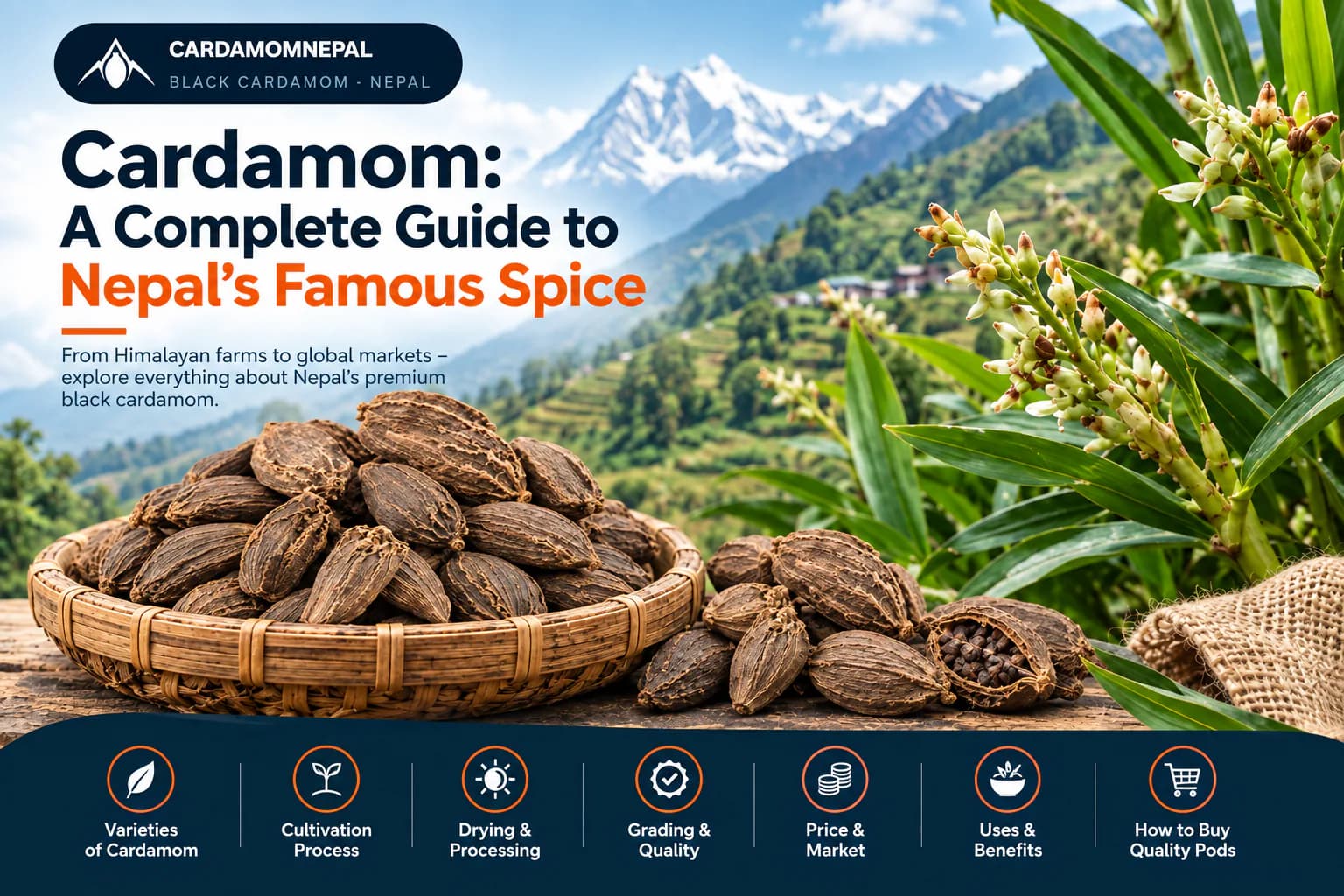
Cardamom announces itself before you see it. Walk through the trading yards of Birtamod in eastern Nepal during October and the air is thick with smoke, resin and something close to citrus.
This one crop earns Nepal more foreign currency than nearly any other agricultural product. Yet most people who cook with it could not tell you where it was grown.
This guide covers what cardamom actually is, how the Nepali variety differs from the pods in your masala chai, and how it moves from a shaded hillside to your kitchen. For the spice itself, its flavour, how to cook with it and the Chinese pod it gets confused with, see our complete guide to black cardamom.
What Is Cardamom?
Cardamom is the dried seed pod of several plants in the ginger family (Zingiberaceae), valued as a spice for its warm, aromatic flavour. Pods are harvested green, dried, then used whole or ground.
Two species matter commercially. Elettaria cardamomum produces small green pods, while Amomum subulatum produces the larger dark-brown pods grown across Nepal’s eastern hills.
Both are called cardamom in English, which causes most of the confusion. In Nepali, the large type is alainchi and the green type is sukumel: two different names for two genuinely different spices. The other pods sold as cardamom are covered in our guide to what cardamom is.
Cardamom Varieties: Green, Black and Large Explained
Here is the short answer people usually come looking for: black cardamom and large cardamom are the same thing. Green cardamom is a separate plant with a completely different flavour.
| Feature | Green Cardamom | Large / Black Cardamom |
|---|---|---|
| Botanical name | Elettaria cardamomum | Amomum subulatum |
| Pod size | 10–15mm | 18–28mm |
| Colour | Pale green | Dark brown to near black |
| Flavour | Sweet, floral, citrus | Smoky, resinous, camphor-like |
| Main producers | Guatemala, India (Kerala) | Nepal, India (Sikkim), Bhutan |
| Typical use | Desserts, chai, baking | Curries, biryani, dal, meat |
| Nepali name | Sukumel | Alainchi |
Within large cardamom, Nepali farmers grow several distinct cultivars. Ramsey performs best at higher altitudes, Golsey suits warmer lower slopes, and Sawney, Bharlangey and Chibesay sit somewhere between.
Each differs in pod size, yield and disease tolerance. Experienced growers often plant two or three cultivars together to spread risk across an unpredictable season.
Cardamom in Nepal: Why the Country Leads the World
Nepal is the world’s largest producer of large cardamom, accounting for roughly half of global output. India and Bhutan together make up most of the rest.
Production concentrates in seven eastern hill districts: Taplejung, Sankhuwasabha, Ilam, Panchthar, Terhathum, Bhojpur and Dhankuta. Taplejung alone contributes a substantial share of the national crop.
The reason is geography rather than policy. These slopes sit between roughly 900 and 1,800 metres, with heavy monsoon rainfall, high humidity and deep natural shade, a combination few regions on earth can offer.
Cardamom appears consistently among Nepal’s priority export products in national trade strategy. Current export categories and volumes can be checked through the Nepal Trade Information Portal.
Most of the harvest moves through Birtamod in Jhapa, the country’s largest cardamom market, before crossing into India. From there much of it is re-exported onward to Pakistan, the Gulf and the wider Middle East.
Cardamom Cultivation: How the Plant Actually Grows
Cardamom farming in Nepal is agroforestry, not open-field agriculture. The plant grows beneath a canopy, usually of Alnus nepalensis: the alder known locally as utis.
That shade tree does three jobs simultaneously. It filters harsh sunlight, fixes nitrogen into the soil, and drops leaf litter that builds the organic matter cardamom roots depend on.
Propagation is normally by rhizome suckers taken from healthy mother clumps, though seedlings are used when establishing disease-free plots. Suckers are faster; seedlings are cleaner.
A new plantation needs about three years before its first real harvest. After that, a well-managed clump keeps yielding for 15 to 20 years before replacement becomes necessary.
What cardamom farming requires:
- Altitude between 900 and 1,800 metres
- Annual rainfall above 1,500 mm, well distributed through the year
- 50–60% shade cover maintained year-round
- Deep, loamy, well-drained soil rich in organic matter
- Shelter from strong winds and extended dry spells
Most Nepali cardamom grows with minimal synthetic input. Farmyard manure and forest leaf litter do the work, which puts the crop naturally close to organic certification standards.
Cardamom Harvesting and Processing
Cardamom harvesting runs from late August into November, peaking through September and October. Pickers cut the spikes at the base of each clump once the topmost capsules begin to turn.
Timing matters more than most people expect. Cut too early and pods shrivel badly during drying; leave it too late and they split, which drops the grade immediately.
Fresh pods carry around 80% moisture. That has to come down to 12% or below in a bhatti, or 9% or below on an electric dryer, within about two days, or the entire lot ferments and is lost.
Traditional Bhatti vs Improved Dryers
The traditional method is the bhatti, a raised platform built over a direct wood fire. Smoke passes straight through the pods for a day and a half or longer.
This is precisely what gives Nepali cardamom its smoky signature. It is also unpredictable: pods scorch, tar settles on the surface, and the fire demands attention through the night.
Improved bhattis and gasifier dryers separate flame from pods using a heat exchanger. Drying then happens at a controlled 45–55°C across roughly 30 hours.
| Feature | Traditional Bhatti | Improved Dryer |
|---|---|---|
| Heat source | Direct wood fire | Indirect, via heat exchanger |
| Smoke contact | Full | Controlled or none |
| Flavour | Heavily smoky | Cleaner, more aromatic |
| Colour | Dark, often tar-marked | Even maroon |
| Fuel consumption | High | 40–50% lower |
| Export suitability | Limited | Preferred by premium buyers |
There is a genuine tension here that rarely gets discussed. Many South Asian buyers actively want heavy smoke, while European and Gulf importers increasingly reject it on polycyclic aromatic hydrocarbon limits.
Once dried, pods are tail-trimmed, winnowed to remove husk and dust, then polished before grading.
Cardamom Quality and Grading Standards
Cardamom quality comes down to four measurable things: pod size, colour uniformity, moisture content and absence of smoke residue.
Trade grading works largely by size. Bold or large pods command the highest prices, medium occupies the middle, and shrivelled or light pods fetch considerably less.
What experienced buyers check first:
- Size: plump, filled pods rather than flat, hollow ones
- Colour: dark brown to near black and even across the lot, free of tar patches
- Moisture: 12% or below for bhatti-cured pods, 9% or below for electric-dried; anything higher invites mould in storage
- Aroma: sharp and resinous when a pod is crushed between fingers
- Foreign matter: minimal stalk, husk and dust in the lot
That aroma comes mainly from 1,8-cineole, the dominant compound in large cardamom essential oil. A weak smell almost always signals old stock or over-drying.
Nepal continues to pursue Geographical Indication protection for its large cardamom. Formal GI status would tie the name to the eastern hill districts and strengthen the country’s hand against re-labelled re-exports.
Buying for a business or a serious kitchen? We grade every lot by size, moisture and drying method before it ships. See our current harvest and grades.
Cardamom Price in Nepal
The farm-gate price of large cardamom in Nepal is currently around NPR 2,500 per kilogram. That is the rate paid to farmers at the point of sale, before grading, transport or export margin.
| Currency | Price per kg | Price per 100g |
|---|---|---|
| Nepali Rupee (NPR) | ₨ 2,500 | ₨ 250 |
| Indian Rupee (INR) | ₹ 1,563 | ₹ 156 |
| US Dollar (USD) | $16.45 | $1.65 |
Graded export lots sell well above farm-gate. Bold and jumbo grades have traded considerably higher, since size and colour uniformity carry a steep premium with Indian buyers.
Three factors drive most of the movement: Indian import demand, the size of Nepal’s own harvest, and disease pressure in the producing districts. A poor year in Sikkim lifts Nepali prices sharply.
Prices are volatile enough that any published figure ages fast.
Uses and Benefits of Cardamom Pods
- Large cardamom pods are used whole. Drop one or two into hot oil at the start of a curry, biryani or dal, and let them bloom before anything else goes in.
- They are not interchangeable with green cardamom in sweets. Those smoke and camphor notes overwhelm delicate desserts, which is firmly green cardamom territory.
- In Nepali households, alainchi also turns up in pickles, in meat marinades, and in strong winter tea. A single pod flavours an entire pot.
- Traditional Ayurvedic and Tibetan medicine have used cardamom for digestion and respiratory complaints for centuries. Chewing a seed after a heavy meal remains common practice across South Asia.
- Modern research is more limited but broadly supportive. Studies have examined cardamom’s antioxidant compounds and its traditional use for oral freshening and digestive comfort, though most trials are small.
- For an evidence-based overview of what the research does and does not show, see Healthline’s review of cardamom benefits.
- The sensible framing: treat cardamom as a spice with pleasant side effects, not as a medicine. It is not a substitute for medical advice or treatment.
Buying Nepali Cardamom: What to Look For
Squeeze a pod between your fingers. It should feel firm and slightly springy rather than brittle or papery, and the seeds inside should be dark and faintly sticky.
Avoid anything with a dull grey cast, visible mould, or a flat smell. Whole pods hold their aroma far longer than pre-ground cardamom powder, which fades within a few months.
Store pods in an airtight container away from light and heat. Kept properly, whole large cardamom retains good flavour well beyond a year.
If you want low-smoke pods for baking or subtler dishes, ask specifically for improved-dryer or electric-dried stock. Most honest sellers can tell you exactly which bhatti a lot came from.
Challenges in Cardamom Farming Today
The most serious threat is viral disease. Chirke (streak virus) and Furkey (bushy dwarf virus) spread through aphids and infected planting material, and neither can be cured once established.
Entire plantations across Ilam and Panchthar have been abandoned to these viruses. Work on resistant and clean planting material continues through the Nepal Agricultural Research Council.
Price volatility is the second problem. When farm-gate rates can halve between seasons, smallholders cannot plan the three-year investment a new plantation demands.
Market dependence is the third. With the overwhelming majority of exports routed through a single border, any shift in Indian demand reaches Nepali farmers within weeks.
Final Thoughts
Cardamom is one of the few products where Nepal genuinely leads the world. Behind every pod sits a three-year wait, a shaded hillside, and a farmer watching a fire at two in the morning.
Next time you fish one out of a curry, there is a fair chance it came from a slope above Taplejung.
Want verified single-origin Nepali cardamom? Browse our current harvest or talk to our sourcing team.
Frequently Asked Questions
Which country produces the most cardamom?
It depends on the type. Guatemala leads global green cardamom production, while Nepal is the world's largest producer of large cardamom, ahead of India and Bhutan.
Why is cardamom so expensive?
Cardamom is hand-harvested, takes three years to first yield, and must be dried within roughly 48 hours of picking. That labour intensity, plus a narrow growing zone, keeps prices high.
Can I substitute black cardamom for green cardamom?
Not reliably. Black cardamom is smoky and savoury; green is sweet and floral. Substituting in desserts will ruin the dish, though a small amount can work in heavy meat curries.
Is cardamom the same as elaichi?
Yes. Elaichi is the Hindi and Urdu term. Badi elaichi means large or black cardamom, while chhoti elaichi means green cardamom.
How do you store cardamom pods?
Keep whole pods in an airtight glass jar away from sunlight and heat. Whole pods last over a year; ground cardamom loses most of its aroma within three to six months.
Do you eat the whole cardamom pod?
For large cardamom, no. Remove the pod before serving, since the husk is tough and intensely smoky. Only the inner seeds are eaten, and usually only once ground.